
A radiation safety in-service compares a diagnostic x-ray beam with an alpha-particle exposure of equal absorbed dose in tissue, noting oxygenated tumor response, cell survival curves, and the dose lethal to half a population within 60 days. Which statement correctly integrates LET, RBE, oxygen effect, and LD50/60 for this comparison?
Select an answer to reveal the explanation.
Short Explanation
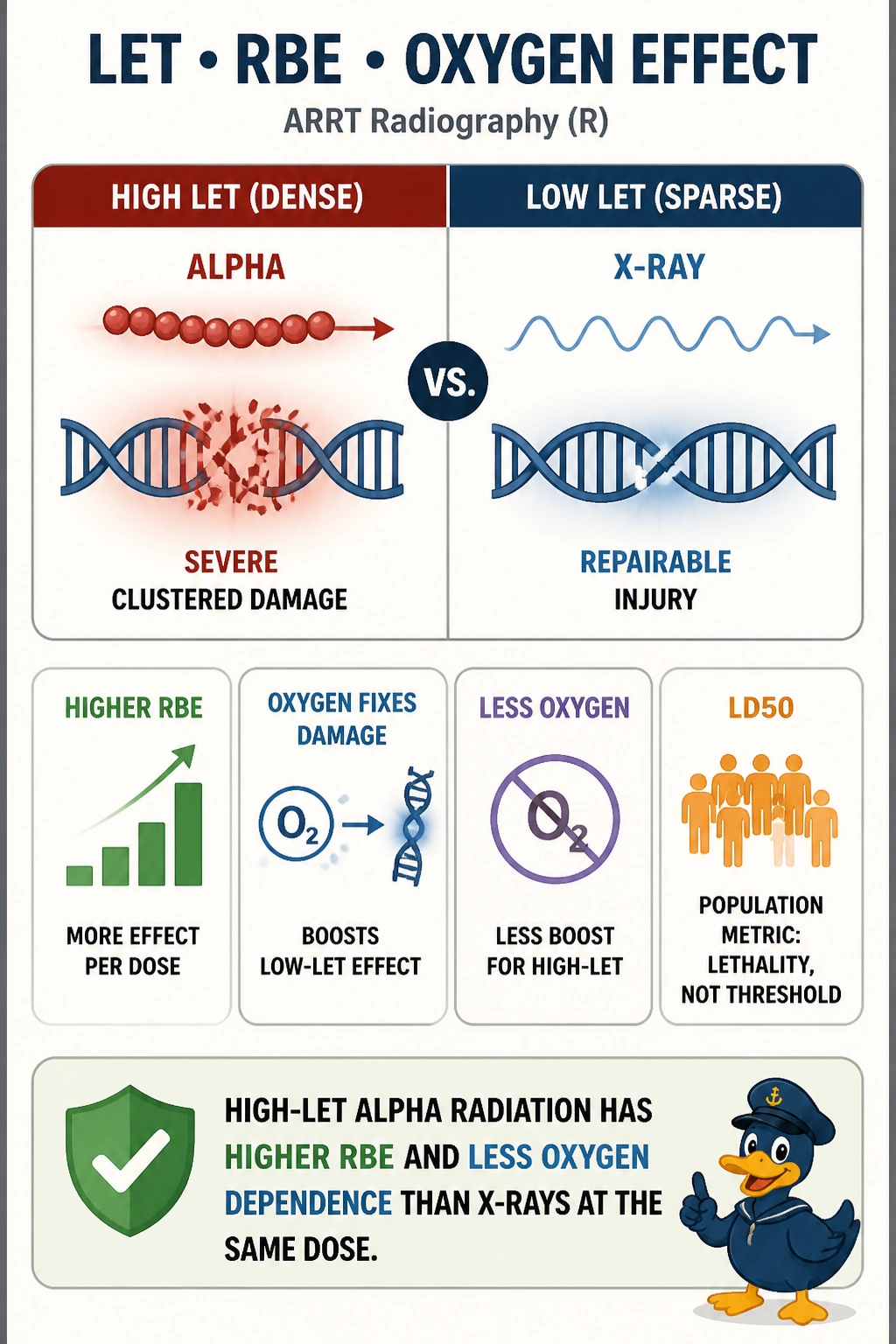
You are sorting dense versus sparse hits beautifully. LET is your clustering clue — dense alpha tracks cause severe damage that oxygen cannot much modify.
Full Explanation
The correct statement holds because at equal absorbed dose in tissue alpha particles deposit energy in dense tracks with high linear energy transfer that causes clustered direct DNA damage that is poorly repairable, so relative biological effectiveness referenced to low-LET x-rays exceeds unity, cell survival becomes steep and nearly exponential with little shoulder, and the oxygen enhancement ratio falls near unity so hypoxic and oxygenated cells respond similarly whereas x-rays depend more on indirect free-radical damage requiring oxygen for fixation with an OER of about 2.5 to 3. The distractor invoking greater oxygen need keeps the correct higher RBE but reverses oxygen radiobiology because high LET specifically reduces, not increases, oxygen dependence for tumor kill. The distractor invoking a broad shoulder keeps higher RBE but reverses survival-curve biology because dense ionization reduces sublethal repair and shoulder width, while low-LET sparing depends on that shoulder. The distractor invoking LD50/60 for tumor cure confuses levels of effect because LD50/60 quantifies whole-body lethality to 50% of an exposed population within 60 days from hematopoietic or gastrointestinal syndrome, not clonogenic tumor control or in vitro survival. An exam caveat is to separate absorbed dose in gray from RBE-weighted and oxygen-modified outcome and not equate diagnostic low-dose risk with therapeutic response. A practical check is to confirm tissue dose, LET, tumor oxygenation, survival-curve shape, and whether any lethality statistic refers to population mortality versus local control before comparing modalities.