
A technologist performs a mobile chest at 72-inch SID with a set technique, then repeats the projection in a small isolation room at 36-inch SID for the same adult patient thickness. The supervisor asks about changes in beam intensity and terminology. Which statement about beam quantity, beam type, and inverse square law best guides the repeat exposure?
Select an answer to reveal the explanation.
Short Explanation
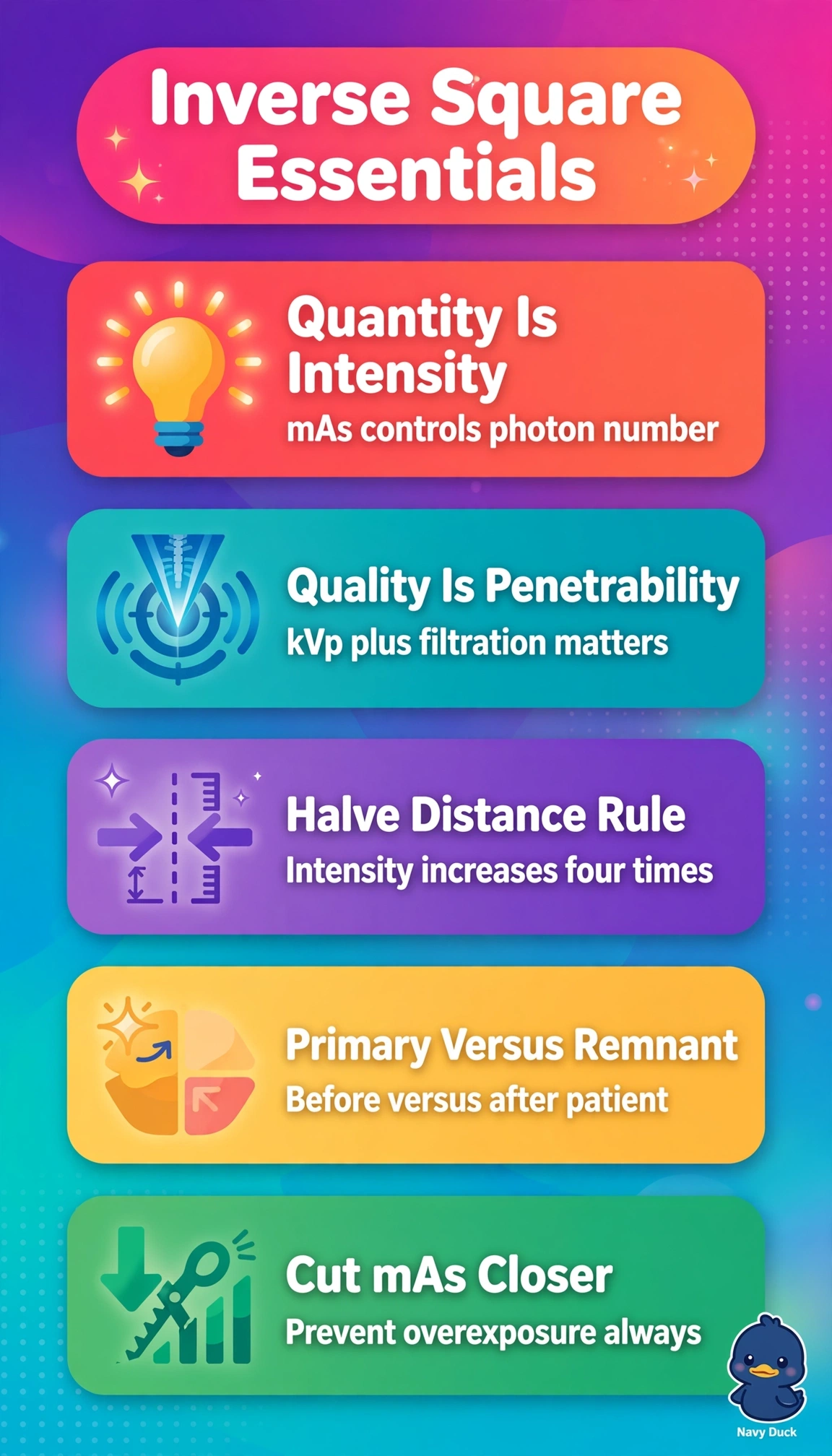
Distance packs a punch because intensity follows an inverse-square curve. Remember quantity rises fast when you move closer, so you cut mAs to protect the patient and image.
Full Explanation
Halving distance from 72 to 36 inches increases primary-beam intensity fourfold because intensity varies inversely with the square of SID under the inverse square law, so for identical adult thickness the repeat requires approximately one-quarter the original mAs to maintain detector exposure and avoid overexposure, with terminology correctly assigning quantity to mAs-controlled photon number in the primary beam before patient interaction rather than quality or post-interaction remnant radiation. The statement invoking reduced kVp for quantity control fails on control concept because kVp governs penetrability, beam quality and contrast while mAs governs quantity through tube current and time, so lowering kVp would alter penetration without correctly compensating photon number. The statement invoking remnant radiation fails on beam timing because technique is set on the primary beam leaving the tube before interaction, whereas remnant radiation is what exits the patient to reach the detector and cannot be preset directly. The statement invoking doubled intensity with halved mAs fails on mathematics because the relationship is squared rather than linear, so one-half distance yields fourfold intensity requiring quarter mAs, not half. An exam caveat is to distinguish the inverse square law for intensity versus distance from the direct square law used to calculate new mAs to maintain exposure and from reciprocity, and to confirm whether the stem asks about pre-interaction quantity or detector dose. A practical check is to apply the square-ratio calculation, set approximately one-quarter mAs for the short SID, verify with the technique chart and exposure indicator, and reassess if thickness, grid, or generator limits differ.