
In a busy emergency department hallway, an anxious adult with a sprained ankle asks you why the doctor ordered radiographs instead of MRI, saying a friend told them MRI shows everything better. You have two minutes before the examination, must stay within your scope, and need to preserve trust. Which response best addresses their question about other imaging modalities?
Select an answer to reveal the explanation.
Short Explanation
Your calm comparison keeps trust without overstepping. Scope matters here like staying in your lane while still giving directions.
Full Explanation
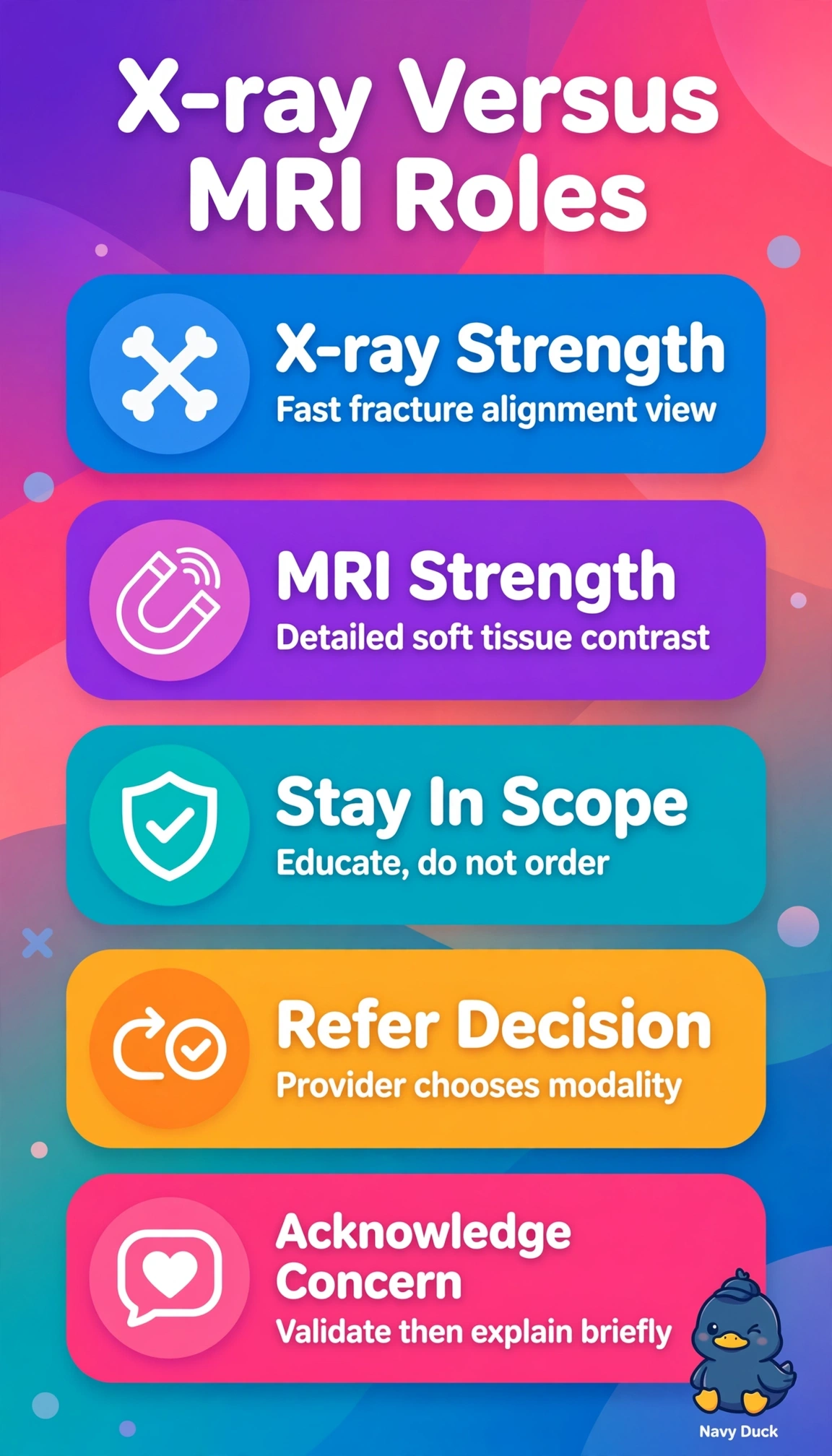
Responding to questions about other modalities requires accurate, scope-appropriate education that compares strengths, limitations, and typical indications without diagnosing, recommending a specific modality, or ordering examinations, while acknowledging concerns and referring final decisions to the ordering provider; for acute ankle trauma, radiography is fast, accessible, and excellent for fracture, dislocation, and alignment, whereas MRI provides superior soft tissue and occult fracture detail but is longer, costlier, and reserved for specific indications. Stating MRI uses stronger radiation is factually incorrect because MRI uses magnetic fields and radiofrequency without ionizing radiation, and misinformation undermines trust and examination performance. Offering to order an MRI exceeds radiographer scope of practice and disrupts provider responsibility for clinical decision-making and utilization. Claiming ultrasound and CT are never useful overstates the case because each has selective roles, such as tendon assessment or complex fracture characterization, and absolute statements mislead patients about appropriate care pathways.