
A 74-year-old inpatient has acute left lower quadrant pain, fever, and CT concern for diverticular microperforation with contained leak. The surgeon requests a fluoroscopic enema to assess for free communication, and gastroenterology plans ERCP next week for choledocholithiasis. The patient is afebrile enough for a cautious study with surgical backup. Which enema contrast strategy best evaluates suspected perforation while preserving ERCP planning?
Select an answer to reveal the explanation.
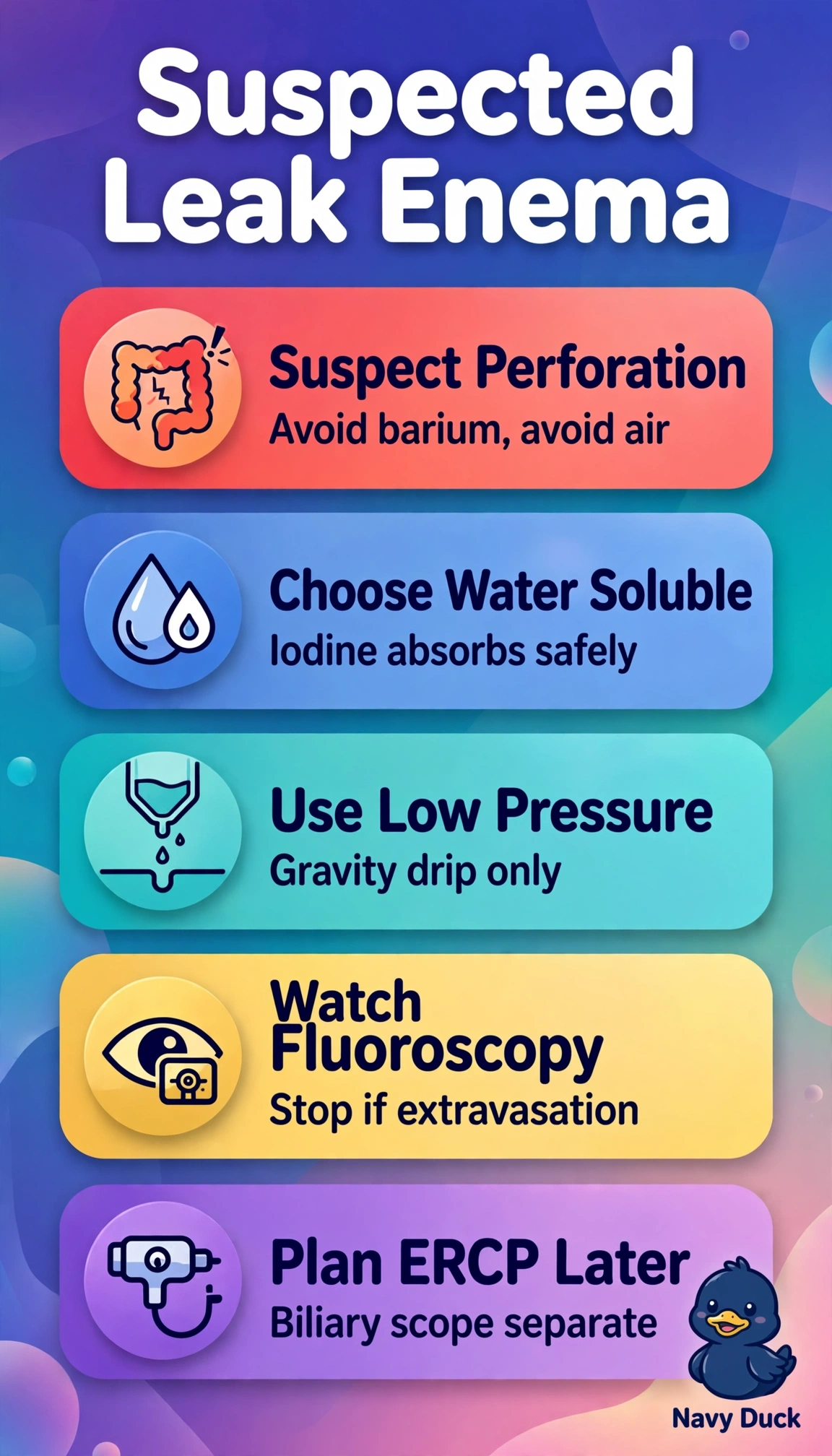
Short Explanation
You chose safety over detail here. Water-soluble iodine with gentle flow shows a leak without leaving irritating barium, keeping the future ERCP plan clean.
Full Explanation
In suspected diverticular microperforation with contained leak, low-pressure single-contrast water-soluble iodine enema best assesses free communication while preserving ERCP planning because water-soluble agent is absorbed if extravasated and causes far less chemical peritonitis and fibrosis than barium, single-contrast pooling directly demonstrates extraluminal leak without mucosal coating, low pressure avoids converting a contained seal into free perforation, and rapid clearance without prolonged coating preserves duodenal and biliary visualization for next-week ERCP for choledocholithiasis. The double-contrast iodine enema with air fails by pressure concept because air insufflation for mucosal detail distends inflamed colon and can disrupt containment to cause free perforation, never appropriate when leak detection is the priority. The low-pressure single-contrast thin barium enema fails by contrast concept because even thin barium in peritoneum risks severe barium peritonitis with persistent retention that degrades subsequent fluoroscopy and ERCP planning. The water-soluble enema filling to cecum fails by extent concept because leak evaluation requires limited titrated fill stopping at first extravasation or after the suspect segment, while complete cecal fill adds volume, pressure and time in vulnerable colon. Exam caveat is suspected perforation, ischemic obstruction or anastomotic leak mandates water-soluble first, barium only after perforation is excluded and ERCP-sensitive procedures are complete. Practical check is confirm surgical backup and consent, monitor vitals, use pulsed fluoroscopy with gentle hand injection, stop at first extraluminal contrast, document location and containment, and notify surgery and gastroenterology to preserve ERCP timing.