
An outpatient adult needs a retrograde cystogram after pelvic trauma to check for bladder rupture, and the urologist has placed a Foley catheter with balloon inflated. The radiologist requests AP and bilateral oblique images with contrast instilled by gravity drip to a specified volume. Which imaging control best confirms bladder integrity during cystography?
Select an answer to reveal the explanation.
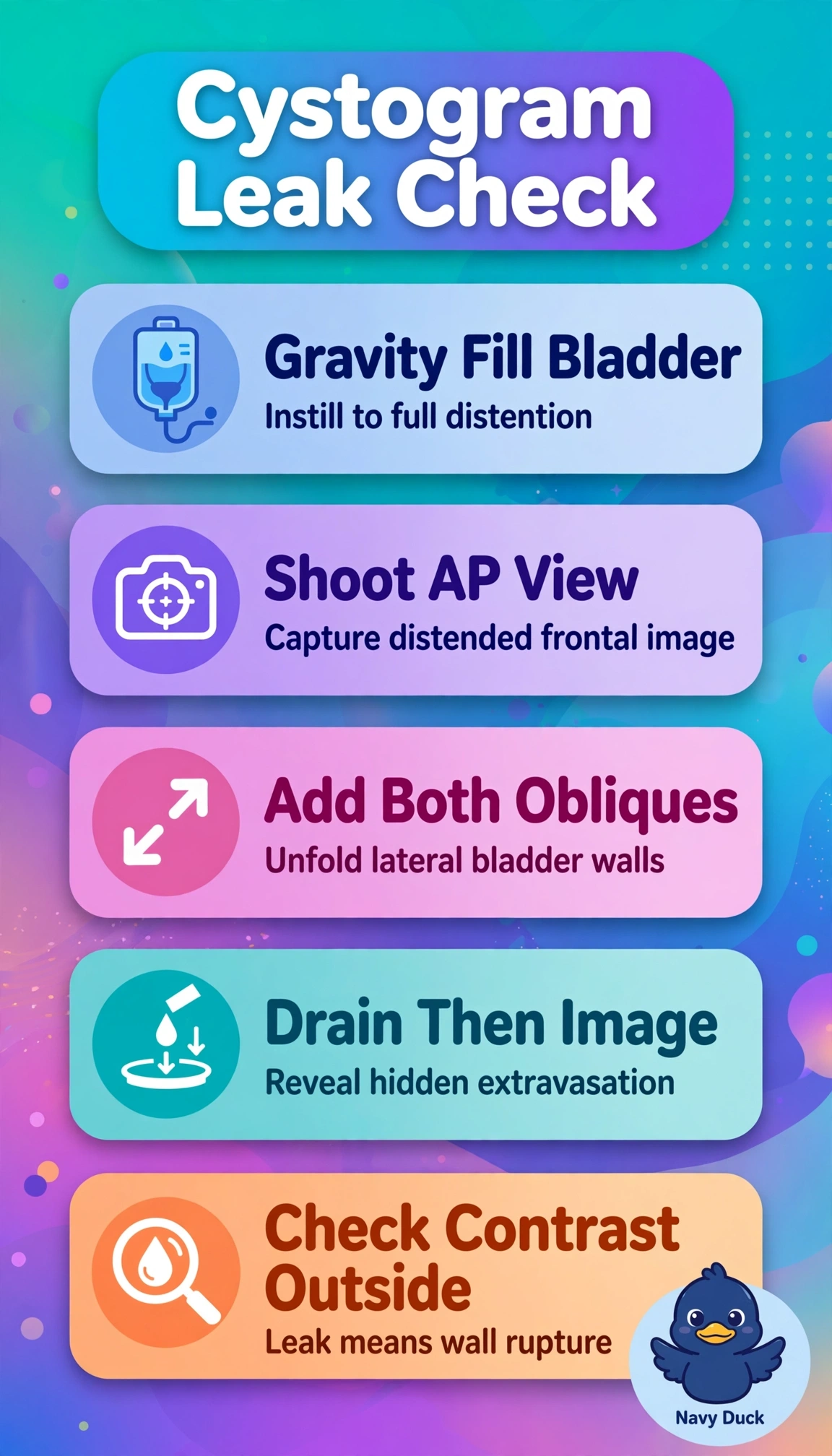
Short Explanation
You nailed the leak hunt when you distend, angle, then drain. Distention opens the whole story like filling a water balloon to spot pinholes.
Full Explanation
Cystography evaluates bladder wall integrity by gravity instillation of iodinated contrast to adequate distention, typically 300-400 mL in adults or to tolerance, followed by AP and bilateral oblique projections that unfold the lateral walls and base from overlying contrast, and a critical post-drainage radiograph that reveals extravasation, mucosal detail, or posterior leaks obscured by a full bladder; oblique positioning is essential because a bladder rupture, especially extraperitoneal, may layer dependently and hide on frontal views alone. A voiding description with catheter removal confuses cystography with voiding cystourethrography, where urethral evaluation during micturition is the goal and would risk inadequate bladder distention and loss of controlled filling pressure. An AP-only approach without drainage reduces sensitivity because residual contrast in a full bladder can mask small tears and prevents assessment of drainage and mucosal coating. A steep Trendelenburg approach during active infusion misapplies positioning intended for other fluoroscopic studies and does not substitute for standardized distention, obliques, and drainage to demonstrate leak versus reflux.