
A busy ED orders a supine AP abdomen for a large adult with ileus at 80 kVp using an 8:1 grid and a wide open field. The image shows low contrast from scatter and marginal exposure. The tech must convert from the nongrid technique and tighten restriction. Which grid and beam restriction change best balances scatter cleanup and exposure for this grid conversion?
Select an answer to reveal the explanation.
Short Explanation
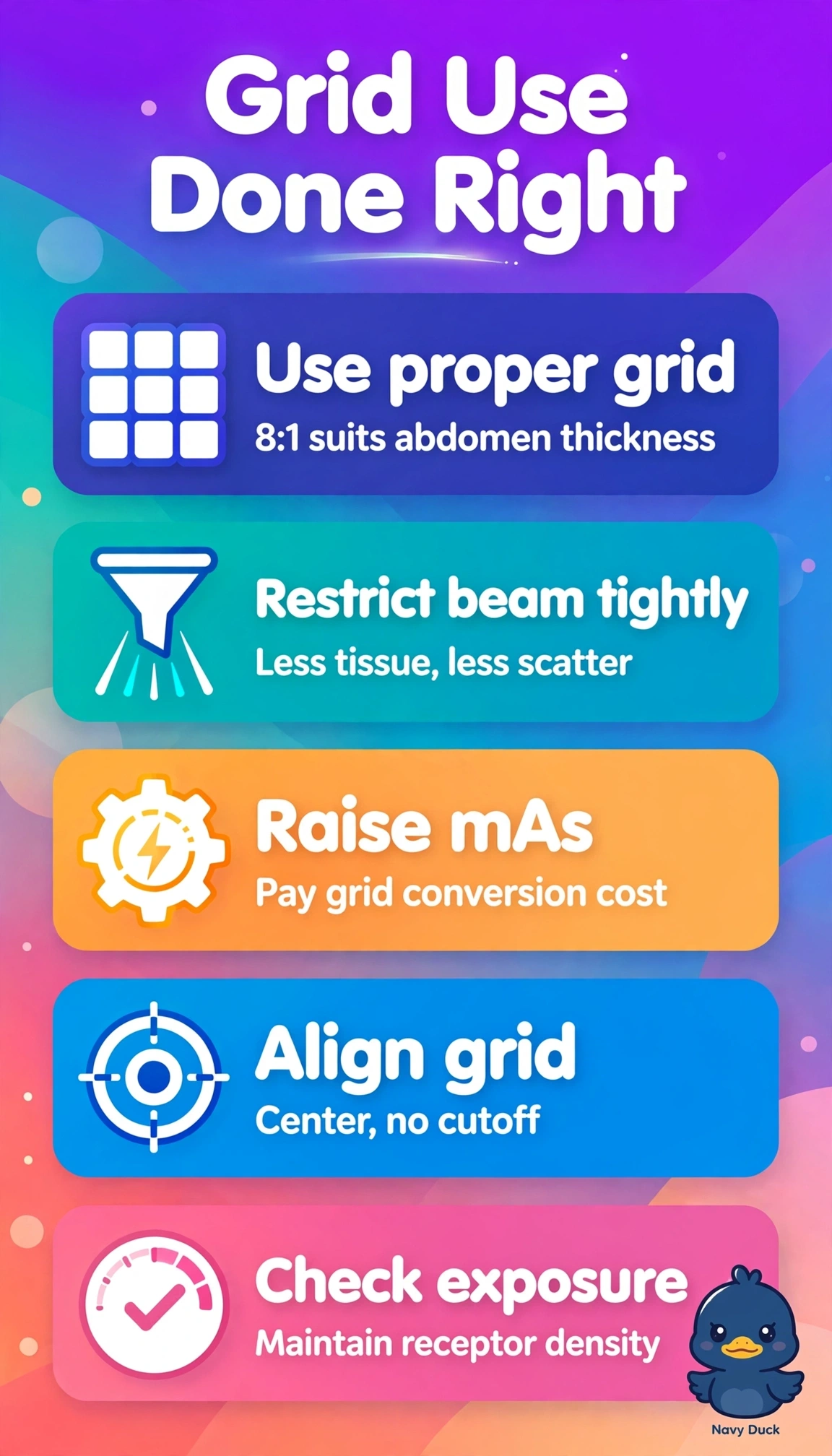
You get cleaner contrast when you trap scatter and pay the exposure toll. Tight collimation cuts scatter production while grid conversion demands more mAs, so only that combo fits this thick abdomen.
Full Explanation
Grids improve contrast by absorbing scatter before it reaches the receptor, and a higher ratio grid cleans more scatter but requires a larger grid conversion factor increase in mAs to maintain receptor exposure; beam restriction also improves contrast by reducing the volume of tissue producing scatter and improves detail by limiting penumbra. Keeping the appropriate 8:1 grid for abdomen work with tight collimation therefore addresses both scatter production and cleanup while the increased mAs compensates for grid absorption, preserving density. Removing the grid and opening collimation increases scatter fog and lowers contrast despite higher kVp penetration. Changing to a 16:1 grid without increasing mAs under-exposes the image because the higher ratio absorbs more primary as well as scatter, and keeping the field wide retains scatter production. Keeping the 8:1 grid but opening collimation and decreasing mAs both increases scatter and starves the receptor, producing a noisy low-contrast image. Exam caveat: never select grid ratio by dose alone; match ratio to kVp and part thickness and always apply the conversion factor. Practical check: collimate to the anatomy, center and align the grid, then adjust mAs for grid use before exposing.