
A portable radiographer images a med-surg patient at 40-inch SID using 10 mAs with acceptable density. The next morning the patient is in isolation and the technologist must use 72-inch SID to include the chest and reduce magnification while keeping beam quality constant. Which exposure adjustment demonstrates correct use of the inverse square law to maintain receptor exposure?
Select an answer to reveal the explanation.
Short Explanation
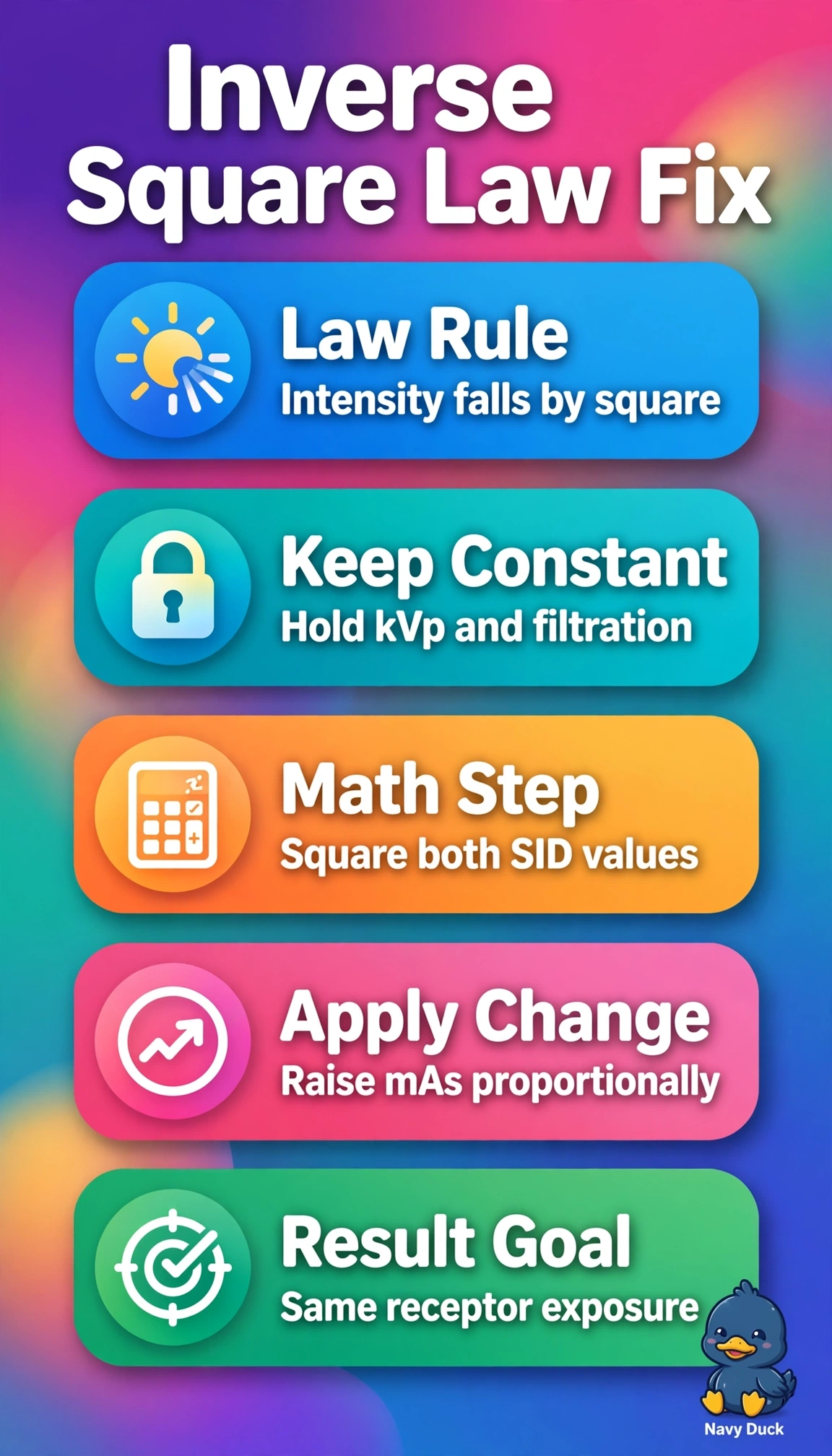
You nailed the math behind distance and brightness. Doubling distance spreads photons thin, so mAs must rise by the square-factor to hold density steady.
Full Explanation
Primary radiation leaves the tube and intensity falls with the square of distance, so moving from 40 to 72 inches reduces beam quantity at the receptor by the square of the distance ratio, requiring mAs to increase proportionally when kVp and filtration stay constant. Calculation uses new mAs equals old mAs times new distance squared divided by old distance squared, yielding approximately 32 mAs, which preserves remnant radiation exiting the patient to expose the receptor. Increasing to about 18 mAs underestimates loss because it uses a linear ratio rather than a squared ratio and confuses quantity with quality, which is controlled by kVp and filtration rather than distance. Increasing to about 20 mAs misattributes the effect to remnant radiation, which is the result after attenuation rather than the cause of intensity loss in air. Keeping technique constant ignores the inverse square law entirely and would produce a markedly underexposed image because air divergence alone greatly reduces photon number. Exam caveat is to square both distances before dividing and keep units identical, and practical check is to verify SID with a tape measure and adjust mAs before exposing.