
A 45-year-old outpatient is scheduled for fluoroscopic shoulder arthrography with iodinated contrast to evaluate a suspected labral tear, with no reported allergies and normal labs. The radiologist will perform sterile joint injection and needs radiographer support. Which support step best promotes safe joint injection for contrast arthrography?
Select an answer to reveal the explanation.
Short Explanation
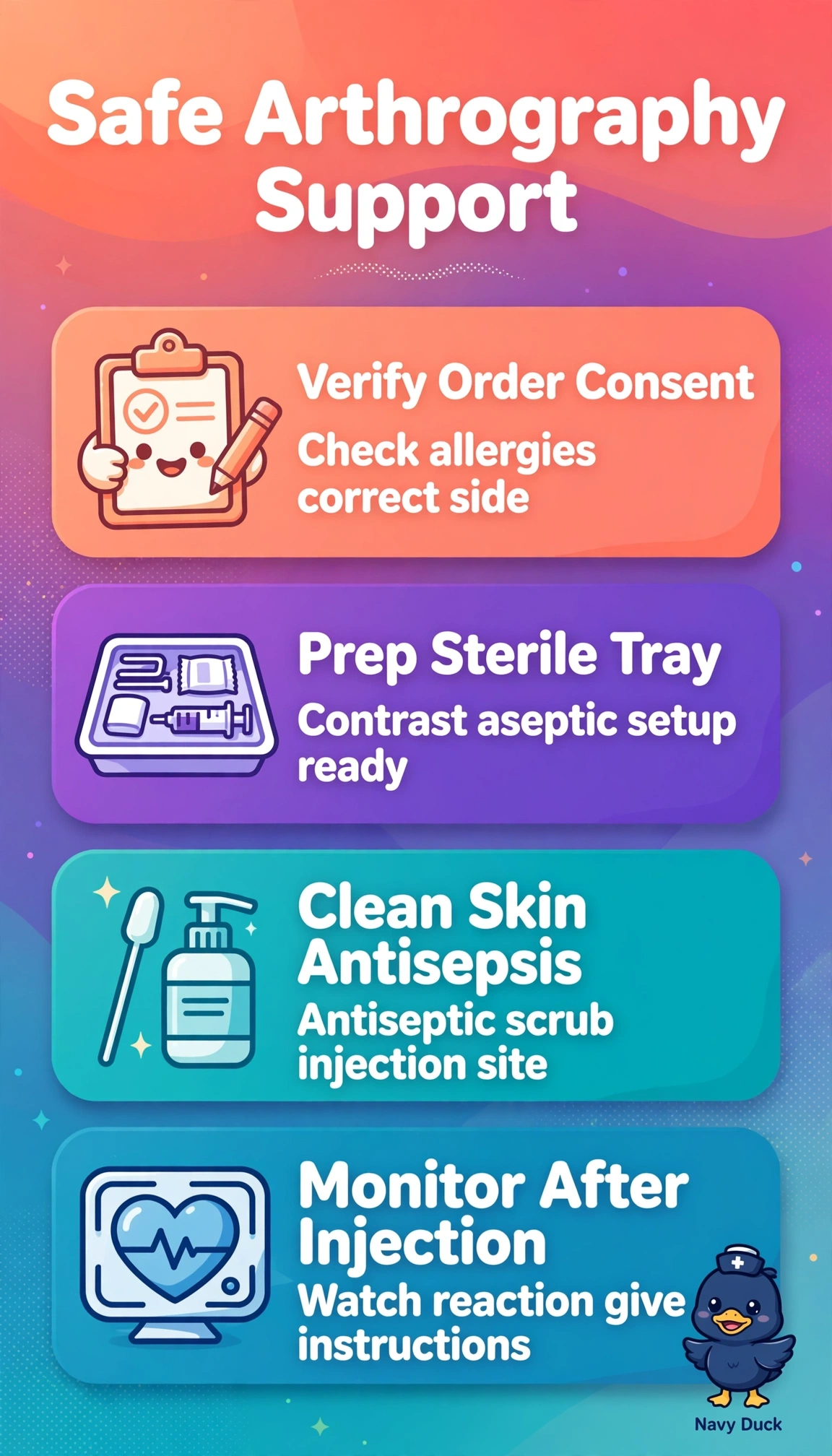
You are the careful co-pilot for a sterile joint mission. Verified arthrography prep and watchful aftercare keep the injection safe.
Full Explanation
The correct support step is right because fluoroscopic shoulder arthrography requires direct intra-articular delivery of iodinated contrast under sterile conditions, so support must include immediate pre-procedure verification of informed consent and allergies, preparation of a sterile tray with the correct contrast to protect joint sterility and prevent septic arthritis, and active monitoring after injection for hypersensitivity or vagal reaction. The choice describing review of normal labs and shoulder history with sterile preparation and monitoring fails by pre-procedure verification concept, since reassuring labs and history do not substitute for explicit consent and allergy confirmation before invasive contrast use. The choice describing sterile contrast prepared for intravenous administration fails by route concept, since IV preparation, although standard for enhanced studies, does not provide the sterile intra-articular tray and joint-specific handling required for arthrography. The choice describing consent verification and sterile tray with only positioning support during injection fails by surveillance concept, since assistance limited to the injection itself omits dedicated observation after contrast exposure when reactions commonly manifest. An exam caveat is that no reported allergies and normal labs do not remove consent or monitoring requirements, and vignettes often use reassuring history to distract from mandatory safety steps. A practical check is to perform a time-out with read-back of contrast name, concentration and expiry, confirm sterile field integrity, and record baseline and post-injection status with defined observation before discharge.