
A 55-year-old with chronic shoulder pain and limited abduction needs evaluation of the glenohumeral joint space without rib overlap, and the physician also wants to assess anterior dislocation with humeral head position relative to the glenoid. Which shoulder projections best demonstrate the joint space and then confirm humeral head alignment?
Select an answer to reveal the explanation.
Short Explanation
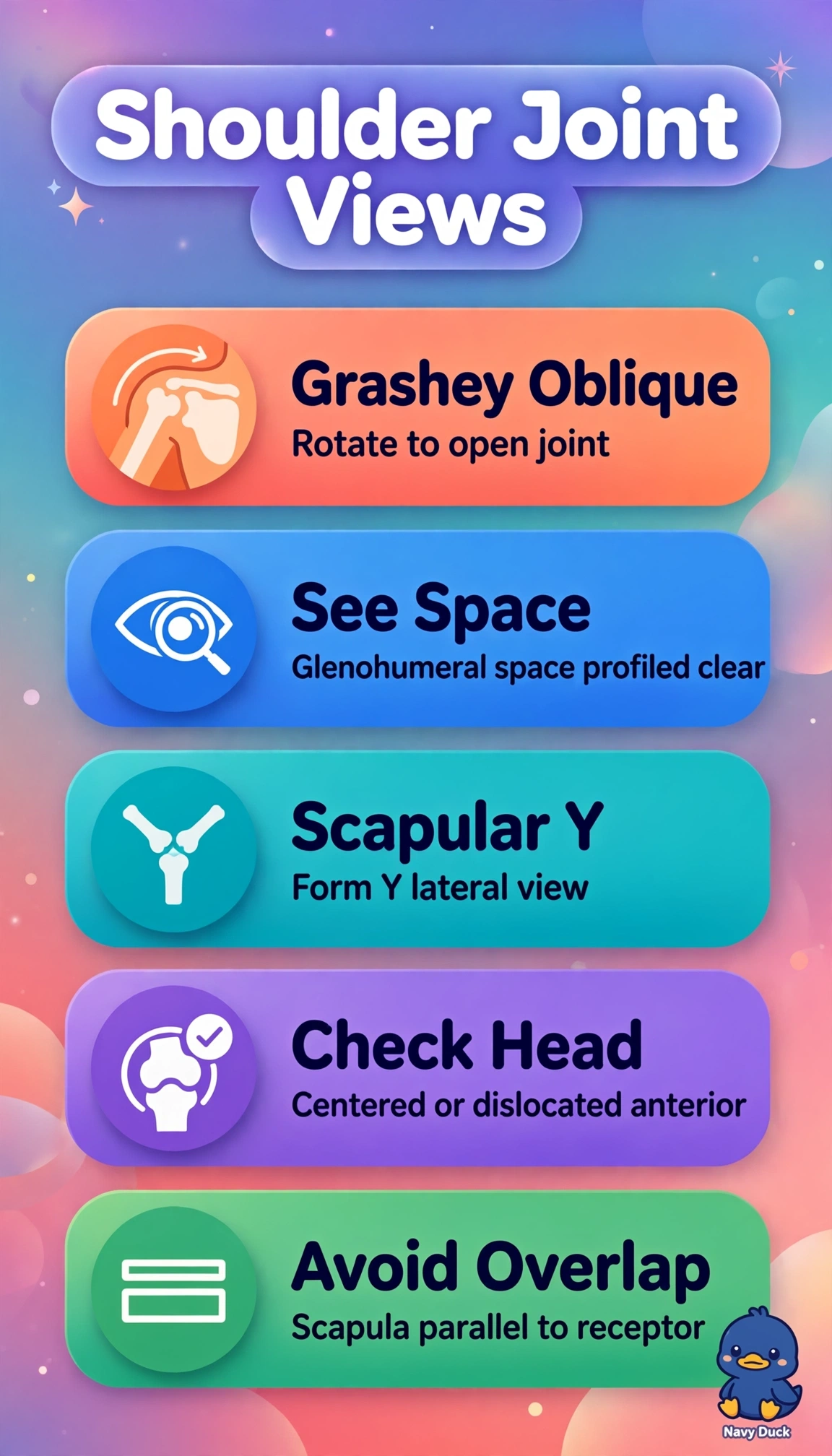
You open the joint then check the lineup. Grashey plus Y work as a team like opening a door then looking from the side.
Full Explanation
The Grashey AP oblique is correct first because 35 to 45 degrees of obliquity toward the affected side profiles the glenoid en face, opening the glenohumeral joint space and clearing ribs to show narrowing, osteophytes and chronic arthropathy, while the scapular Y lateral uses that same scapular plane to project the body, acromion and coracoid as a Y centered on the glenoid, so anterior dislocation is confirmed when the humeral head sits anterior to the junction rather than centered over it. A Grashey followed by axillary inferosuperior fails by positioning because the axillary projection requires arm abduction to direct the beam through the axilla, which is not feasible with limited painful abduction despite excellent head to glenoid detail. A standard AP in neutral rotation followed by scapular Y fails by geometry because without Grashey obliquity the glenoid is seen obliquely with rib and humeral overlap that obscures true joint width, even though the Y would assess dislocation. A Grashey followed by weighted acromioclavicular views fails by target anatomy because stress views grade AC separation and do not display humeral head position relative to the glenoid, leaving dislocation unanswered. Exam caveat is that limited abduction signals avoidance of axillary and rib overlap without joint opening signals Grashey rather than routine AP, so both clues must be satisfied together. Practical check is to confirm an open glenohumeral space without rib superimposition on the Grashey and a true lateral Y with the humeral head localization clearly shown before accepting alignment.