
A thin older adult with pleuritic pain needs upper rib detail above the diaphragm. She is upright, mildly kyphotic, breathes shallowly, and drifts without support. The order specifies no rotation with best cortical detail. Which respiration and aid combination correctly demonstrates the upper ribs with optimal positioning?
Select an answer to reveal the explanation.
Short Explanation
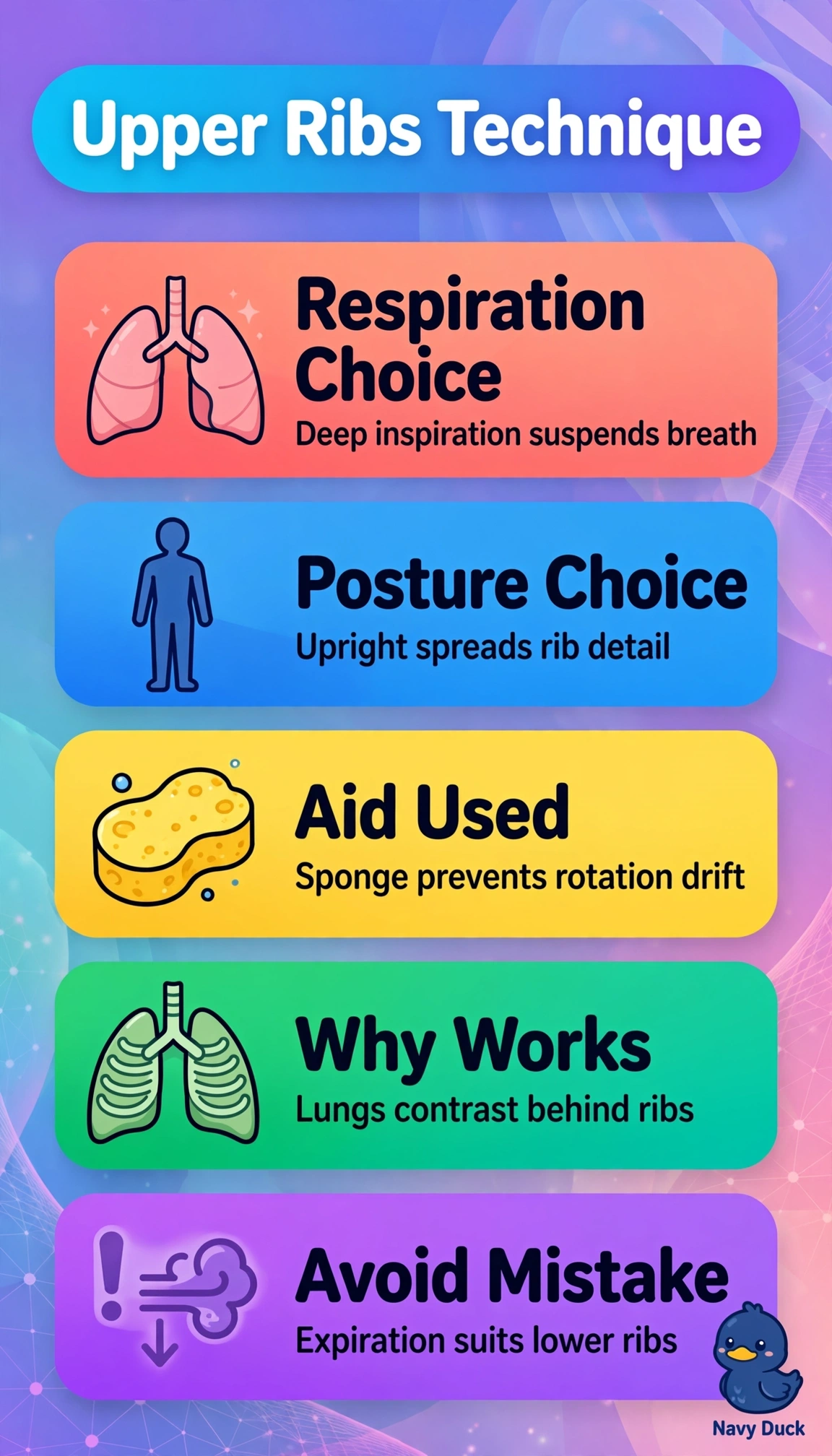
You’re lifting the lungs to spotlight bone. A full breath in drops the diaphragm and spreads ribs, while a gentle sponge keeps a wobbly patient straight for inspiration detail.
Full Explanation
Upper ribs must be demonstrated above the diaphragm with maximum thoracic expansion and sharp cortical margins, which requires suspended deep inspiration in the upright position, and this thin, mildly kyphotic older adult who drifts requires gentle sponge support to maintain a true AP or PA projection without rotation and to prevent motion during the exposure. The expiration variant fails by respiration concept because full expiration elevates the diaphragm and crowds upper ribs while optimizing lower ribs below the diaphragm, so it is a valid lower-rib technique but directly contradicts the stated need for upper rib detail. The supine variant fails by positioning concept because recumbency limits gravity-assisted diaphragmatic descent and lung expansion, degrades upper rib visualization, and disregards that the patient is already upright and ordered upright, although supine suspension with support is routine for trauma or immobile patients. The shallow-breathing variant fails by detail concept because continuous respiration, even with support and upright positioning, introduces cortical blur and prevents full inspiratory expansion, although controlled shallow breathing is commonly and compassionately used to ease pleuritic pain or to blur lung markings. A key exam caveat is to link anatomy to breathing on every rib question, remembering inspiration for ribs one through ten above the diaphragm and expiration for ribs eight through twelve below it, and never select comfort or pain reduction over the specified diagnostic goal unless the order changes. A practical check is to coach and rehearse the suspended breath, wedge sponges snugly without forcing kyphotic posture, confirm no rotation by symmetric sternal ends, clavicles, and posterior rib symmetry, and expose only at full suspended inspiration.