
A 52-year-old warehouse worker has chronic neck stiffness with radiating arm tingling, cleared for movement, and needs evaluation of intervertebral foramina and alignment. The surgeon requests cervical obliques plus flexion and extension views. The patient is mobile but anxious about bending. Which projection set best demonstrates cervical foramina and stability for this degenerative case?
Select an answer to reveal the explanation.
Short Explanation
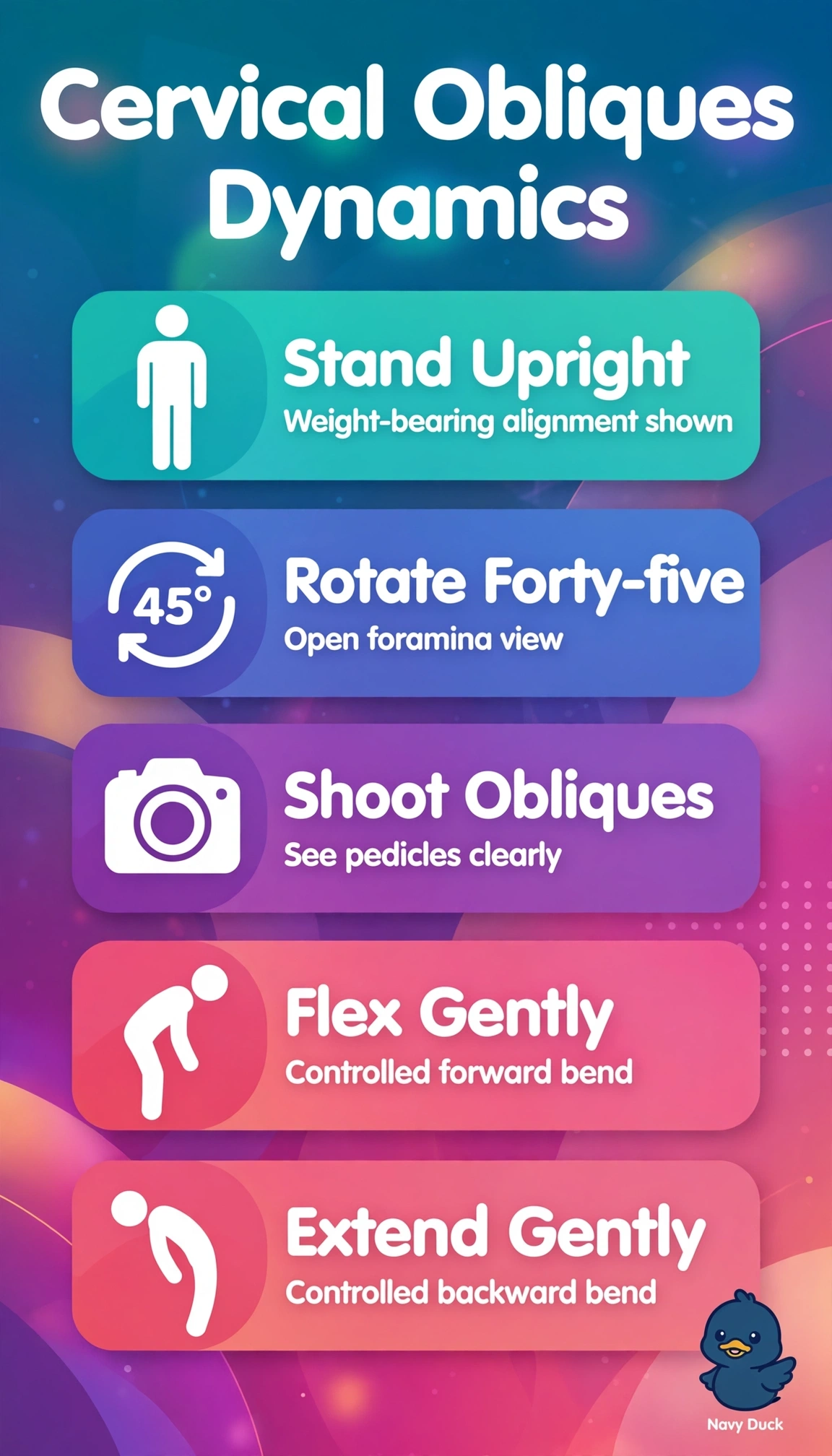
When you're chasing that arm tingling, you've got to angle right into the nerve tunnels like peeking around a doorway. Anterior obliques at 45 degrees open the foramina, then gentle seated flexion and extension let you spot any wobble safely.
Full Explanation
The correct projection set works because upright anterior obliques at 45-degree rotation elongate and open the lower cervical intervertebral foramina and pedicles to evaluate degenerative foraminal stenosis causing radiating tingling, while seated active flexion and extension laterals with slow patient-controlled motion show dynamic alignment, disc mobility and instability under physiologic weight-bearing safely in a cleared mobile patient. The 30-degree rotation variant fails by geometry because lesser obliquity leaves facets and uncovertebral joints superimposed over the foramina so encroachment cannot be judged despite adequate dynamic laterals. The neutral lateral with odontoid variant fails by function because static lateral plus C1-C2 open-mouth views assess routine alignment and dens well but provide no flexion-extension excursion to detect spondylolisthesis, lordosis reversal or hypermobility requested. The supine with recumbent variant fails by biomechanics because non-weight-bearing unloads the column and may reduce or mask subluxation, anterolisthesis and disc narrowing visible erect despite correct angle and motion. For examinations, remember cervical foraminal obliquity is 45 degrees and never substitute forced passive hyperflexion for active seated flexion-extension in degenerative disease. Practically, verify posterior mandibular rami superimposed with foramina open, include C7-T1 on true midline laterals with stop-if-pain coaching, and compare posterior body and spinolaminar lines across positions for stability.