
A radiographer is assigned to routine lumbar spine imaging in a room where the light field looks much larger than the anatomy and prior images show wide uncollimated borders. The supervisor stresses NCRP 102 beam limitation and adequate filtration for dose control. Which beam restriction and filtration action best minimizes patient exposure?
Select an answer to reveal the explanation.
Short Explanation
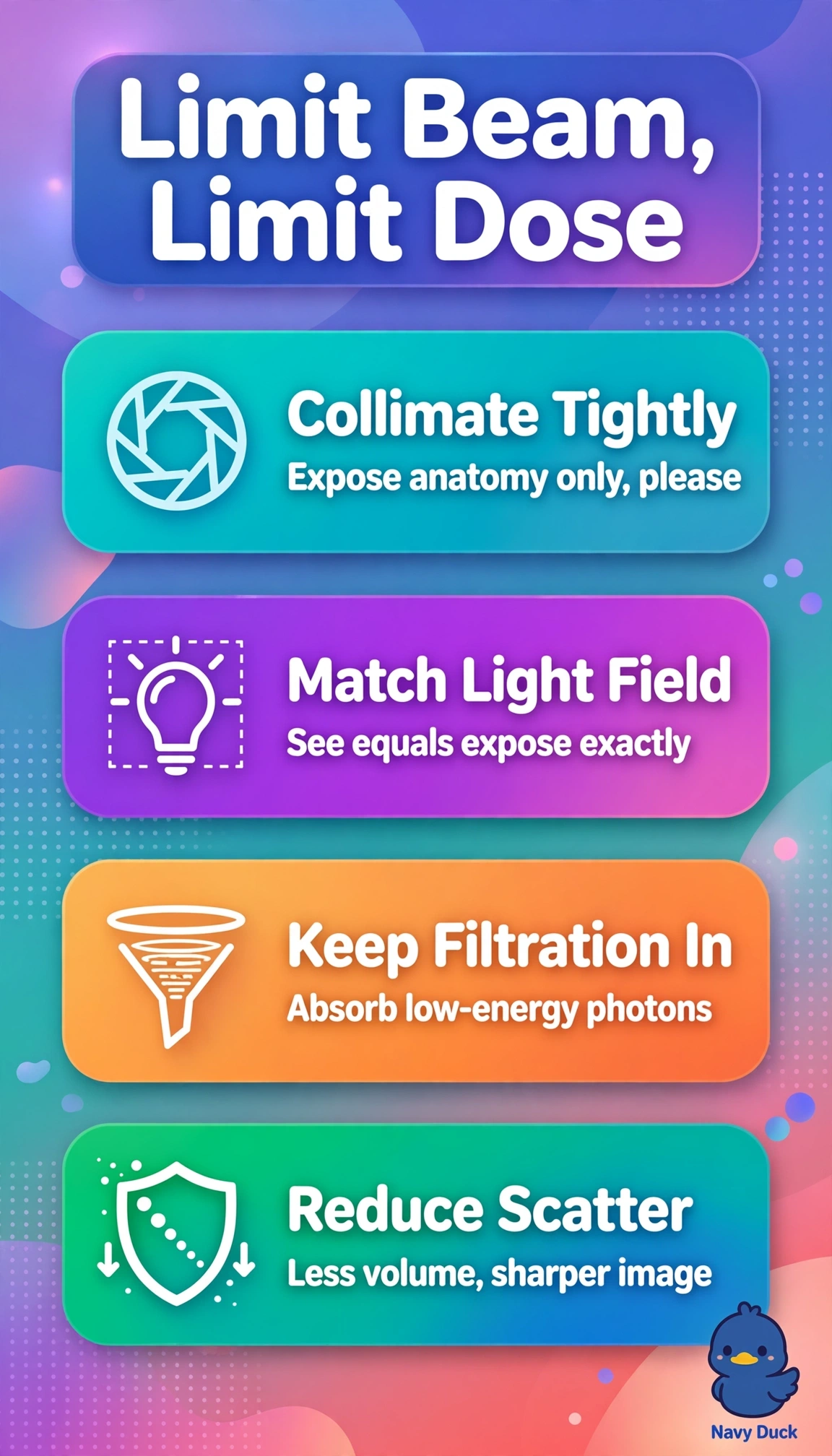
You're trimming the beam to only what you need to see. Tight collimation with matched light field keeps scatter down and detail up through beam-limitation discipline like closing curtains to brighten a room.
Full Explanation
Patient dose reduction depends on irradiating only the anatomy of interest, because tight collimation decreases tissue volume exposed, reduces scatter that degrades contrast, and lowers integral dose, while NCRP 102 beam-limitation principles require the x-ray field not extend beyond the image receptor and light-field to x-ray-field congruence be maintained so what you see is what you expose, with adequate aluminum filtration removing low-energy photons that would otherwise contribute skin dose without reaching the receptor. The wide-open collimation approach fails by concept of volume control because generous margins directly increase exposed tissue and scatter while suggesting positioning ease outweighs dose, which violates ALARA and collimation standards. The filtration removal approach fails by concept of beam quality because added filtration hardens the beam by absorbing nonpenetrating low-energy photons, so removing it increases skin dose and does not usefully improve contrast for lumbar work. The SID-only approach fails by concept of primary restriction because greater distance modestly changes intensity distribution but without collimation adjustment the same excessive tissue area remains irradiated and scatter persists. For the exam, associate beam restriction first with collimation and congruence before technique changes, and in practice set collimation borders to the anatomy, verify light-field alignment, and confirm filtration indicators before exposing.