
A competent adult inpatient with a signed advance directive asks that test results not be shared with visiting family, then declines a contrast study after discussion of risks and alternatives. The care team asks imaging to proceed quickly. Which patient rights action should the technologist take for consent types, HIPAA confidentiality and advance directives?
Select an answer to reveal the explanation.
Short Explanation
You are guarding both voice and privacy at the bedside in one moment. Respecting refusal and limiting disclosure keeps trust intact, and autonomy guides your next call.
Full Explanation
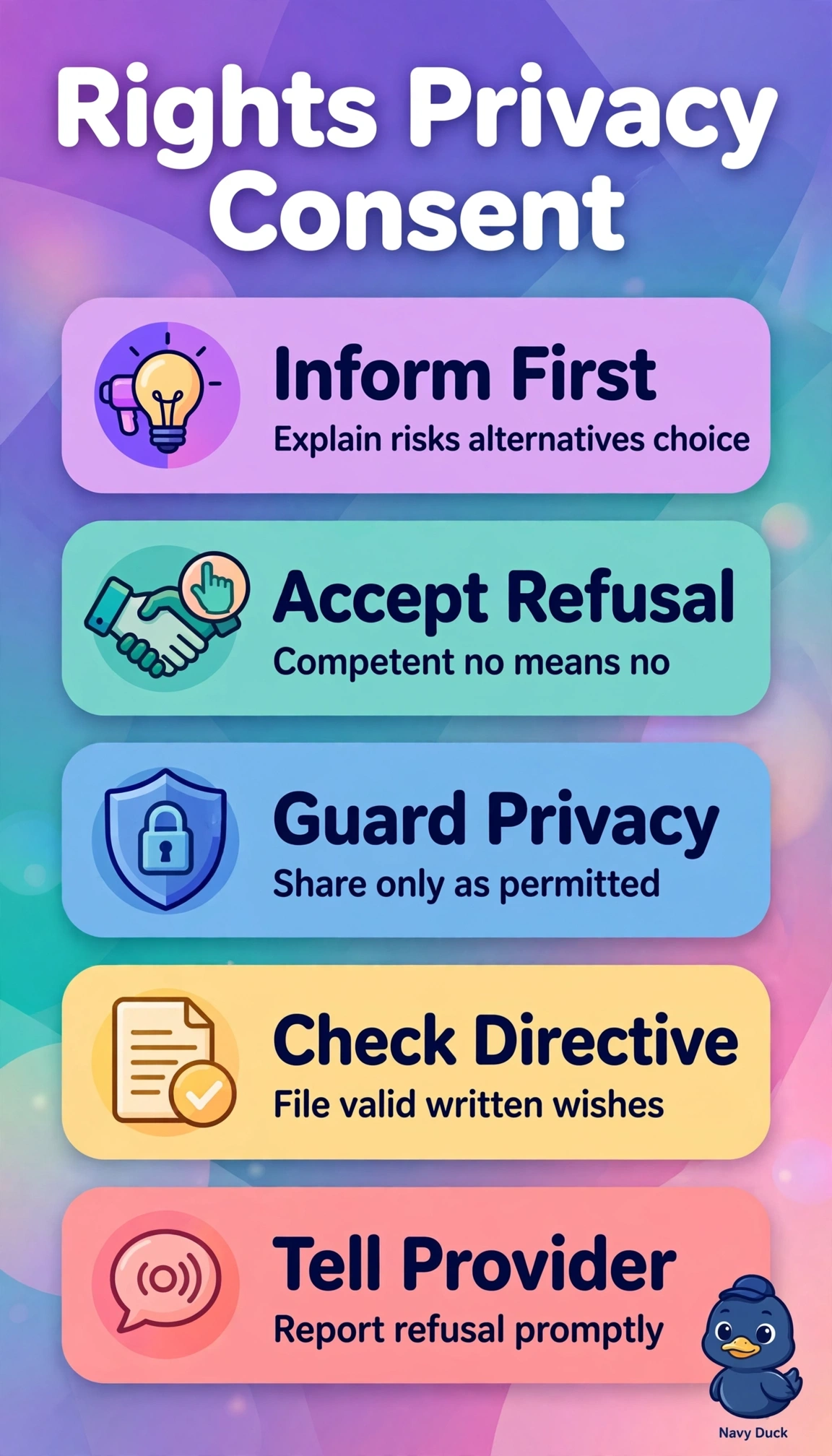
The correct action upholds three concurrent duties: a competent adult's informed refusal after discussion of risks and alternatives must be honored and cannot be overridden by team urgency or implied consent, the explicit HIPAA request to withhold results from visitors must be respected, and the signed advance directive must be verified for authenticity and applicability while promptly informing the ordering provider so orders and care plans can be updated and unwanted imaging avoided. The choice that defers provider notification to routine rounds captures documentation and verification but fails the timeliness standard because informed refusal requires immediate closed-loop communication when the team is pressing to proceed. The choice that consults or activates the surrogate captures privacy and prompt notification but fails the competence principle because a signed directive does not transfer authority while the patient retains decision-making capacity. The choice that briefs visiting family for support captures refusal handling and prompt notification but fails confidentiality because HIPAA permission to involve family in care does not override an explicit patient request for nondisclosure. Exam caveat: distinguish what is generally permitted from what the facts require, as urgency, routine workflow, and family-centered practice never outrank explicit refusal, explicit privacy restriction, or competence. Practical check: verify the directive in the record, document the refusal discussion and privacy request verbatim, and use direct timely communication with the provider with read-back.