
A 28-year-old carpenter presents with snuffbox tenderness after a fall on an outstretched hand, and the physician suspects a scaphoid fracture that was occult on standard wrist views. The hand is ulnarly deviated to isolate the bone. Which specialized wrist projection best elongates the scaphoid to demonstrate a nondisplaced fracture?
Select an answer to reveal the explanation.
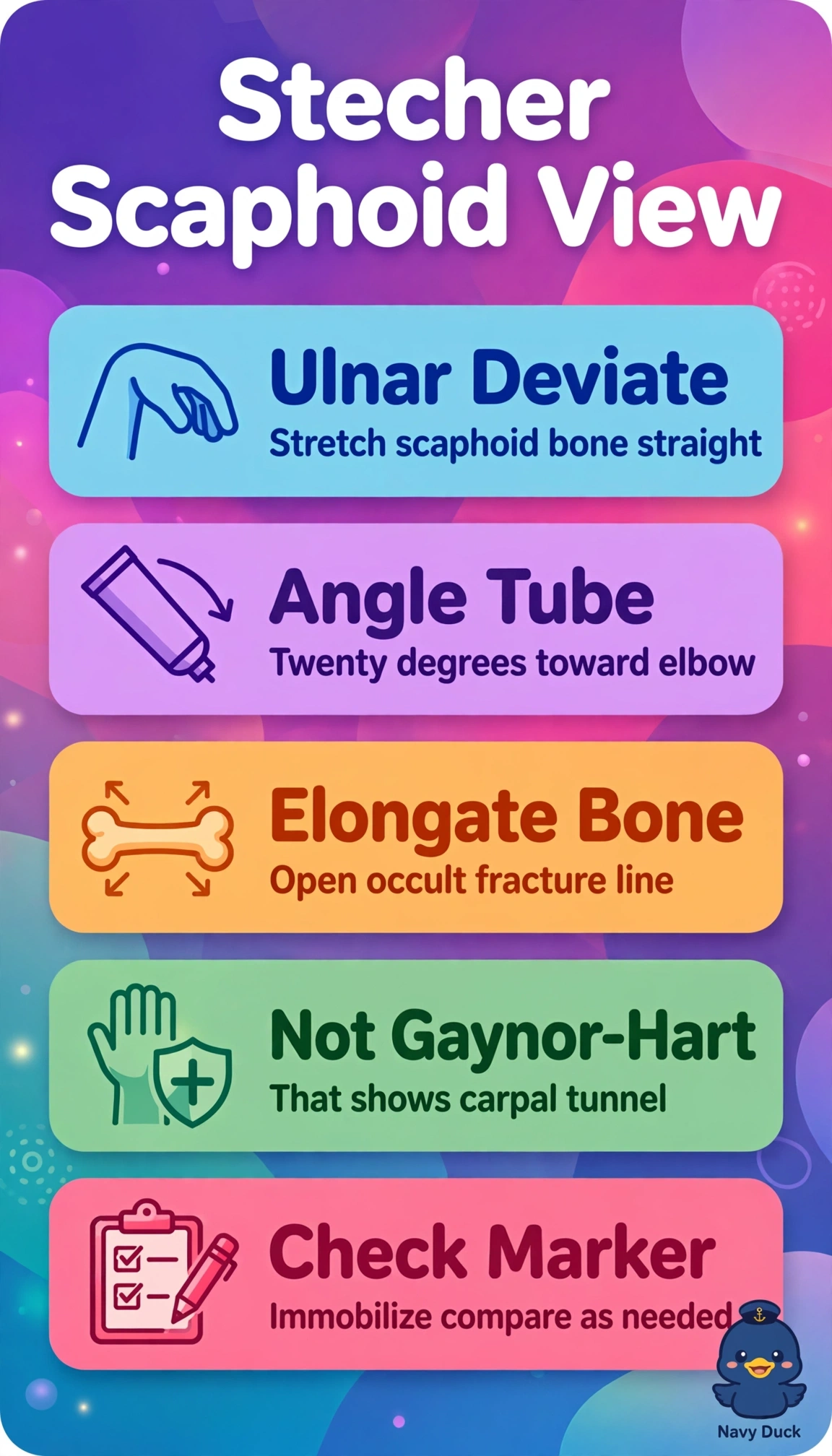
Short Explanation
You stretch the scaphoid out to see it. Stecher with ulnar deviation pulls that little boat bone straight like extending a telescope.
Full Explanation
The Stecher projection is correct because ulnar deviation draws the scaphoid away from radial overlap and aligns its long axis with the receptor, while 20-degree cranial angulation corrects for distal radial inclination to project the waist elongated en face and reveal a subtle nondisplaced lucency missed on routine views. A variant retaining ulnar deviation but using a perpendicular beam fails geometrically because without cephalic tilt the scaphoid remains foreshortened under radial overlap and waist cortical disruption stays obscured. An anteroposterior variant retaining deviation and angulation fails on positioning physics because only PA placement puts the scaphoid directly against the receptor for maximal sharpness, while AP increases object-to-image distance with magnification and blur that hide hairline fractures. A variant retaining Stecher angulation but using radial deviation fails anatomically because radial deviation flexes and shortens the scaphoid and crowds the radial column, concealing rather than elongating the waist. For examinations remember a clinically suspected scaphoid fracture with snuffbox tenderness requires thumb-spica immobilization with MRI or 10- to 14-day reimaging even if initial views are negative, since proximal pole avascular necrosis is the classic tested complication. Practically verify full ulnar deviation without rotation, 20-degree tube tilt toward the elbow centered to the tubercle, and an elongated scaphoid free of trapezoid overlap before accepting the image.