
A 45-year-old outpatient stands for a routine PA chest for clearance, chin elevated, shoulders rotated forward, and chest against the upright receptor. The exposure is made at full inspiration with the central ray horizontal to mid-chest. The image shows 10 posterior ribs above the diaphragm with clavicular heads equidistant from the spine. Which image finding confirms accurate positioning and tube-part-receptor alignment for this PA chest?
Select an answer to reveal the explanation.
Short Explanation
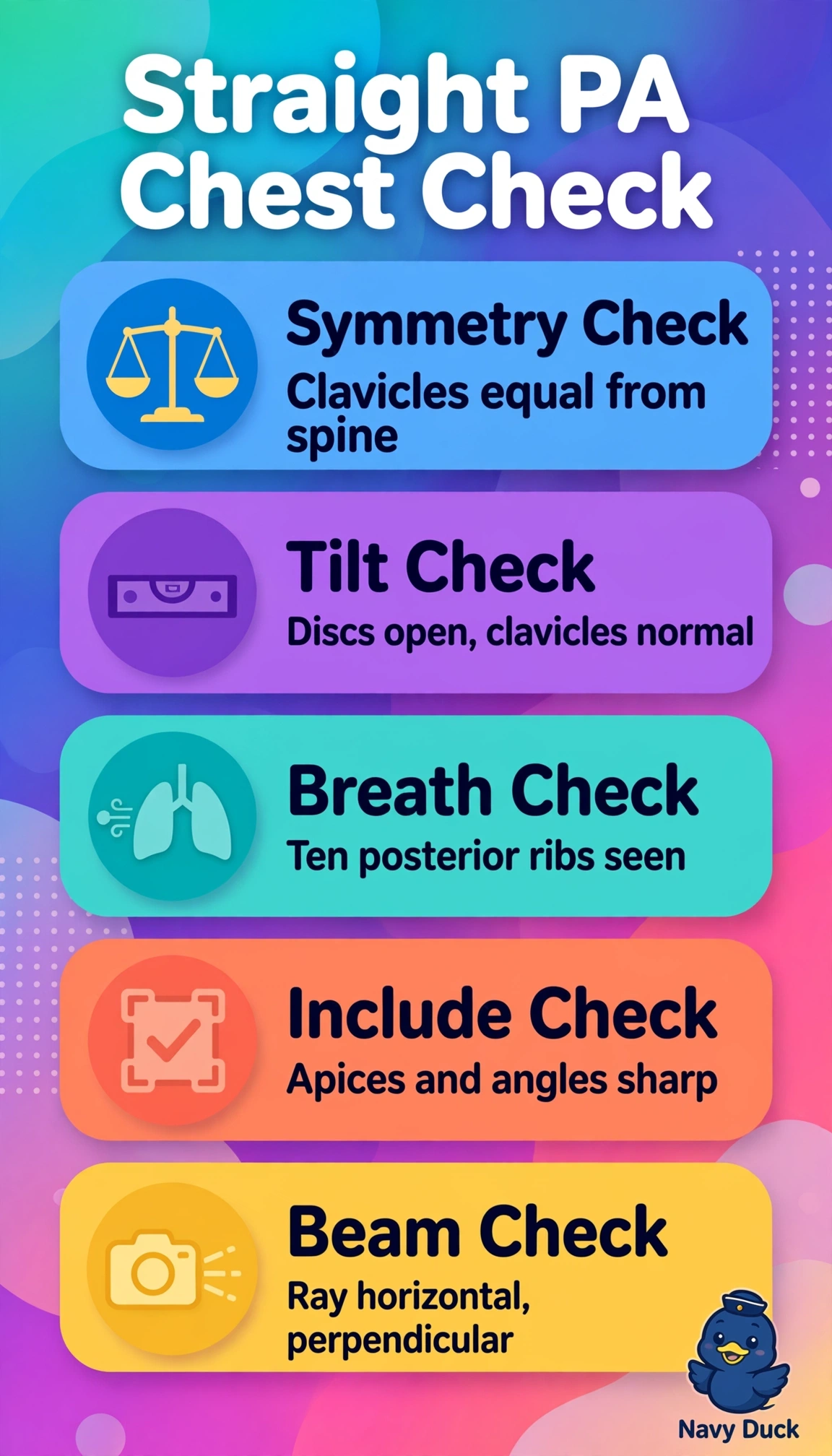
You've nailed full inspiration and a straight-on beam when symmetry meets aeration. Sharp angles plus symmetry are your green light, like level picture frames on a wall.
Full Explanation
The routine PA chest described requires erect positioning with chest against the receptor, chin elevated, shoulders rotated forward to displace scapulae, and horizontal central ray to mid-chest at full inspiration, with quality criteria of approximately ten posterior ribs above the diaphragm, equidistant medial clavicular heads, apices clear without lordotic tilt, scapulae clear of lungs, and sharp lateral costophrenic angles included, so the correct finding directly verifies all of those elements together with symmetry and absence of tilt or rotation indicating true vertical tube-part-receptor alignment. The finding of clipped lateral angles despite ten posterior ribs and symmetry fails by concept of field inclusion because adequate inspiration does not compensate for missing inferior lung and pleural recesses needed for clearance. The finding of only six posterior ribs at end expiration fails by concept of aeration because expiratory technique crowds markings, elevates diaphragms, and cannot demonstrate the stated full inspiratory volume or ten-rib standard. The finding of scapulae overlapping lateral lungs despite symmetry and inspiration fails by concept of positioning because without forward shoulder rotation the scapulae obscure peripheral lung and mimic pleural or parenchymal opacity. An exam caveat is that rotation must be judged from clavicular head-to-spine distances and rib symmetry rather than thoracic shape alone, since slight obliquity can appear symmetric at a glance. As a practical check, confirm ten posterior ribs, equal clavicular distances, clear apices, scapulae outside lungs, and sharp angles included before accepting the image as an aligned PA chest.