
A gastroenterology suite is performing a lengthy therapeutic fluoroscopy case on an adult with prior high skin dose, and the radiologist asks the technologist to set dose-saving defaults while keeping anatomy visible. Table-to-source distance is fixed and magnification was requested only if needed. Which fluoroscopic technique combination best minimizes patient skin dose during the prolonged procedure?
Select an answer to reveal the explanation.
Short Explanation
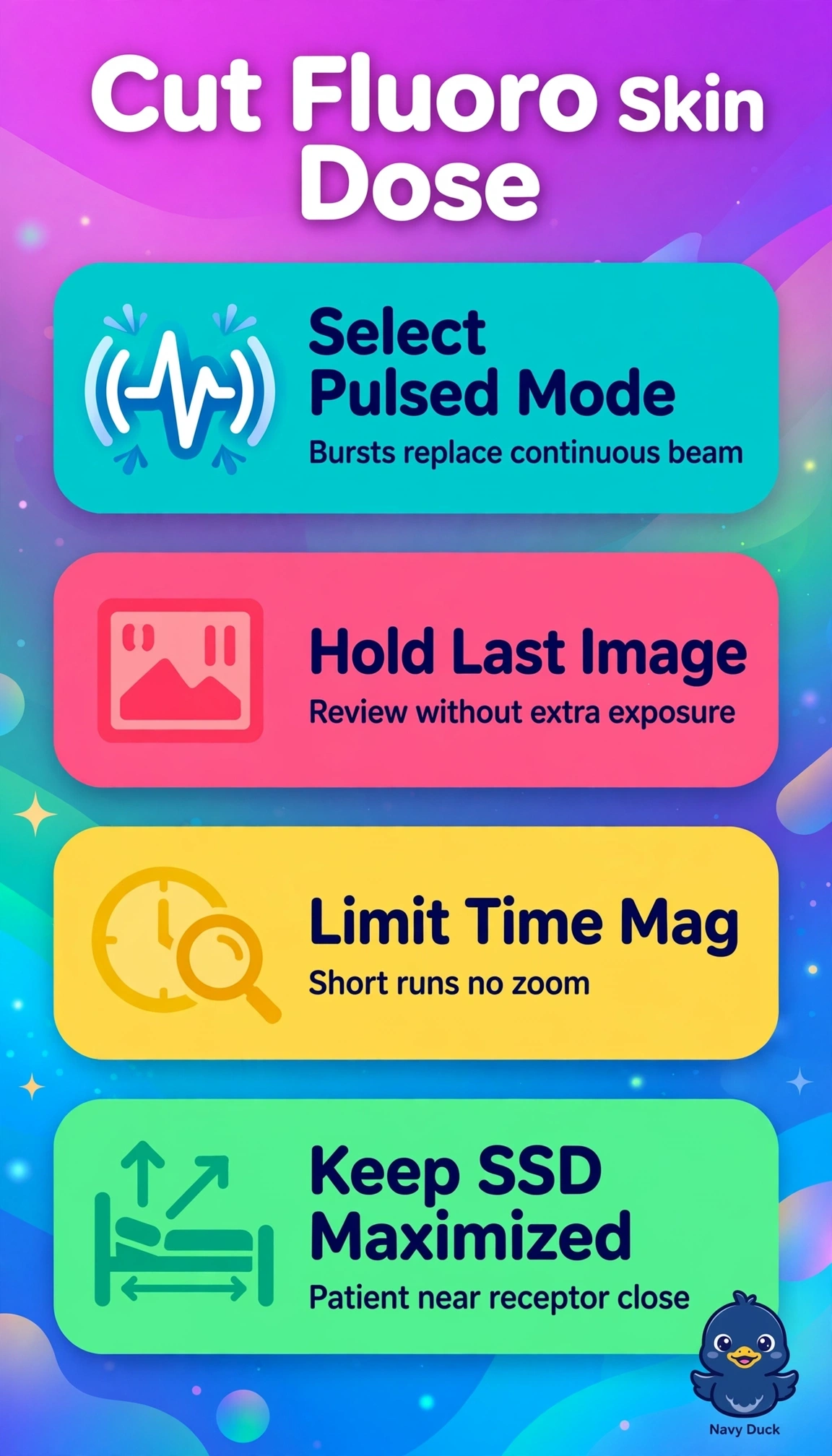
You can save dose without sacrificing useful anatomy by using pulsed fluoroscopy, last-image hold, and brief beam-on time. Keep the patient close to the receptor and reserve magnification for when you truly need it.
Full Explanation
Pulsed fluoroscopy limits effective beam-on time, and last-image hold lets you review anatomy without additional exposure. Limiting beam-on time and magnification also avoids the higher dose rate needed to maintain image quality in zoom modes. With table-to-source distance fixed, keeping the patient close to the receptor preserves source-to-skin distance and avoids the automatic exposure increase associated with a larger patient-to-receptor air gap. Using magnification throughout, even with pulsed mode, hold, and close geometry, fails because electronic magnification narrows the effective field and requires higher entrance exposure; magnification should be used only if needed. Lowering the receptor away from the patient, despite pulsed mode, hold, and restrained magnification, increases the air gap and shortens source-to-skin distance, prompting higher tube output. Continuous low-dose fluoroscopy with hold, limited time and magnification, and close geometry still irradiates throughout activation; pulsed operation reduces exposure when continuous imaging is unnecessary. Exam caveat: collimation can improve contrast and reduce scatter, but it does not correct errors in pulse rate, magnification, or geometry when minimizing skin dose. Practical check: preset a low pulse rate, verify the hold display, position the receptor near the patient, confirm magnification is off unless needed, and announce beam-on time and cumulative air kerma at intervals.