
An adult with severe abdominal pain and suspected free air cannot stand for long, vomits when flat for an acute abdomen series, and needs demonstration of air-fluid levels. The technologist must choose positions that balance safety and diagnostic needs. Which abdomen position combination should the technologist perform for supine, upright and decubitus needs?
Select an answer to reveal the explanation.
Short Explanation
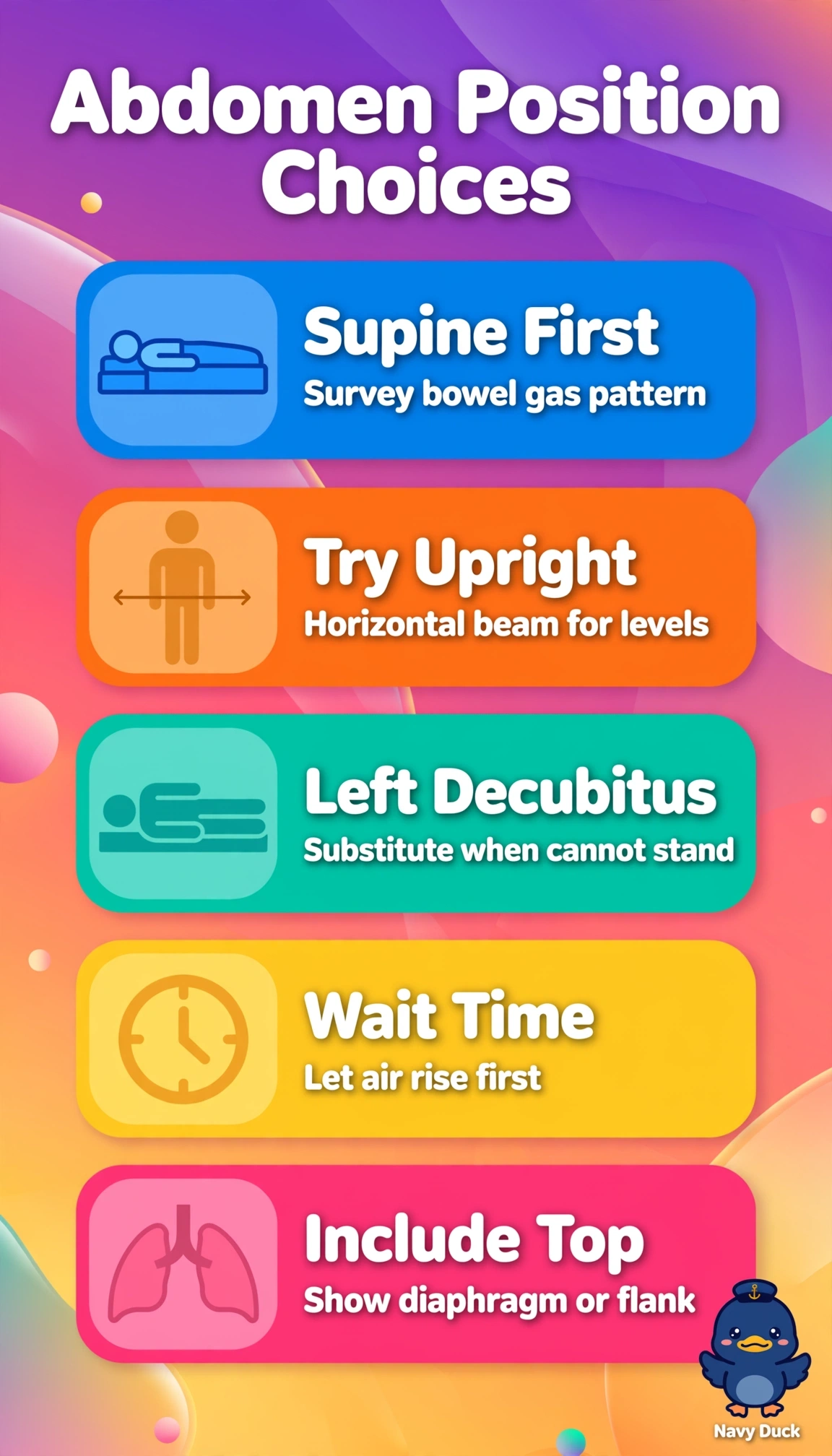
You need air to rise where your beam can catch it without exhausting the patient. Left-side-lying with a crosswise beam mirrors upright findings, and decubitus is your backup plan.
Full Explanation
The correct pairing combines supine abdomen for anatomy with left lateral decubitus using horizontal beam as the upright substitute when standing is unsafe, because horizontal beam profiles free air and air-fluid levels while decubitus preserves safety. Left side down elevates the right flank so air rises to outline the liver edge after dwell, giving sensitive pneumoperitoneum detection without orthostatic risk. An upright abdomen with vertical beam is routine for subdiaphragmatic air in stable patients, but it violates safety here by demanding prolonged standing despite pain and intolerance, risking syncope and fall. A right lateral decubitus with horizontal beam is legitimate and shows levels, but it reduces free-air conspicuity because air rising left is silhouetted against stomach and spleen rather than dense liver, hiding small volumes. A left lateral decubitus with vertical beam uses correct positioning but wrong physics, because levels require horizontal tangential beam and vertical beam projects them en face. An exam caveat is to memorize left lateral decubitus with horizontal beam and dwell as the tested upright substitute for free air. A practical check is to keep left side down with adequate dwell, center horizontal beam on the right upper abdomen, and monitor pain and emesis.