
A facility physicist reviews dosimetry reports referencing NCRP 184 where a fluoroscopy air-kerma display, a personnel badge reading, and a fetal dose estimate use different SI quantities for exposure, absorbed dose, and risk. Which SI unit assignment correctly matches the measured quantity to its clinical radiation dosimetry use?
Select an answer to reveal the explanation.
Short Explanation
You untangle alphabet soup by matching unit to meaning. Gray versus sievert separates energy deposited from biological risk like heat versus burn.
Full Explanation
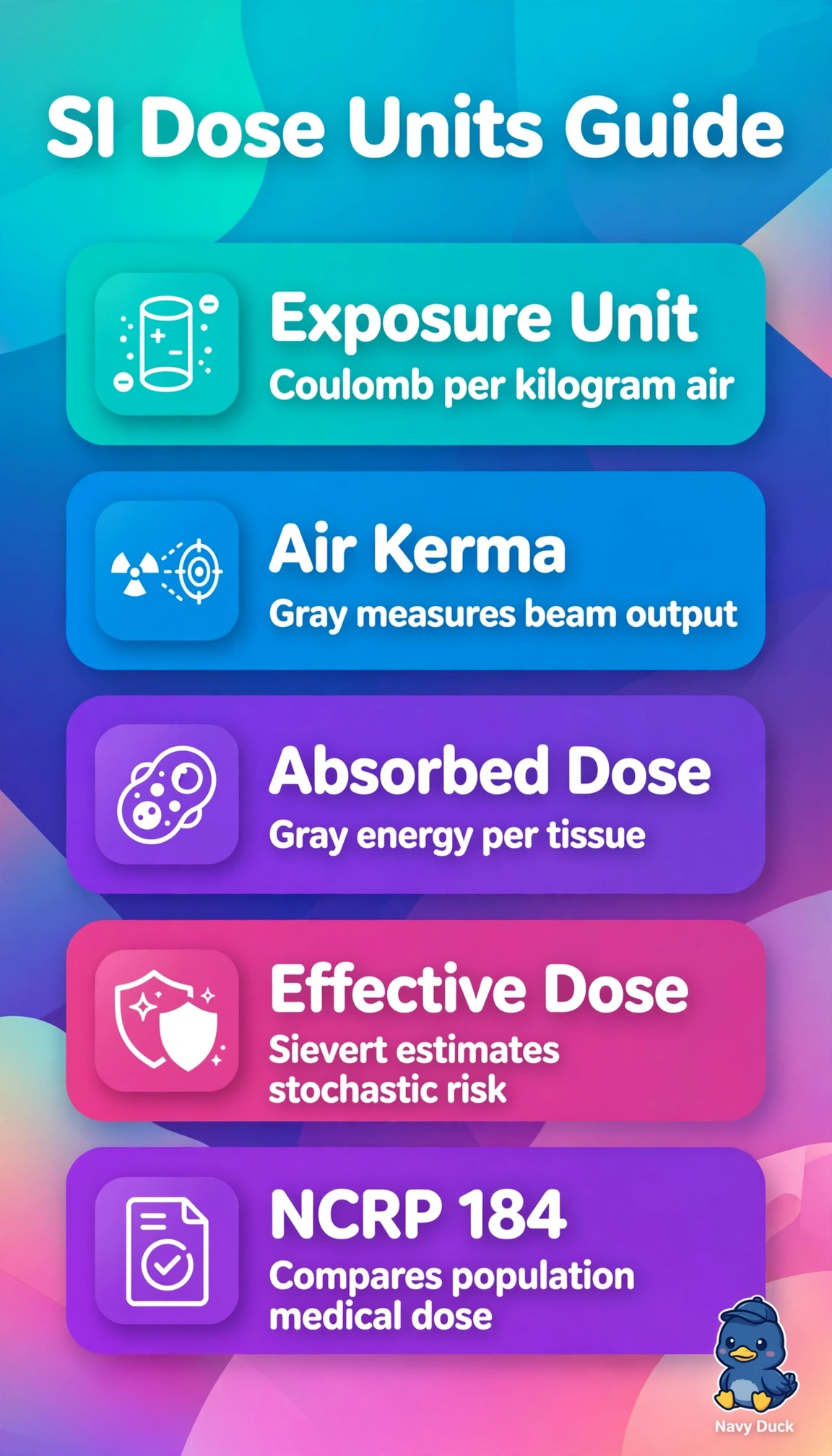
Air kerma quantifies kinetic energy released per unit mass of air at a point in the beam and is expressed in gray with fluoroscopic reference displays in mGy, tracking output and skin dose potential, while effective dose weights organ absorbed doses for tissue sensitivity and radiation type and is expressed in sieverts to estimate stochastic risk for populations and allow modality comparisons emphasized in NCRP Report 184. Exposure strictly quantifies ionization in air and uses coulomb per kilogram, not absorbed dose in tissue and not risk, so assigning it to organ dose confuses the quantity. Absorbed dose uses gray as energy per kilogram in tissue, while equivalent and effective dose use sievert after weighting, so reversing them misstates definitions. Air kerma does not directly estimate lifetime cancer risk and does not use C/kg, and exposure does not use sieverts. For the exam, memorize C/kg for exposure in air, Gy for absorbed dose and air kerma, and Sv for equivalent and effective dose, then practically check whether the display shows reference air kerma versus dose-area product before counseling.