
A student compares hand exposures at 50 kVp and 85 kVp using a tungsten target, same mAs and filtration. Both images penetrate bone, but the higher-kVp beam is more intense and penetrating. Which target-interaction explanation correctly distinguishes bremsstrahlung and characteristic production between these exposures?
Select an answer to reveal the explanation.
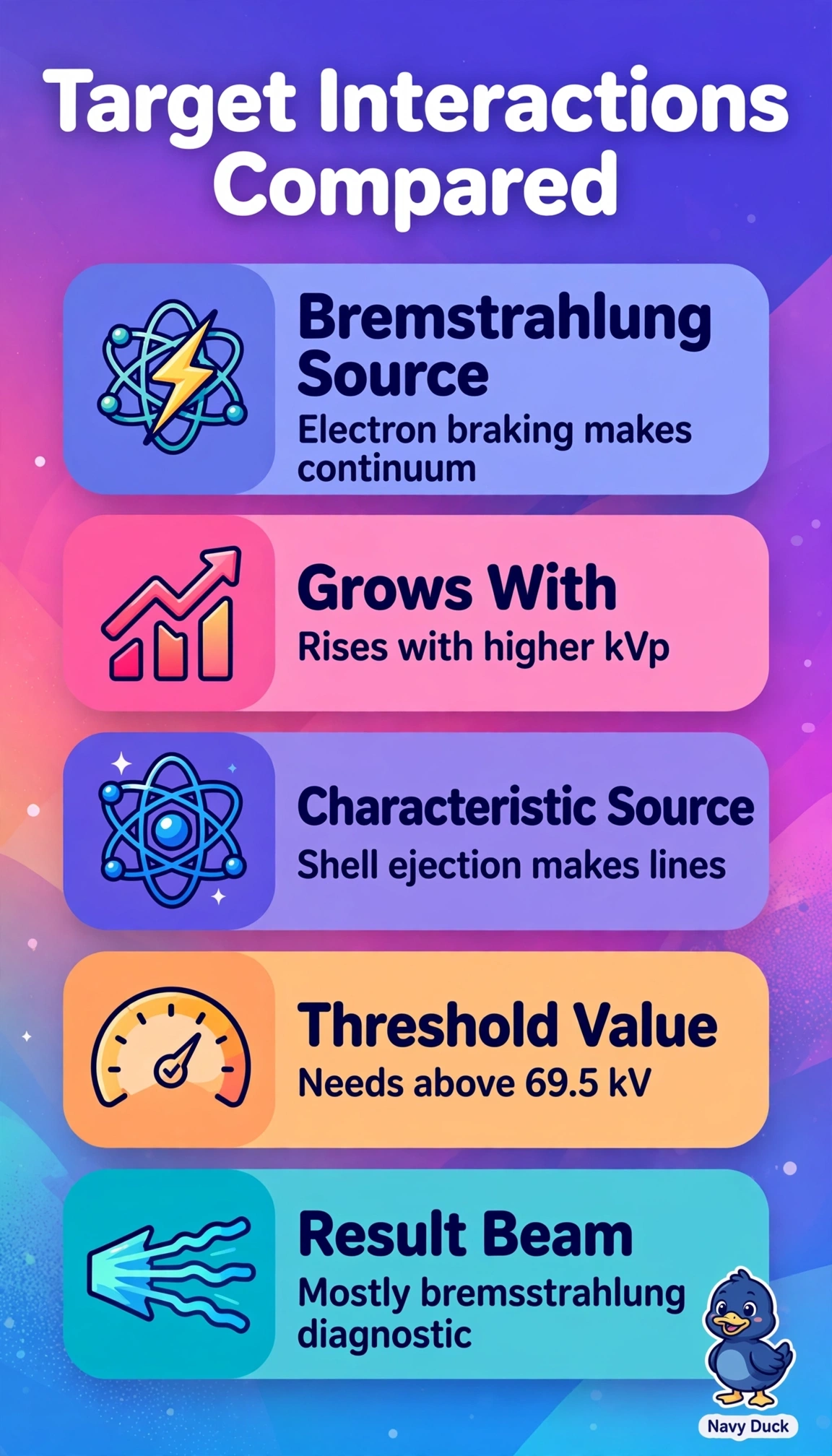
Short Explanation
You’re sorting braking radiation from shell signatures by voltage. Braking grows across the range, but tungsten K lines switch on only past threshold, which is why 85 beats 50.
Full Explanation
Bremsstrahlung arises when incident electrons are decelerated in the nuclear field and emit a continuous spectrum whose efficiency and maximum photon energy increase with kVp, while characteristic radiation requires incident electron energy to exceed the K-shell binding energy of tungsten at about 69.5 keV to eject a K electron and release discrete K lines upon outer-shell fill, so 50 kVp produces mainly bremsstrahlung and 85 kVp produces both with greater output. Stating characteristic dominates at both and bremsstrahlung needs the threshold reverses the physics despite using the correct number, because the threshold governs K-shell ejection, not braking radiation. Stating bremsstrahlung stops above threshold and characteristic falls with higher kVp inverts energy dependence despite acknowledging both mechanisms, because higher kVp increases both efficiency and the fraction exceeding binding energies. Stating both stay constant because mAs controls interactions confuses quantity with energy dependence despite correctly noting mAs affects number of electrons, because kVp controls electron energy and interaction probability. Exam caveat is that ARRT expects the tungsten K-edge value and that diagnostic beams contain mostly bremsstrahlung. Practical check is to recall threshold before predicting contrast, output and heat load changes with kVp.