
A radiography educator demonstrates technique changes on a phantom knee at 60 kVp versus 85 kVp using a tungsten target. Students notice contrast and output change but no new line spectra at low kVp. Which target interaction description correctly distinguishes bremsstrahlung and characteristic radiation for this demonstration?
Select an answer to reveal the explanation.
Short Explanation
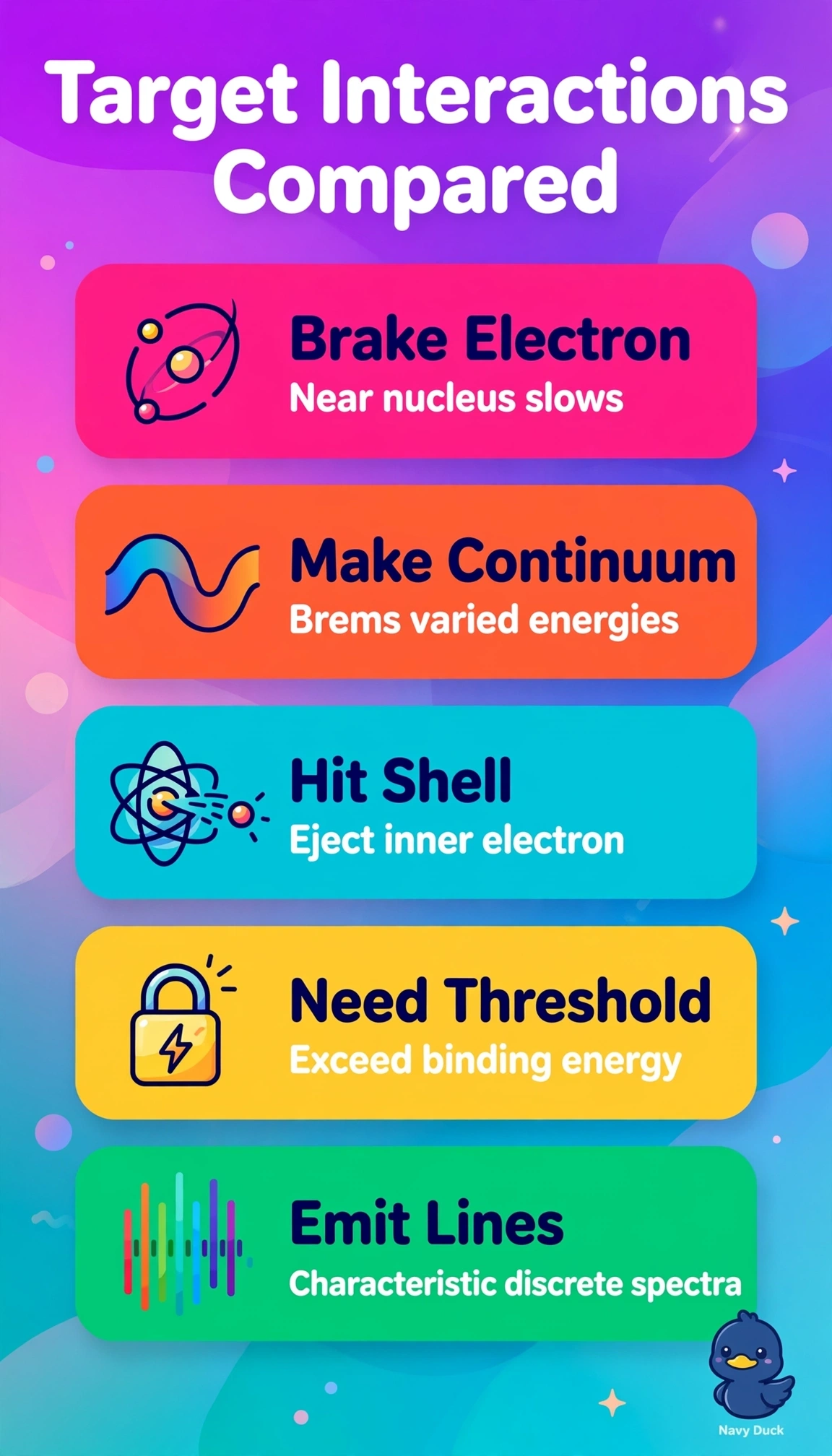
You nailed the split — braking versus knocking out. Threshold energy is your giveaway that characteristic x-rays can't happen until kVp is high enough.
Full Explanation
Bremsstrahlung arises when high-speed electrons pass near tungsten nuclei, are braked by nuclear attraction, and lose energy as a continuous spectrum of photons that increases with kVp, while characteristic radiation requires incident electron energy exceeding K-shell binding energy to eject an inner electron, with outer-shell drop filling the vacancy and emitting discrete line spectra. Distractor swapping definitions fails by mechanism because continuum cannot come from discrete shell transitions and lines cannot come from variable braking distances. Distractor claiming bremsstrahlung produces lines and characteristic produces only heat fails by output concept because most kinetic energy becomes heat in both cases but useful photons follow the braking-continuum and transition-line rules. Distractor attributing interactions to filament or focusing fails by location because both interactions occur in target atoms, not at cathode components. Exam caveat: associate higher kVp with more bremsstrahlung efficiency and crossing binding threshold with adding characteristic lines. Practical check: explain contrast loss at 85 kVp as increased bremsstrahlung continuum and Compton interactions.