
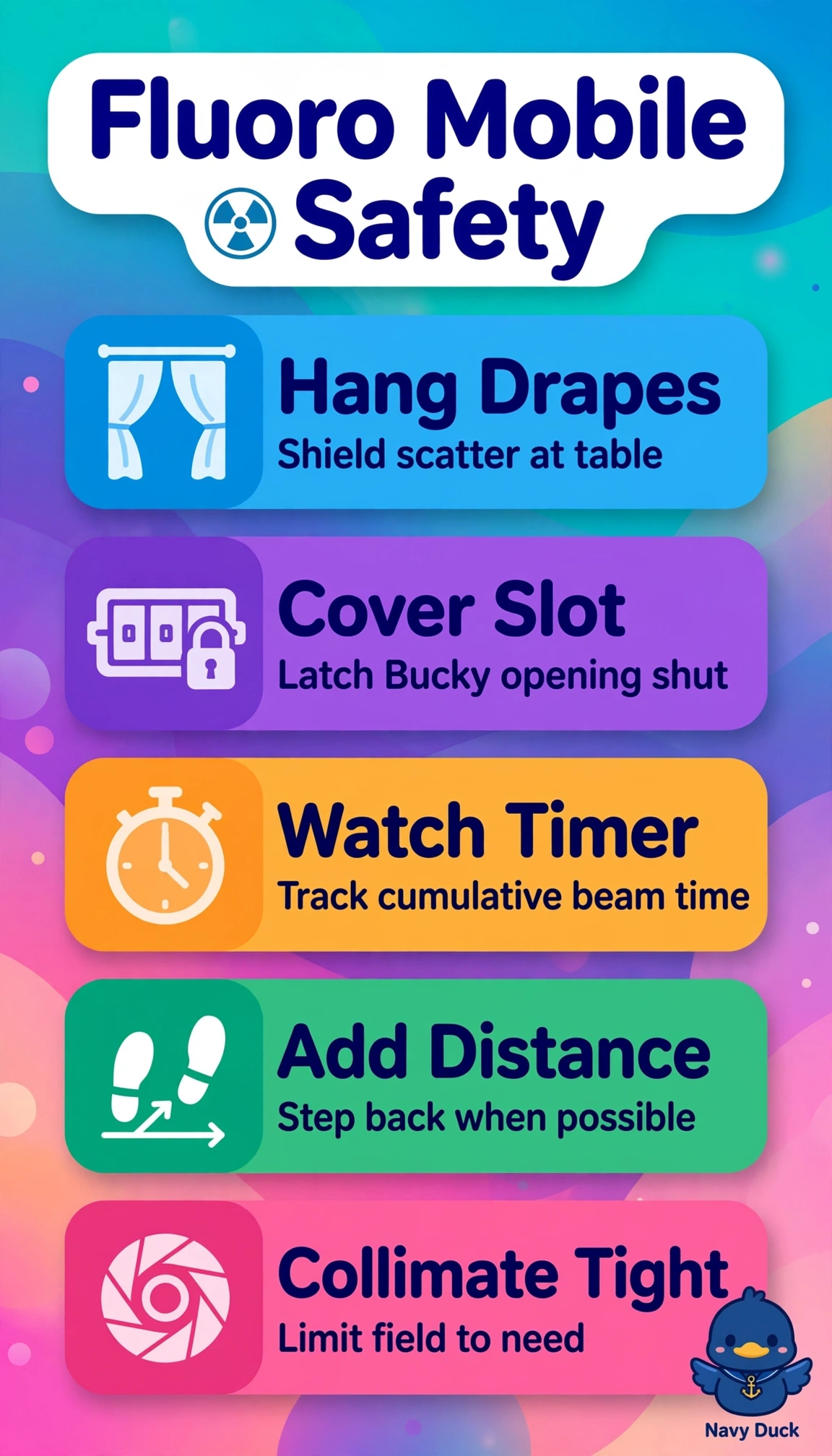
A mobile C-arm case in the operating room involves staff standing near the table without drapes placed, the Bucky slot open on a fluoroscopy tower, and a long procedure with no audible time cue. The technologist must enforce fluoroscopy and mobile safety. Which fluoroscopy and mobile unit safety control should the technologist implement with drapes, Bucky slot cover and timer?
Select an answer to reveal the explanation.
Short Explanation
You are the safety net when the beam stays on in a crowded room. Covering gaps and tracking minutes keeps scatter down, and disciplined timing beats rushing.
Full Explanation
The correct approach combines three complementary fluoroscopy protections: table-suspended protective drapes attenuate scatter to personnel working close to the patient, the closed Bucky slot cover blocks tube-housing and slot leakage during fluoroscopy, and the five-minute cumulative timer with audible alert and technique time-outs enforces deterministic skin-dose awareness on a prolonged mobile C-arm case. Fitting nearby staff with aprons and thyroid shields while closing the slot and watching the timer is routine personal protection but it fails by concept because aprons shield only the wearer and do not replace source-side drapes for scatter to uncovered lower legs and nearby hands when no drapes are placed. Tight collimation with scatter control plus drapes and timer is excellent dose practice but it fails by concept because no degree of beam restriction seals the open Bucky slot, which remains a leakage and scatter path whenever the cover is left open on a fluoroscopy tower. Using drapes with a closed slot while relying on last-image-hold, pulsed mode and image-count review is excellent exposure efficiency but it fails by concept because efficiency features do not provide the required cumulative time warning that triggers reassessment for skin injury. The exam caveat is to distinguish dose-rate displays, image counters and pulsed settings from the mandated cumulative timer function, which must be reset, audible and acted upon. A practical check is to confirm drapes overlap the table edge without gaps, visually and tactilely confirm the Bucky cover latched shut, and verify the timer is zeroed with audible alerts enabled and documented time-outs during the case.