
A 16-year-old female with scoliosis needs serial PA thoracic spine follow-up in your department. The physicist asks you to justify dose-efficient settings that keep growth plates protected while maintaining diagnostic vertebral endplate sharpness. Automatic exposure control chambers are available and calibrated. Which exposure factor strategy best minimizes patient dose while preserving diagnostic quality?
Select an answer to reveal the explanation.
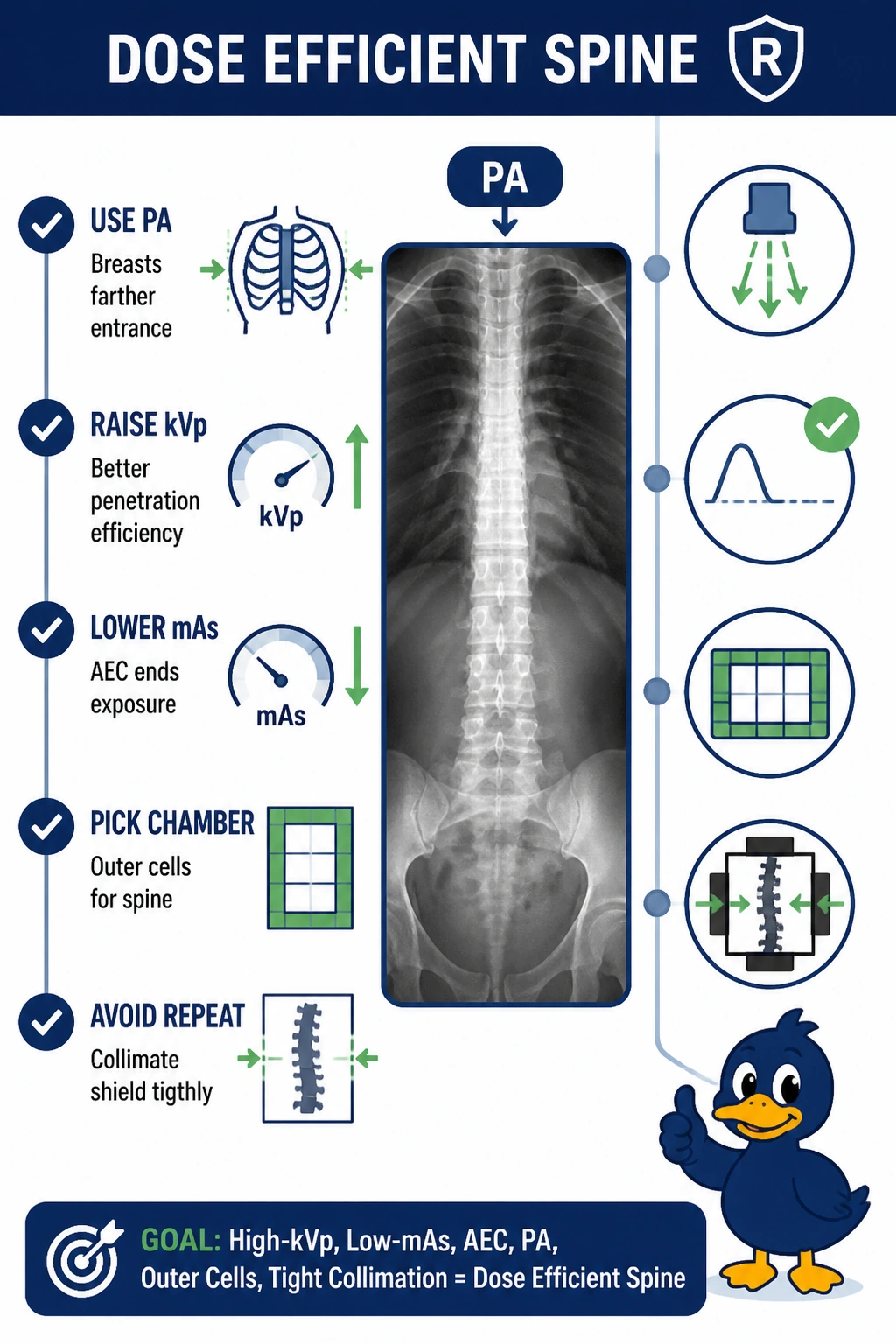
Short Explanation
You're stretching a small dose across a big area. High-kVp AEC pairs efficiency with consistency for growing spines.
Full Explanation
Correct strategy works because PA positioning places radiosensitive breast tissue on exit side and reduces magnification for scoliosis measurement, while high kVp improves penetration allowing much lower mAs and lower entrance dose, and calibrated AEC terminates exposure at required detector signal to maintain consistent density and sharp vertebral endplates across serial visits, limiting repeat exposures that would irradiate growth plates. Low-kVp high-mAs AEC with PA positioning fails on energy efficiency because increased photoelectric interaction demands higher mAs for penetration, raising patient dose despite good contrast and consistent AEC density, which is unjustified for repeated adolescent follow-up. High-kVp low-mAs AEC with AP positioning fails on radiosensitivity because anterior entrance exposes developing breast tissue to higher dose with no improvement in endplate detail, despite efficient factors and AEC consistency. High-kVp low-mAs manual exposure with PA positioning fails on reproducibility because preset time cannot adjust for habitus or positioning variation, causing noise that obscures endplates or overexposure that prompts repeats. Exam caveat is that high kVp lowers subject contrast so tight collimation and proper grid use must preserve endplate definition without raising mAs. Practical check is to select central AEC chambers, confirm exposure terminates within expected low-mAs range, and verify sharp endplate cortex on the monitor before dismissing the patient.