
A high-volume level 1 trauma center needs short, high-mA exposures for motion-free portable work without overheating tubes. The supervisor asks which generator design best supports rapid repeated exposures with stable output and lower tube loading. Which generator, transformer and rectification principle best explains phase and tube loading for this need?
Select an answer to reveal the explanation.
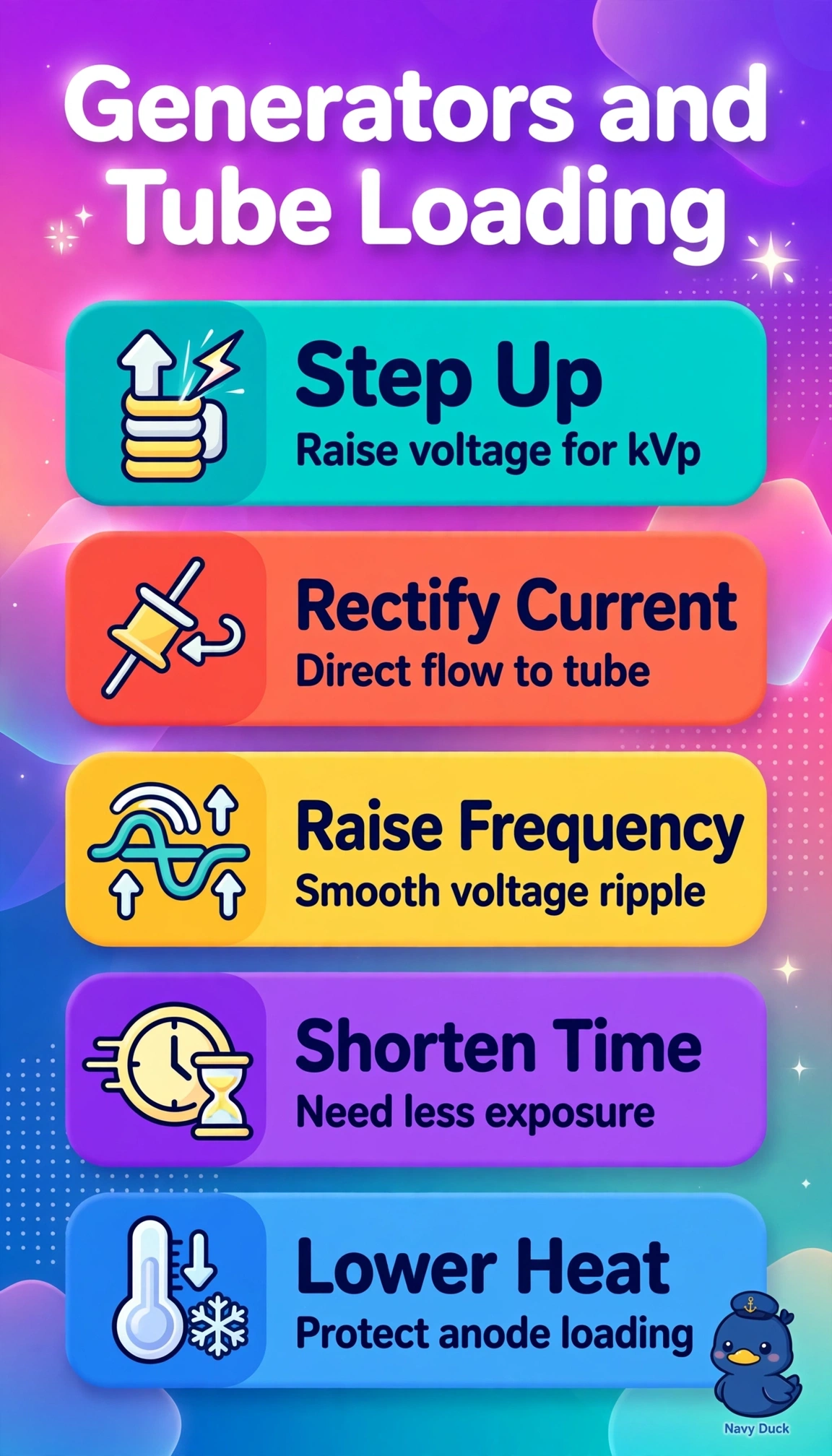
Short Explanation
You spotted that smoother power means faster shots. Less ripple equals near-constant voltage, so you've got more usable x-rays with less wasted heat.
Full Explanation
High-frequency generators use an inverter to convert mains to kilohertz frequencies before step-up transformation and full-wave rectification, producing near-constant potential with ripple under 5%, so effective kVp stays close to peak throughout exposure, allowing shorter exposure times at high mA for motion-free imaging while depositing fewer waste heat units in the anode and permitting rapid cooling and repeat exposures critical in high-volume trauma portable work. A three-phase twelve-pulse fixed installation also achieves low ripple and efficient high output for rapid sequences, but it depends on three-phase mains power with a large iron-core transformer and control cabinet, making it immobile and unsuitable for bedside portable demands where compact lightweight design matters. A capacitor-discharge mobile unit offers true cordless portability with short bursts from stored charge, yet kVp falls as the capacitor depletes during exposure, reducing output consistency and reproducibility and requiring recharge time that limits true rapid repetition. A single-phase full-wave rectified unit remains a reliable economical workhorse for routine general rooms, yet its substantially higher voltage ripple lowers average photon energy, forcing longer exposures to achieve density and increasing motion blur and anode heat accumulation under repeated high-mA loads. For exams, distinguish transformer function from rectification from inverter frequency and remember that lower ripple means higher effective energy, shorter time, and less heat, not merely higher kVp; practically, verify generator type on the console label, compare rated mA stations and shortest times, and consult anode cooling and housing heat-unit charts before scheduling back-to-back trauma portables.