
An ICU portable chest at 40-inch SID is slightly overexposed with adequate contrast. The surgeon requests a repeat at 72-inch SID to reduce magnification, using the same kVp, grid, and receptor. The patient cannot hold deep inspiration consistently. Which adjustment restores receptor exposure while preserving image contrast?
Select an answer to reveal the explanation.
Short Explanation
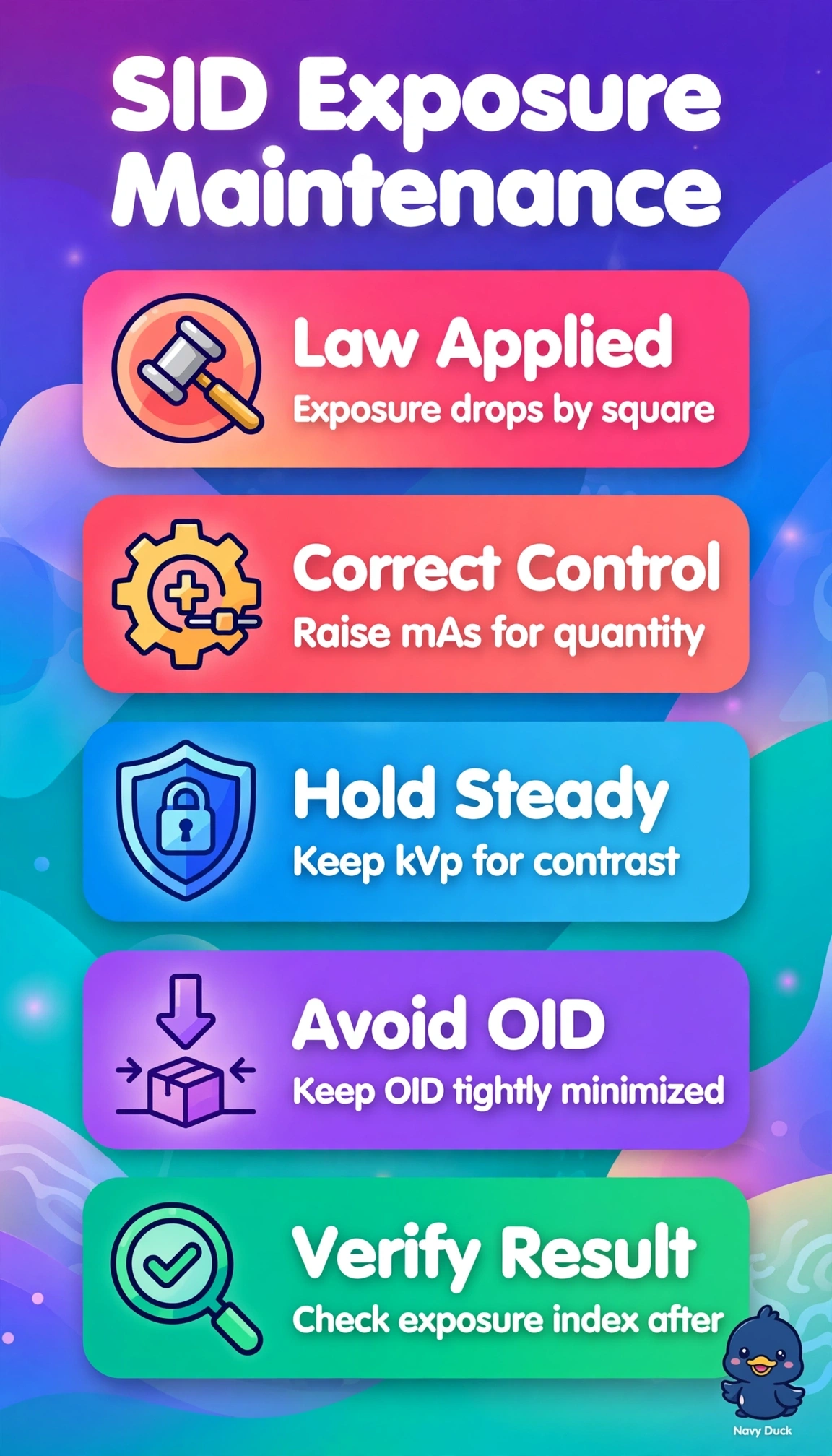
You’re keeping the look while fixing the brightness after moving back. Distance follows the inverse-square law, so only mAs raises quantity without reshaping contrast the way kVp does.
Full Explanation
Receptor exposure falls with the square of increasing SID by the inverse-square law, so moving from 40 to 72 inches requires mAs to increase by the square of the SID ratio to restore exposure, and holding kVp constant preserves the original scale of contrast and penetration because kVp controls beam quality. Increasing kVp by fifteen percent changes beam penetrability and reduces contrast while increasing exposure unpredictably, so it fails by altering quality despite increasing exposure, and the fifteen-percent rule changes contrast. Decreasing mAs with increased SID compounds underexposure and increasing OID adds magnification and blur, so it fails by moving both exposure and geometry in the wrong direction despite addressing SID. Keeping factors constant while opening collimation does not compensate for distance and adds scatter and fog while increasing patient dose area, so it fails by confusing field size with exposure maintenance. Exam caveat is that ARRT expects mAs for exposure maintenance and kVp for contrast control, with SID compensation calculated by the square law. Practical check is to calculate the new mAs, keep kVp identical, and verify the exposure index after the repeat.