
A department is replacing an old single-phase radiographic unit with a three-phase, high-frequency unit in a high-volume trauma room requiring short exposures and heavy tube use. The technologists ask why the new unit handles heat better and allows higher mA. Which generator characteristic best explains improved tube loading with multiphase operation?
Select an answer to reveal the explanation.
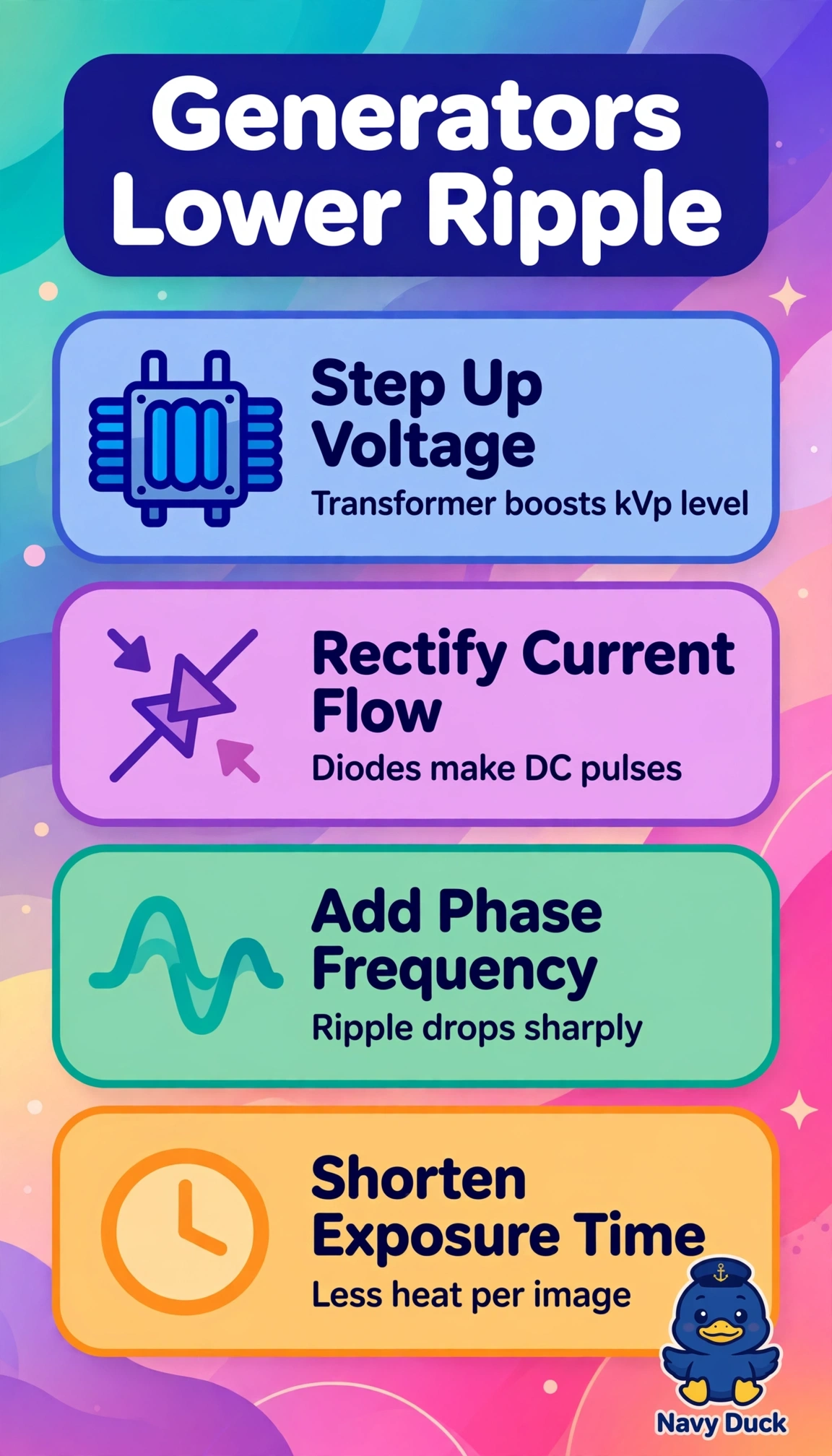
Short Explanation
You are smoothing bumpy power into a steady stream. Less ripple means more useful x-rays per second, so exposures get shorter and the tube stays cooler.
Full Explanation
Multiphase and high-frequency operation full-wave rectifies overlapping pulses to reduce voltage ripple from nearly 100% in single-phase to about 13% in three-phase and less than 5% in high-frequency units, so average photon energy stays closer to peak kVp and more useful x-rays are produced per mAs, allowing the timer to terminate earlier at higher effective mA with fewer heat units deposited for the same detector dose, which directly explains heavier consecutive trauma loading without overheating. Upgrading to a high-speed rotating anode is a legitimate tube-side method to spread focal-track heating and increase anode heat capacity for rapid sequences, but it describes anode construction rather than the generator waveform advantage asked for here. Using falling-load control is also standard practice to hold the anode at its thermal limit by starting at maximum safe mA and dropping during exposure to shorten time, yet it is a separate exposure-control logic and does not explain why multiphase voltage is intrinsically more efficient than single-phase voltage. Raising filament current legitimately increases space-charge-limited tube current to permit short high-mA exposures, but emission alone does not raise effective beam energy or reduce ripple-related wasted heat, so the same tube would still be less efficient on a high-ripple generator. Examination caveat is to distinguish current availability from voltage efficiency, since questions about phase, frequency and ripple test kVp constancy and heat per useful output rather than filament or anode ratings. Practical check is to verify the technique chart after conversion, confirm shorter times at equivalent or higher kVp and mA, and monitor housing heat-unit display and cooling curves during heavy trauma use to confirm reduced heat accumulation.