
A 28-year-old warehouse worker fell onto the left side and has focal tenderness over the left lateral 9th-10th ribs. The patient can stand upright but cannot raise the left arm overhead due to pain. The physician suspects a lower axillary rib injury without pneumothorax. Which rib projection protocol best demonstrates the suspected lower rib injury?
Select an answer to reveal the explanation.
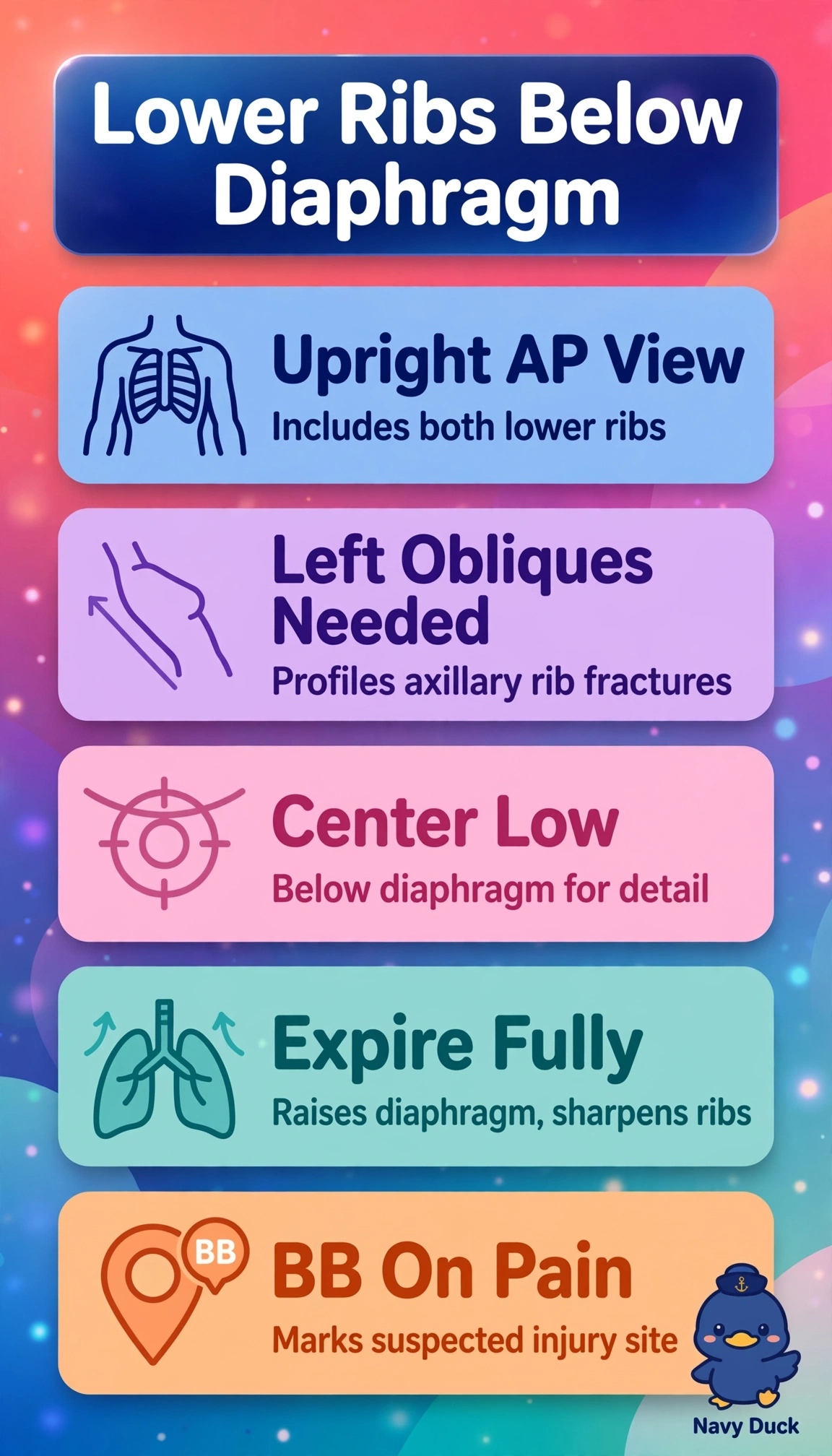
Short Explanation
You’ll want the lower ribs shown low and still. Expiration raises the diaphragm, placing the injured ribs against more uniform abdominal density.
Full Explanation
Ribs 8–12 lie below the diaphragm and are best demonstrated on expiration, which raises the diaphragm so the lower ribs are seen against more uniform abdominal density. Upright AP and left oblique views centered below the diaphragm on expiration, with a BB over the focal pain, include the area of interest and correlate the anatomy with symptoms. Centering those views below the diaphragm on inspiration fails because inspiration lowers the diaphragm and aerates the lungs; this is better for upper ribs 1–7 and leaves the 9th–10th ribs at mixed lung and abdominal density. Centering upright AP and left oblique views above the diaphragm on expiration fails because the high centering may include upper axillary ribs and clavicle while excluding the suspected 9th–10th rib region. A PA chest and left lateral rib views centered at the diaphragm on inspiration without a marker fail because chest technique emphasizes lung parenchyma and mediastinum, not tangential rib profiles and marker correlation for a nondisplaced fracture. Exam caveat: expect below-diaphragm ribs on expiration and above-diaphragm ribs on inspiration, with posterior obliques for the side of interest. Practical check: confirm the BB is over maximal tenderness, the diaphragm is raised, and there is no motion before releasing the patient.