
During annual quality control in a busy fluoroscopy suite, you gather all lead aprons and thyroid shields for inspection. Recent fluoroscopy images show faint edge artifacts and one apron feels thin at the waist. Overhead lights work and exposure indicators are normal. Which quality control action best evaluates lead apron and glove integrity for continued use?
Select an answer to reveal the explanation.
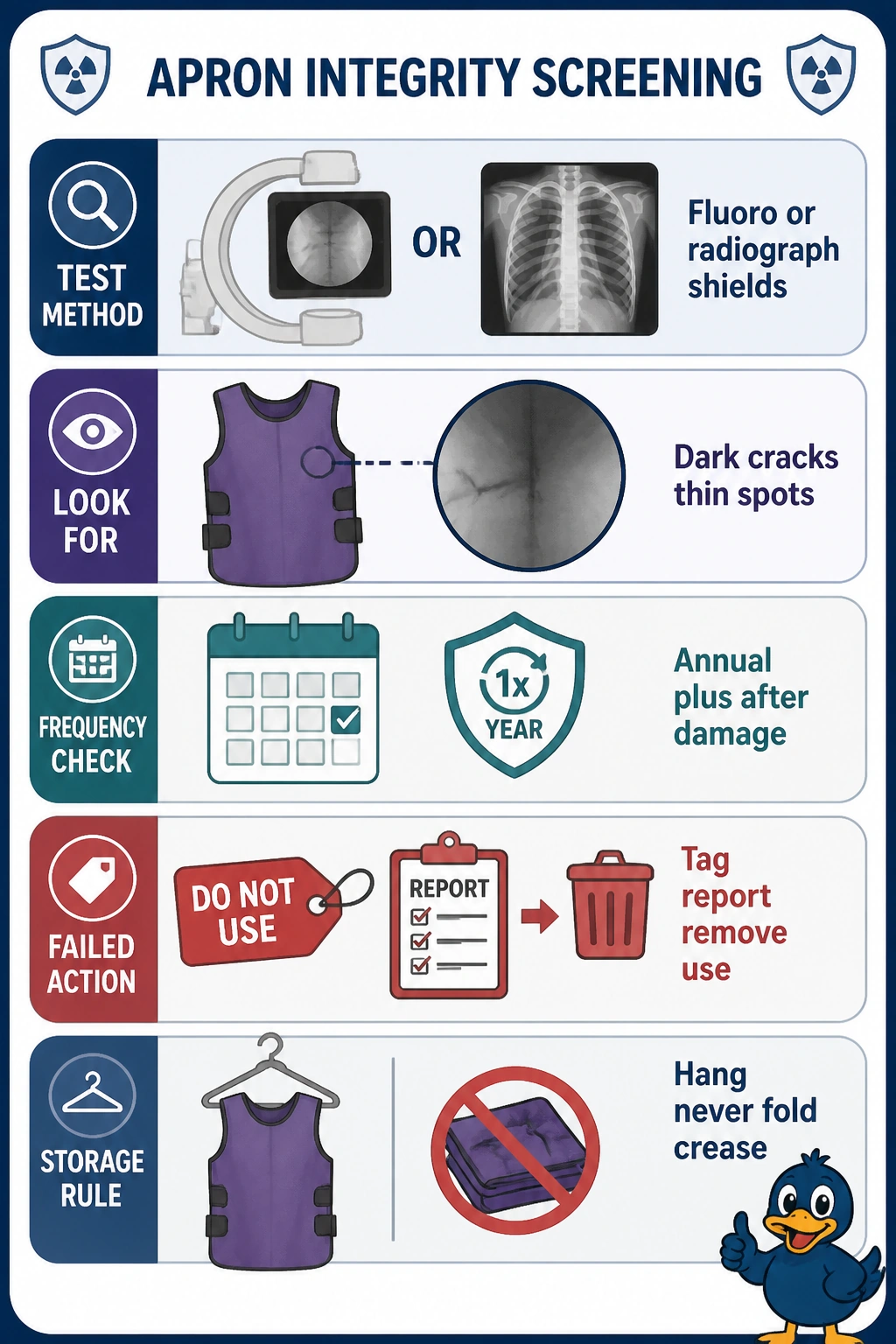
Short Explanation
You're hunting invisible cracks, so you need to see through the cover. Fluoroscopic screening reveals thinning and defects you can't feel.
Full Explanation
Annual quality control requires direct visualization of the internal lead attenuating layer because faint edge artifacts and focal thinning suggest cracked or displaced shielding that cannot be confirmed externally, and fluoroscopic or radiographic inspection reveals lucent fissures, holes, and seam defects allowing objective pass, repair, or reject tagging for continued use. Visual and tactile palpation assessment is an essential routine step for detecting outer fabric tears, stitching failure, and palpable thinning that prompts further testing and cleaning, yet surface examination alone cannot confirm or exclude internal cracks and therefore does not satisfy the integrity evaluation. Inventory audit of labeled lead equivalence and sizing supports regulatory documentation, traceability, and correct selection of 0.25, 0.35, or 0.5 mm protection, yet verifying labels and records does not test physical condition and misses the stated concern for damage. Personnel dosimetry trend review is vital for monitoring occupational exposure and ALARA compliance during fluoroscopy, yet badge readings reflect cumulative staff dose under normal exposure indicators and cannot localize apron defects or certify a specific garment. An exam caveat is that normal overhead lights and exposure indicators do not rule out shielding failure, so questions mentioning artifacts plus thinning point to imaging inspection rather than administrative checks. A practical check is to hang each apron and thyroid shield flat without folding, image the full area including waist, seams, and thyroid region, and immediately tag any cracked garment for repair while documenting results for the annual QC log.