
A technologist repeats a bedside chest radiograph and must double the SID from 40 to 80 inches to reduce magnification, but needs to maintain the original receptor exposure without changing kVp or patient contrast. The exposure was 10 mAs at the shorter distance with acceptable density. Which mAs adjustment compensates for the SID change to preserve receptor exposure?
Select an answer to reveal the explanation.
Short Explanation
You are wrestling with the inverse-square law here. Exposure falls fast with distance, so doubling SID needs four times the mAs like turning up a hose.
Full Explanation
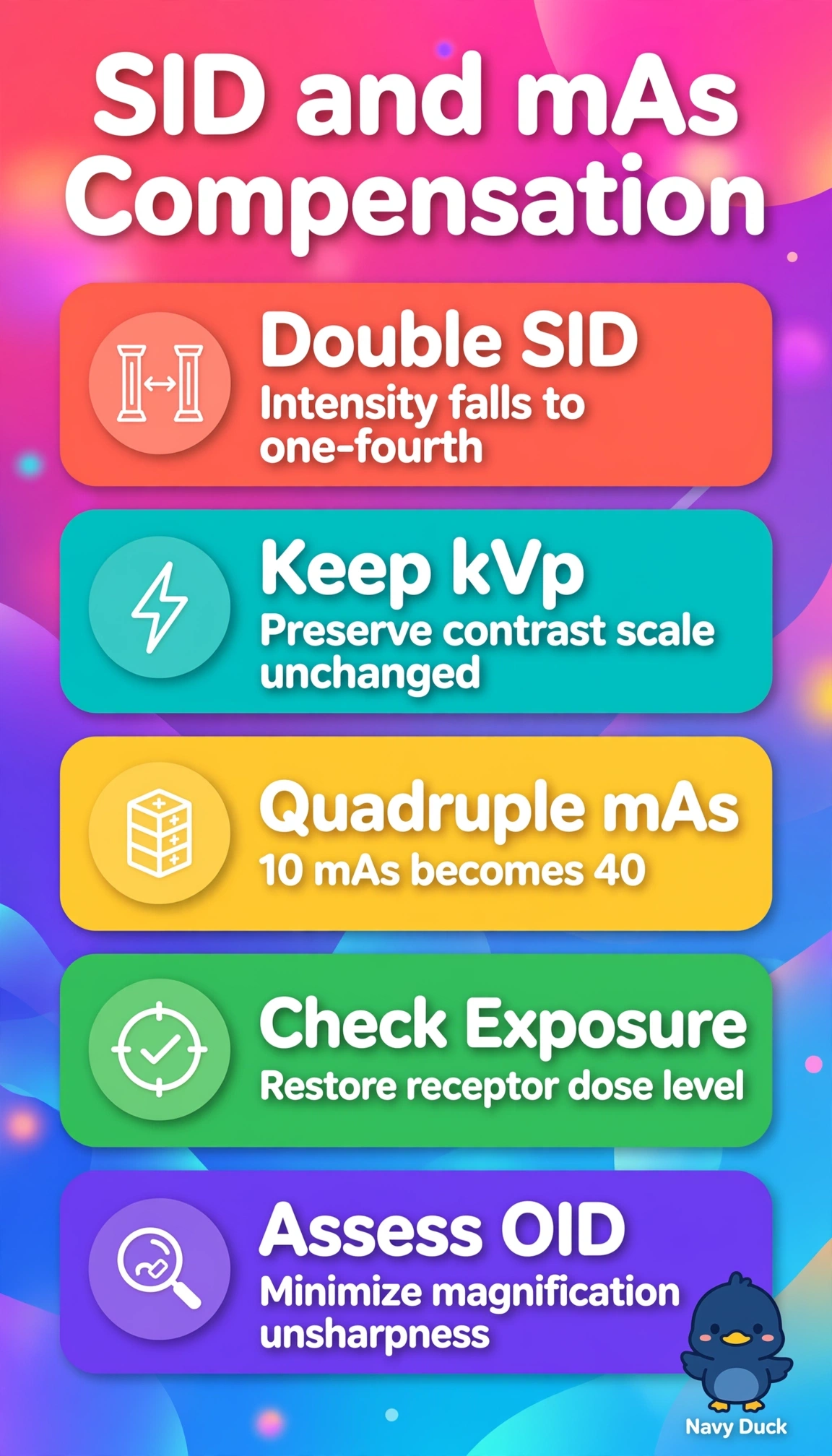
Radiation intensity follows the inverse square law, so doubling SID from 40 to 80 inches reduces intensity to one-fourth at the receptor, requiring four times the mAs to restore exposure if kVp, filtration, and all else remain constant, which means 10 mAs becomes 40 mAs and preserves density without altering kVp-dependent contrast. Increasing to only 20 mAs applies the direct linear rule for doubling distance and would leave the image underexposed by half because it ignores the squared relationship. Decreasing to 5 mAs or maintaining 10 mAs further reduces photons reaching the receptor and produces excessive quantum mottle and darkroom or digital underexposure that cannot be fixed by windowing without noise. For the exam, remember mAs controls quantity and receptor exposure linearly while kVp controls quality, penetration, and scale of contrast, and SID changes demand square-law compensation while OID primarily affects magnification and sharpness, then practically verify the new mAs against the technique chart before exposing.