
During morning tube warm-up a student asks why no x-rays are made until exposure factors are applied. The filament circuit is on low heat, the focusing cup is intact, the rotor is spinning, and no kVp is applied across the tube. Which electron sequence describes thermionic emission through deceleration during exposure?
Select an answer to reveal the explanation.
Short Explanation
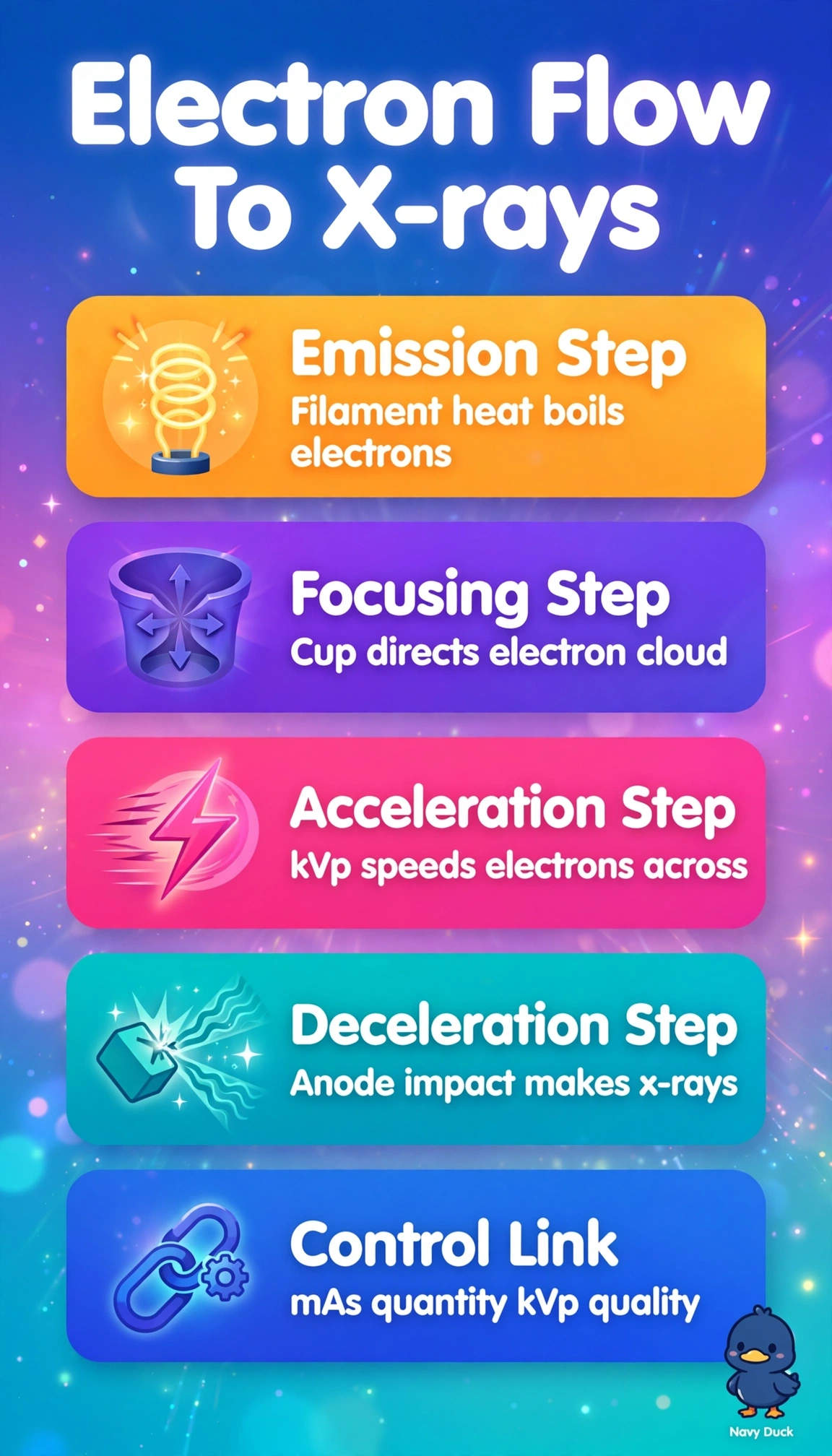
You’re tracing electrons from boil-off to sudden stop, and order matters for the test. Heat frees them, the cup steers them, voltage speeds them, and the anode creates deceleration that yields x-rays.
Full Explanation
Thermionic emission occurs when filament current heats the filament and boils off electrons into a space-charge cloud, the negatively charged focusing cup electrostatically confines and directs that cloud toward the anode focal spot, tube kVp applied across cathode to anode creates the potential difference that accelerates electrons at high velocity, and sudden deceleration and interaction at the tungsten target converts kinetic energy into heat and x-ray photons. The distractor swapping cup and kVp functions fails by misassigning focusing versus acceleration despite correctly stating emission and deceleration, because voltage drives speed while cup geometry drives aim. The distractor stating kVp heats the filament and the cup emits electrons fails by reversing cathode roles and impact site despite using correct vocabulary, because filament current controls heat and the anode is the deceleration target. The distractor scrambling release, acceleration and focusing fails by disordering cause and effect despite mentioning all components, because emission must precede focusing and acceleration. Exam caveat is that ARRT separates filament mA and tube kVp controls, so link mAs to quantity via emission and kVp to quality via acceleration. Practical check is to confirm filament warm-up, rotor spin, then select kVp before initiating exposure.