
A busy emergency department acquires a portable AP chest on a febrile adult in isolation. The image shows a faint repeating grid-like pattern, reduced contrast, and a correctly placed right marker but the lead marker is near the edge and partially clipped. A repeat is requested. Which assessment correctly addresses identification markers and image artifacts for this portable chest?
Select an answer to reveal the explanation.
Short Explanation
Sharp eyes—you’ve spotted a classic detector–grid clash, not motion. Your marker duty is identification accuracy, so keep the lead marker fully visible and never fix clipping later.
Full Explanation
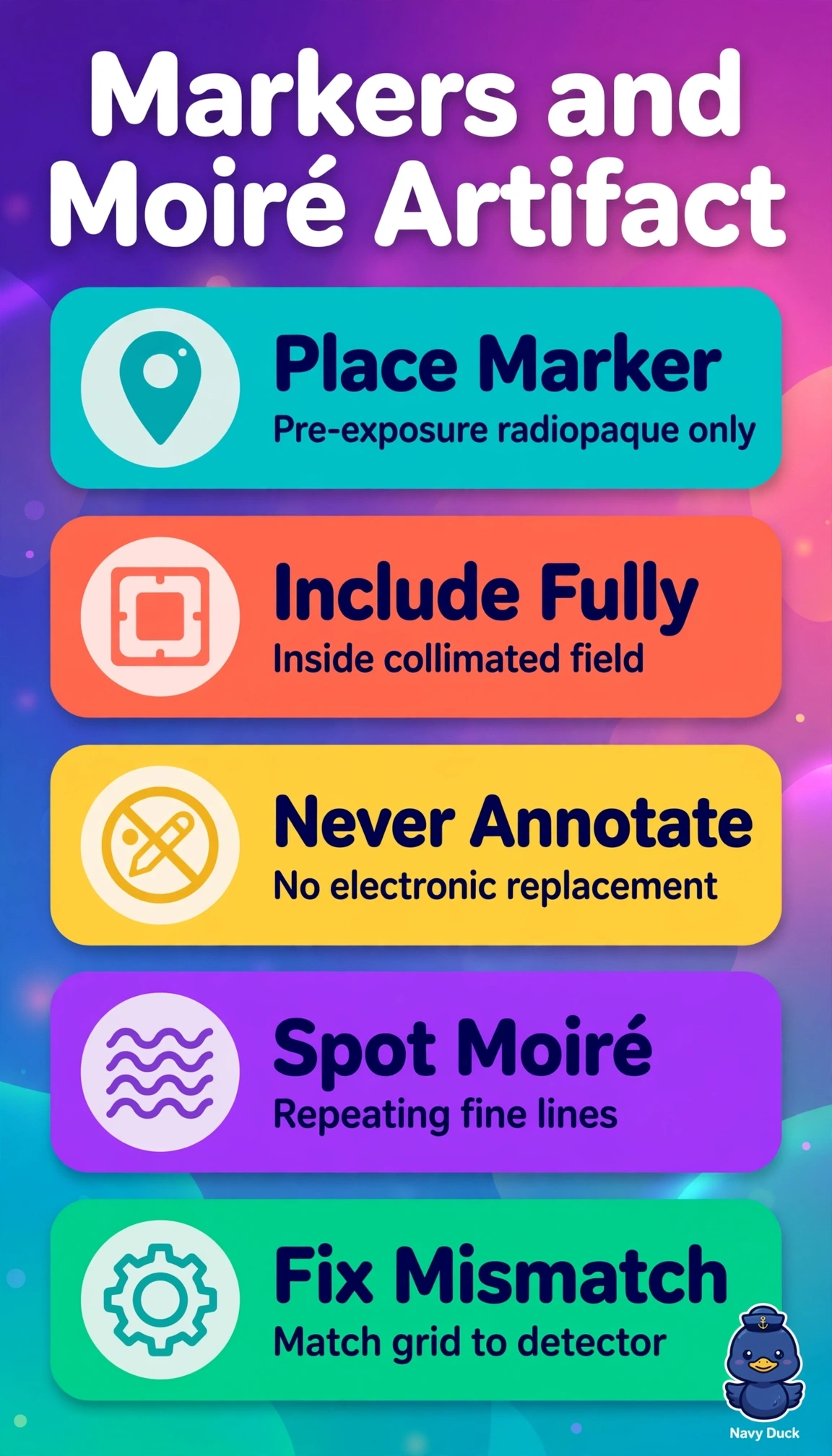
The correct assessment identifies two separate issues for the repeat. A physical lead right marker that is legible and correctly sided but partially clipped at the collimation edge does not meet identification standards: it must be fully included within the exposed field, without cutoff or overlap, and cannot be repaired by electronic annotation. Reposition it fully inside the collimated field on repeat. The faint repeating geometric pattern with reduced contrast is classic moiré aliasing, caused by interference between a stationary line grid and the detector matrix when grid frequency does not match detector sampling. Increased scatter from omitting a grid can create diffuse fog and reduce contrast, but it does not produce a regular repeating pattern. Treating a clipped marker as diagnostic despite its correct side and legibility fails because complete marker inclusion is required for medicolegal documentation. Off-center portable tube alignment can cause grid cutoff, with peripheral underexposure and density loss, rather than fine periodic interference. An exam caveat: isolation portable cases may tempt you to rely on electronic markers or post-processing to avoid a repeat, but an intact lead marker must be present in the original exposure. Before repeating, place a fully visible right lead marker well inside the light field, check grid-to-detector compatibility or remove the mismatched grid per protocol, and use tight but inclusive collimation.