
A 45-year-old adult in the emergency department is ordered an upright PA chest for dyspnea. She stands facing the receptor with weight evenly distributed, chin extended, mid-sagittal plane perpendicular to the receptor and midcoronal plane parallel to it, with the central ray horizontal. Which positioning statement correctly describes topographic plane alignment and central ray path for this PA chest?
Select an answer to reveal the explanation.
Short Explanation
You nailed the orientation puzzle here! PA means back-to-tube, so the midcoronal plane stays parallel while the ray dives posterior to anterior.
Full Explanation
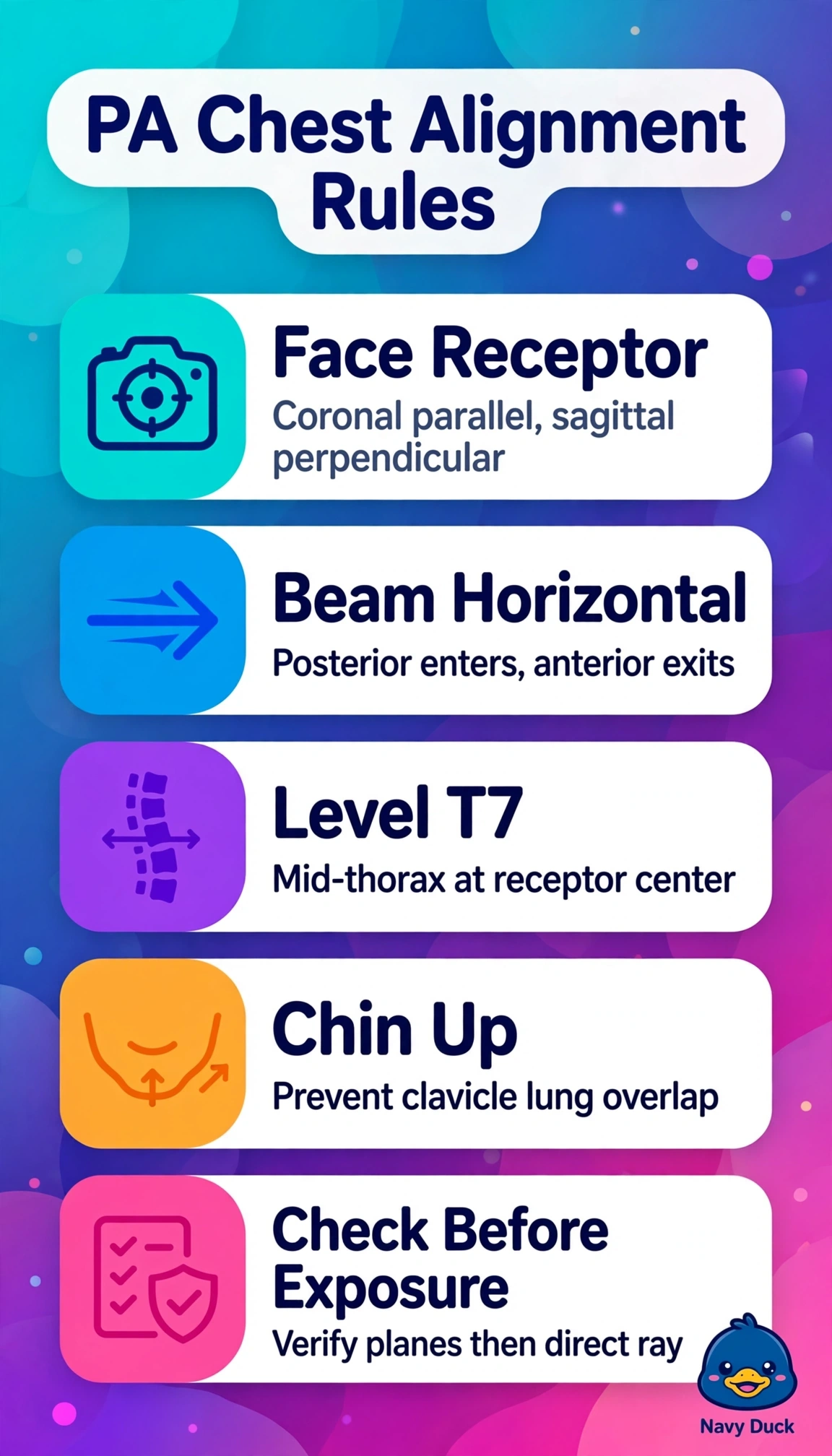
For an upright PA chest the patient faces the receptor so the midcoronal plane is parallel to the receptor and the midsagittal plane is perpendicular to it, with a horizontal central ray directed posterior to anterior to the level of T7 to place the heart closer to the receptor and minimize magnification. Aligning the midcoronal plane parallel with posterior entry at T7 satisfies both the body position and central ray path requirements for a true PA projection. Aligning the midsagittal plane parallel describes a lateral position and would misrepresent the planes while also reversing the geometry, and aligning the midcoronal plane parallel but with anterior entry describes an AP projection which magnifies the heart and reverses the required ray direction. Using the transverse plane parallel with a vertical ray describes axial or supine geometry and violates the upright horizontal-beam requirement as well as the plane orientation. Exam caveat is to link PA with posterior entry plus coronal parallel and AP with anterior entry, and practically check chin up, shoulders rolled forward, and the ray horizontal at T7 before exposure.