
An 18-year-old soccer player has a suspected eversion injury in the ED with swelling but no fracture on AP and lateral ankle views. The physician orders a mortise view to assess the tibiotalar joint space and needs it open and symmetric. Which positioning maneuver best produces the mortise projection for tibiotalar assessment?
Select an answer to reveal the explanation.
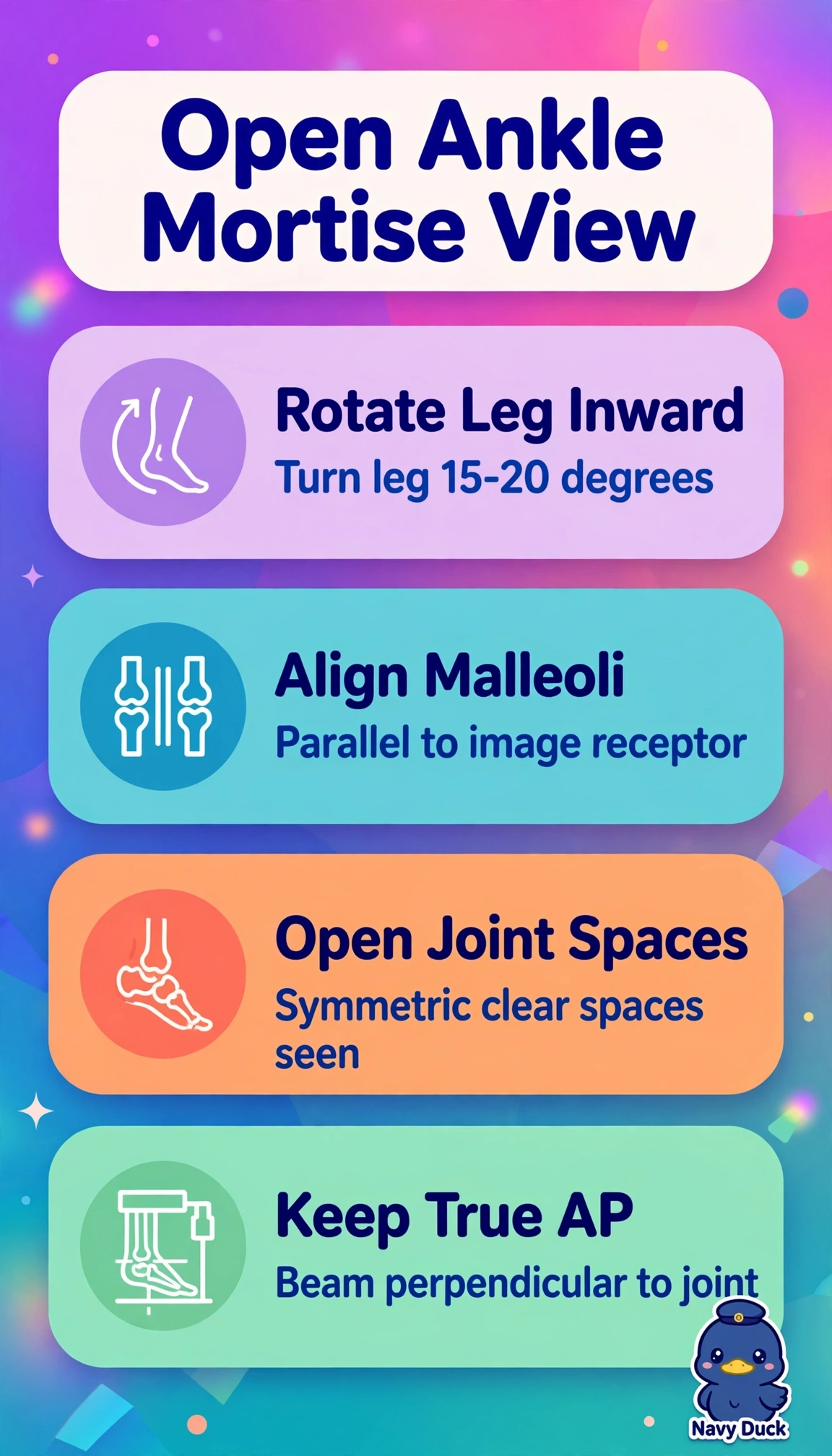
Short Explanation
You are opening a tricky mortise lock with a slight inward twist. Rotating the mortise 15 to 20 degrees medially lines up the malleoli and pops that joint space open evenly.
Full Explanation
The mortise view requires internal rotation of the leg 15 to 20 degrees from true AP so the intermalleolar line becomes parallel to the image receptor, which places the talus symmetrically beneath the tibial plafond and opens the medial and lateral clear spaces for evaluation of ligament injury or diastasis. Keeping the foot in neutral AP leaves the fibula overlapping the talus and closes the mortise, so the joint spaces cannot be judged symmetric even though centering and CR angle are correct. Externally rotating 45 degrees creates an AP oblique that profiles the tibiofibular joint but asymmetrically widens one side and narrows the other, defeating assessment of uniform joint space. Dorsiflexing with cephalad angulation describes an AP axial ankle projection which shows the articular surface but does not correct for rotation, so overlap persists and the mortise remains closed. Exam caveat: ARRT expects mortise equals AP with 15-20 degrees medial rotation, not a separate oblique, and weight-bearing mortise uses the same rotation while standing. Practical check: palpate both malleoli and adjust rotation until they feel equidistant from the cassette before exposing.