
A busy portable ward has a technologist doing morning chest rounds with a lead apron available and a mobile barrier nearby. The workload requires staying near the exposure area for positioning, and the supervisor asks about best personnel protection. Which personnel protection principle should the technologist prioritize for time, distance and shielding with apron and barrier use?
Select an answer to reveal the explanation.
Short Explanation
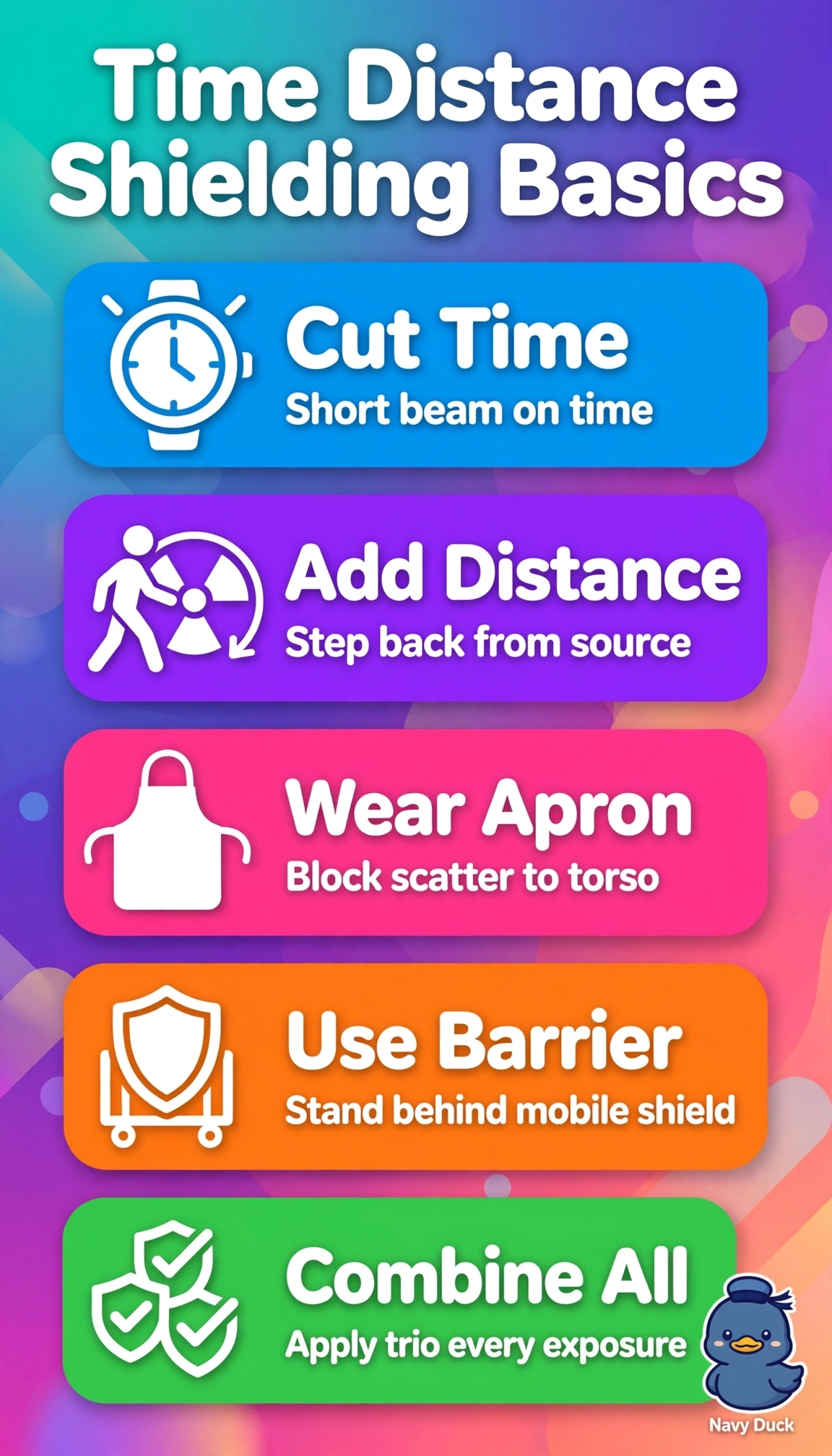
You are juggling all three protectors at once in that hallway. Distance and less beam time do heavy lifting, with shielding as backup, like layers of sunscreen and shade and shielding.
Full Explanation
The correct principle integrates all three personnel protection pillars because portable morning rounds involve repeated scatter exposure where cumulative dose matters, so minimizing beam-on time through proper technique and avoiding repeats limits total output, maximizing distance leverages the inverse square law to sharply reduce exposure rate, and using the mobile barrier or lead apron attenuates residual scatter when brief proximity for positioning cannot be avoided. One distractor correctly uses distance and shielding but accepts extra exposures to perfect positioning, which fails on time because each repeat creates additional primary output and scatter that increases personnel dose even with good shielding and positioning. Another distractor correctly uses short exposure time and apron shielding while remaining at the bedside for workflow, which fails on distance because closeness to the patient as the scatter source greatly raises dose rate that time reduction and aprons alone cannot fully offset. The remaining distractor correctly uses short time and stepped-back distance while relying on distance alone, which fails on shielding because the scenario explicitly makes apron and barrier available and best practice requires using available shielding rather than omitting it as redundant. An exam caveat is to distinguish personnel protection from patient protection, so focus on operator time, occupancy distance, and protective devices rather than being drawn to technique factors like kVp or collimation alone when the stem asks about staff safety. A practical check is to inspect the apron, position the mobile barrier between operator and bed, preset technique, announce the exposure, then step back to the full cord length during beam-on while wearing shielding.