
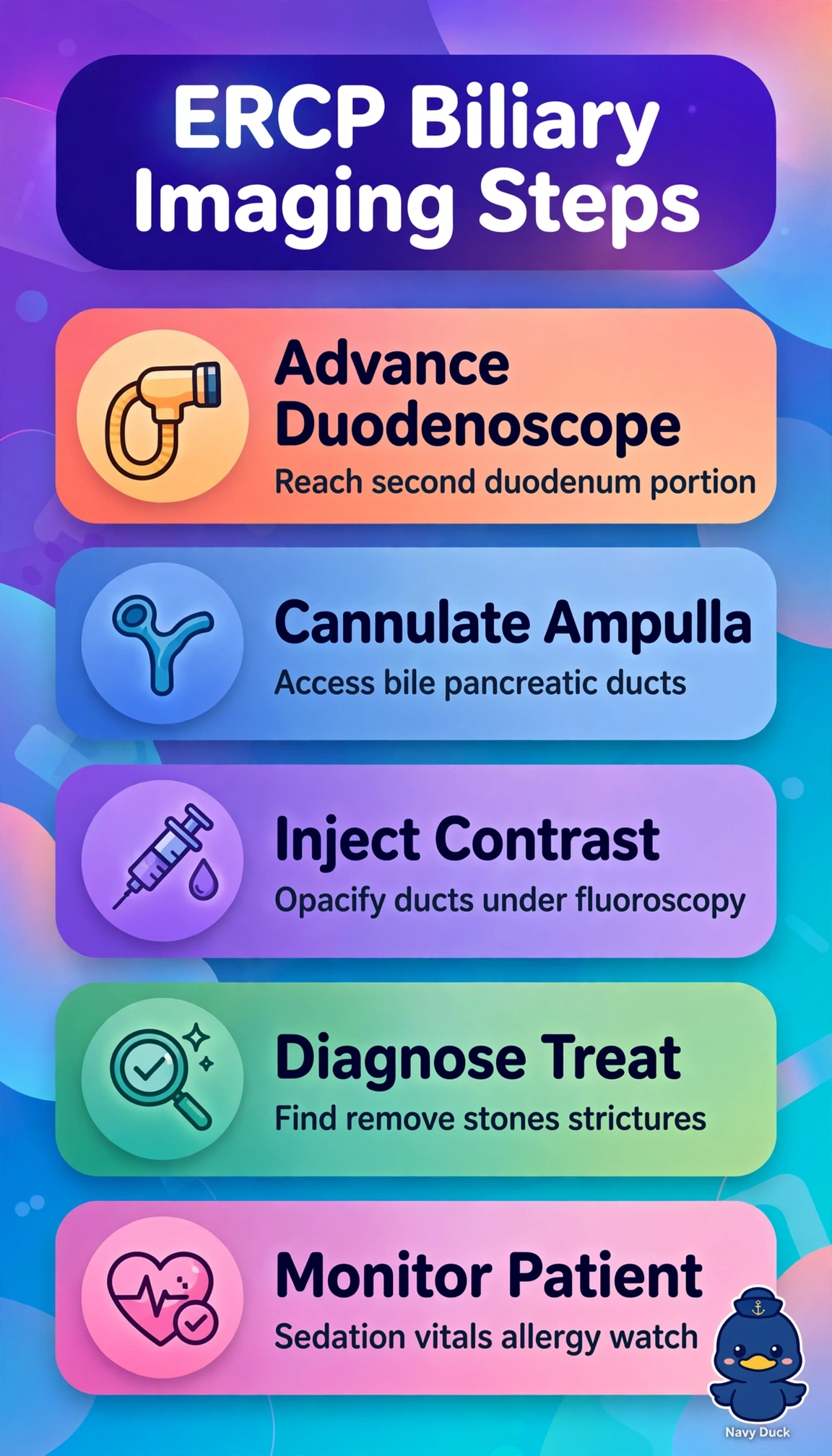
An adult with obstructive jaundice and suspected common bile duct stones is scheduled in a GI suite where a duodenoscope is advanced to the ampulla and contrast is injected under fluoroscopy to opacify the biliary and pancreatic ducts for diagnosis and stone removal. Which fluoroscopic biliary procedure uses endoscopic cannulation to visualize the ducts?
Select an answer to reveal the explanation.
Short Explanation
You nailed the clue when you spot the scope at the ampulla. ERCP blends endoscopy with fluoro to fill and treat the biliary tree like snaking a drain while watching it.
Full Explanation
ERCP is correct because side-viewing duodenoscopy to the ampulla with selective papillary cannulation and fluoroscopic contrast injection opacifies biliary and pancreatic ducts, permitting diagnosis of obstructive jaundice from choledocholithiasis plus sphincterotomy and stone extraction in the GI suite. Percutaneous transhepatic cholangiography fails by access because despite fluoroscopic contrast delineation of obstruction and drainage capability, entry is via transhepatic liver puncture from interventional radiology rather than retrograde endoscopic ampullary cannulation, used when ERCP is impossible or anatomy is altered. Intraoperative cholangiography fails by context because although fluoroscopic cystic duct contrast visualizes the common bile duct, it occurs during cholecystectomy in the operating room via surgical cannulation, not endoscopic ampullary cannulation in the GI suite, without endoscopic therapy. Endoscopic ultrasound fails by modality because echoendoscope advancement to the duodenum accurately detects bile duct stones but uses high-frequency ultrasound rather than fluoroscopic contrast opacification and provides no sphincterotomy or cholangiopancreatography. Exam caveat is to anchor on duodenoscope to ampulla plus fluoroscopic contrast plus therapy to select ERCP over ultrasound, percutaneous, or surgical imaging. Practical check is to confirm indication, fluoroscopy, duodenoscope, cannulation tools, contrast, antibiotics, and monitoring for pancreatitis, bleeding, or perforation.