
A 24-year-old outpatient presents for a lateral elbow after a fall, immobilized at 90 degrees flexion. The image shows the joint space, radial head free of coronoid overlap, but humeral epicondyles are not superimposed and the capitulum appears elongated. Central ray was angled slightly. Which evaluation confirms positioning accuracy and tube-part-receptor alignment for the lateral elbow?
Select an answer to reveal the explanation.
Short Explanation
You nailed the clue — elongation screams tube angle trouble, not patient motion. A true lateral lives or dies on superimposition, like stacking two coins perfectly.
Full Explanation
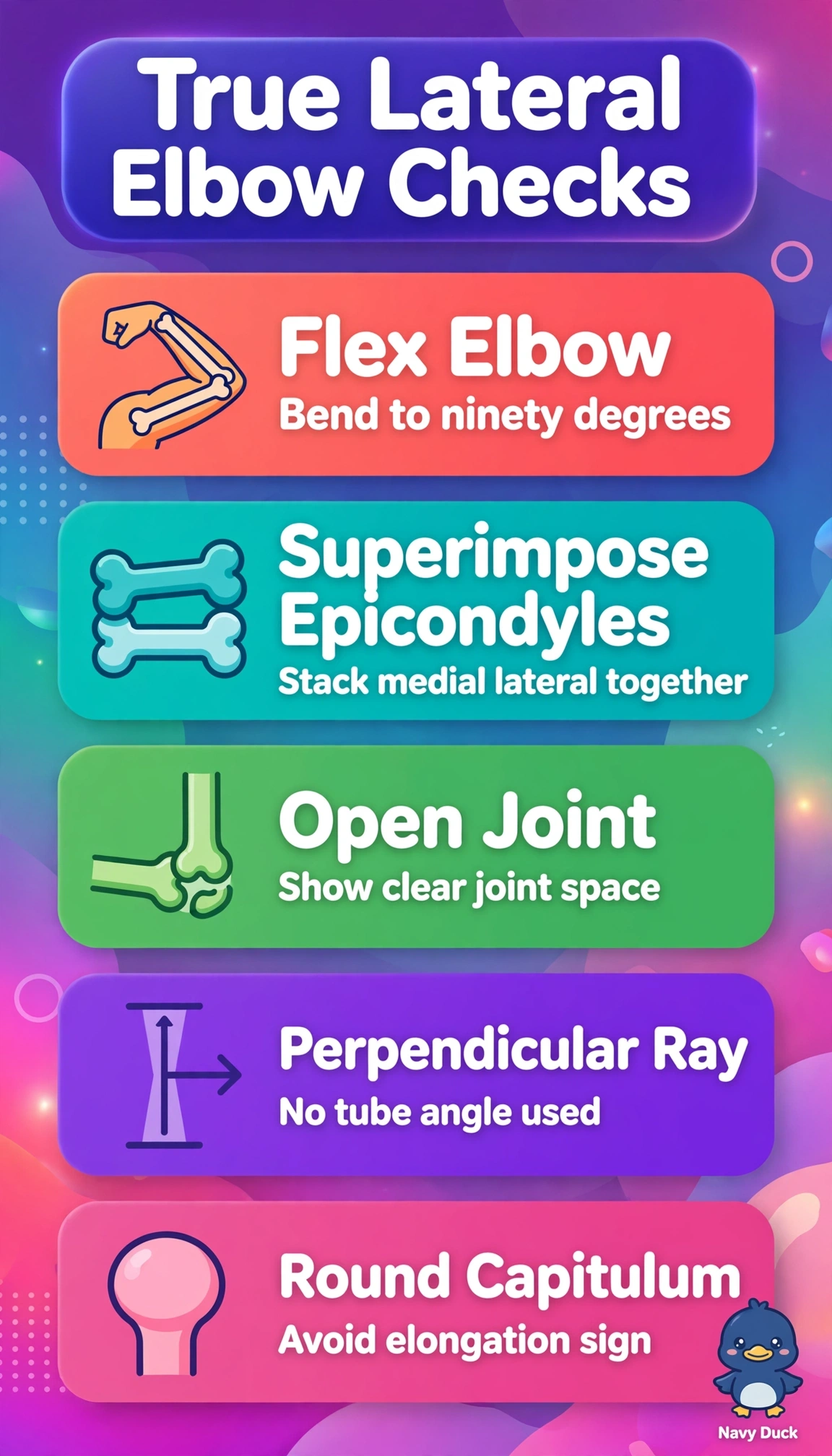
A true lateral elbow requires 90 degrees flexion with humerus and forearm in the same plane, epicondyles directly superimposed to prove absent rotation, joint space open with radial head free of coronoid overlap to prove correct flexion, and central ray perpendicular to the joint and receptor to keep the capitulum round without elongation, so the correct evaluation identifies both defects in this image, separated epicondyles from rotation and elongated capitulum from angled beam, and states the required correction. The angled-beam description fails alignment concept because any intentional cephalad angle projects the distal humerus obliquely and elongates the capitulum, a maneuver reserved for dedicated radial head projections and not for the routine lateral that demands perpendicularity. The comfort-tolerant description fails rotation concept because accepting slight epicondylar separation permits residual obliquity and cannot be called a true lateral even when flexion and beam are correct, since pain is managed with support and sponges rather than relaxed superimposition. The partial-flexion description fails flexion concept because a closed joint with lesser flexion describes the trauma adaptation when full flexion is impossible, whereas this outpatient is at 90 degrees and should show an open joint, so closure indicates under-flexion rather than acceptable positioning. Exam caveat is to separate rotation shown by epicondylar misalignment from beam error shown by elongation and from flexion error shown by joint closure rather than attributing all findings to one cause. Practical check is to place epicondyles equidistant to the receptor at true 90 degrees, direct the beam perpendicular through the joint center, then confirm round capitulum, superimposed epicondyles, open joint, and freed radial head before accepting.