
During plan review, an oblique photon field to a patient's sloped shoulder shows a hot spot on the crest and a cold band below it, with the isodose lines running diagonally across the target. Which beam modifier can correct this dose distribution?
Select an answer to reveal the explanation.
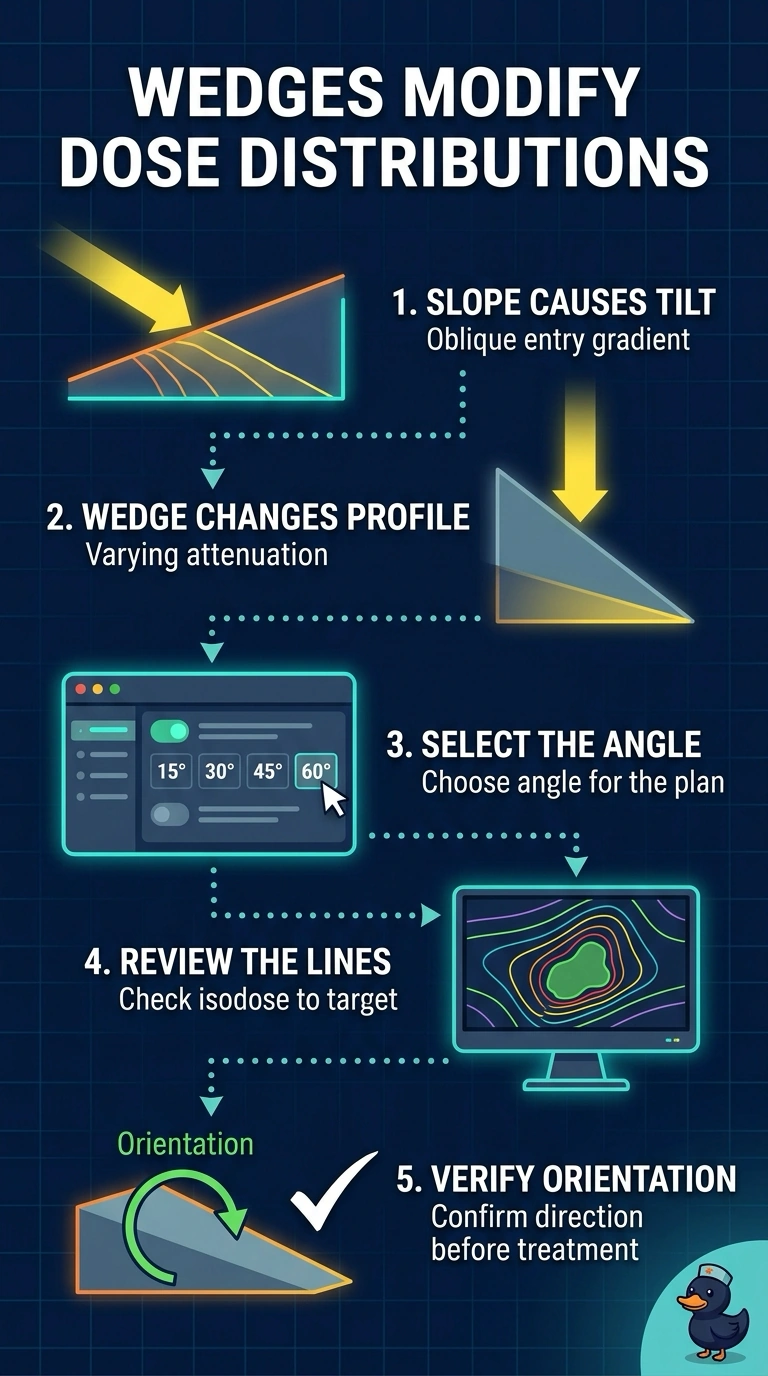
Short Explanation
For your sloped shoulder target, a properly oriented wedge tilts the isodose lines like turning a ramp so the dose better follows the target. You’ll still want to confirm the resulting distribution in the treatment plan.
Full Explanation
A sloped surface and oblique beam incidence can contribute to a dose gradient across a target, but the resulting distribution depends on the patient geometry and beam arrangement. A wedge can tilt the isodose distribution to help compensate for a gradient; its orientation and angle must be selected for the specific plan rather than simply matched to the surface slope. Bolus can modify surface dose and compensate for some surface irregularities, but a uniform sheet is not a reliable way to correct this particular gradient. A custom block changes the field outline rather than the intensity profile within the field. Changing source-to-surface distance affects beam geometry and output, but does not by itself equalize dose across the target. Review the dose distribution in the plan and verify the wedge orientation before treatment.