
A patient with widespread cutaneous T-cell lymphoma has plaques covering the trunk, arms, legs and scalp, and the oncologist wants a radiation option that treats the whole skin surface while keeping the dose shallow so deeper organs are spared. Which treatment option best fits that description?
Select an answer to reveal the explanation.
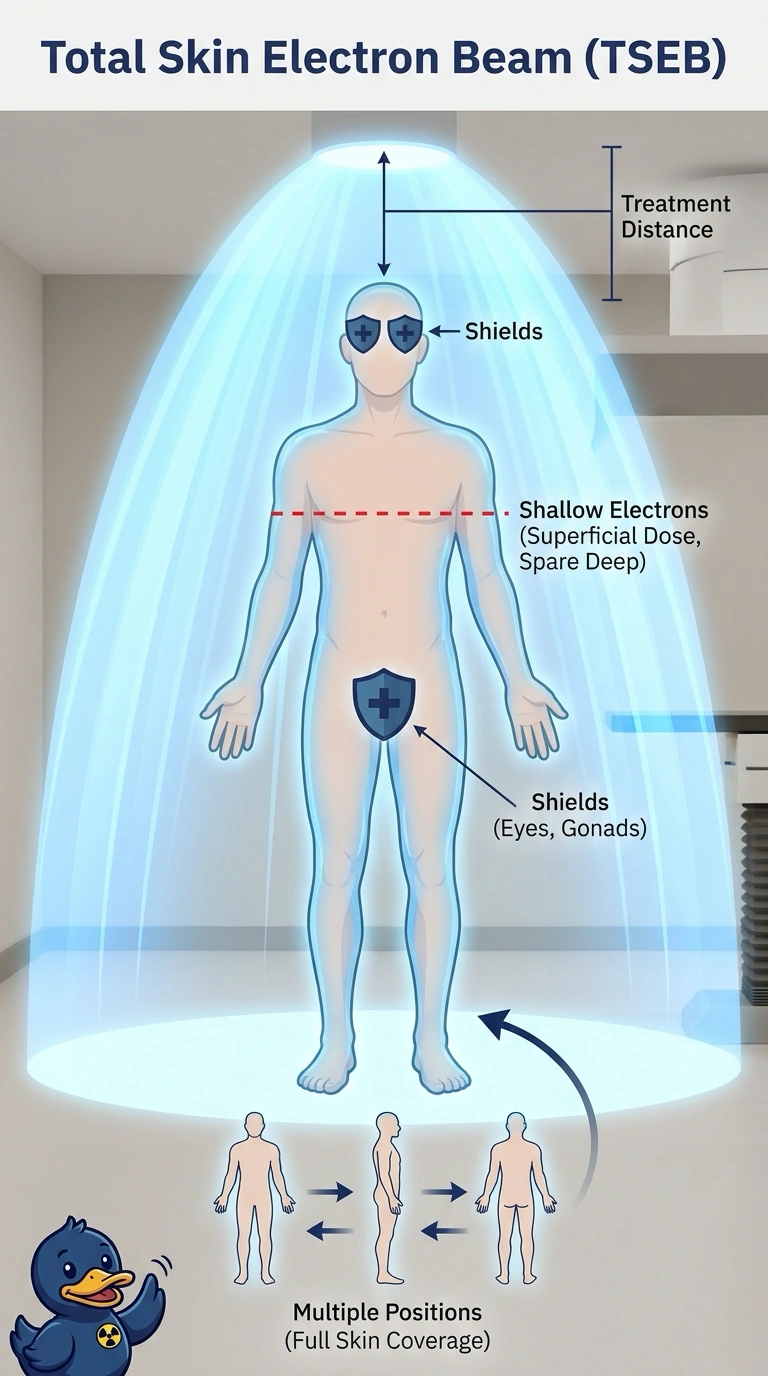
Short Explanation
You need a beam that deposits dose superficially rather than treating the whole body, and electrons have a limited range in tissue. Total skin electron irradiation uses multiple fields and patient positions to cover the skin surface, with shielding used to protect sensitive areas such as the eyes. It's the only option here designed for whole-surface skin treatment.
Full Explanation
Total skin electron irradiation (TSEI) is the best match because electrons deposit a therapeutic dose across the skin with limited penetration, reducing exposure to deeper organs. Using multiple patient positions helps expose the trunk and limbs from different angles, while appropriate eye and gonadal shielding protects sensitive structures; scalp assessment and supplemental treatment can address sites that are difficult to cover uniformly. Six-position TSEI is a genuine whole-skin technique, but the scalp can be underdosed because of hair, contour, or positioning, so it does not meet the stated requirement for coverage of the scalp unless that site is incorporated adequately. Total-body photon irradiation is used in selected settings to treat disease throughout the body, but photons penetrate substantially beyond the skin; shielding cannot make its dose shallow while preserving the intended broad treatment. Large-field superficial x-ray therapy is a reasonable way to treat broad, shallow plaques, yet separate fields and patient repositioning can leave gaps or miss surfaces, so it is not reliably whole-skin treatment. Exam caveat: TSEI protocols vary in technique and dose, and some sites may still need boosts; “whole skin” does not guarantee uniform dose at every contour. Practical check: review the planned coverage map and shielding, specifically confirming scalp and other difficult surfaces are addressed and deeper-organ exposure is acceptable.