
During MRI safety screening, a patient scheduled for a lumbar spine scan reports an MR-conditional spinal cord stimulator with its label checked, an insulin pump worn on the belt, and a nicotine patch on the upper arm. The slot is already running late. Which MRI safety actions must be completed before the patient enters the scan room?
Select an answer to reveal the explanation.
Short Explanation
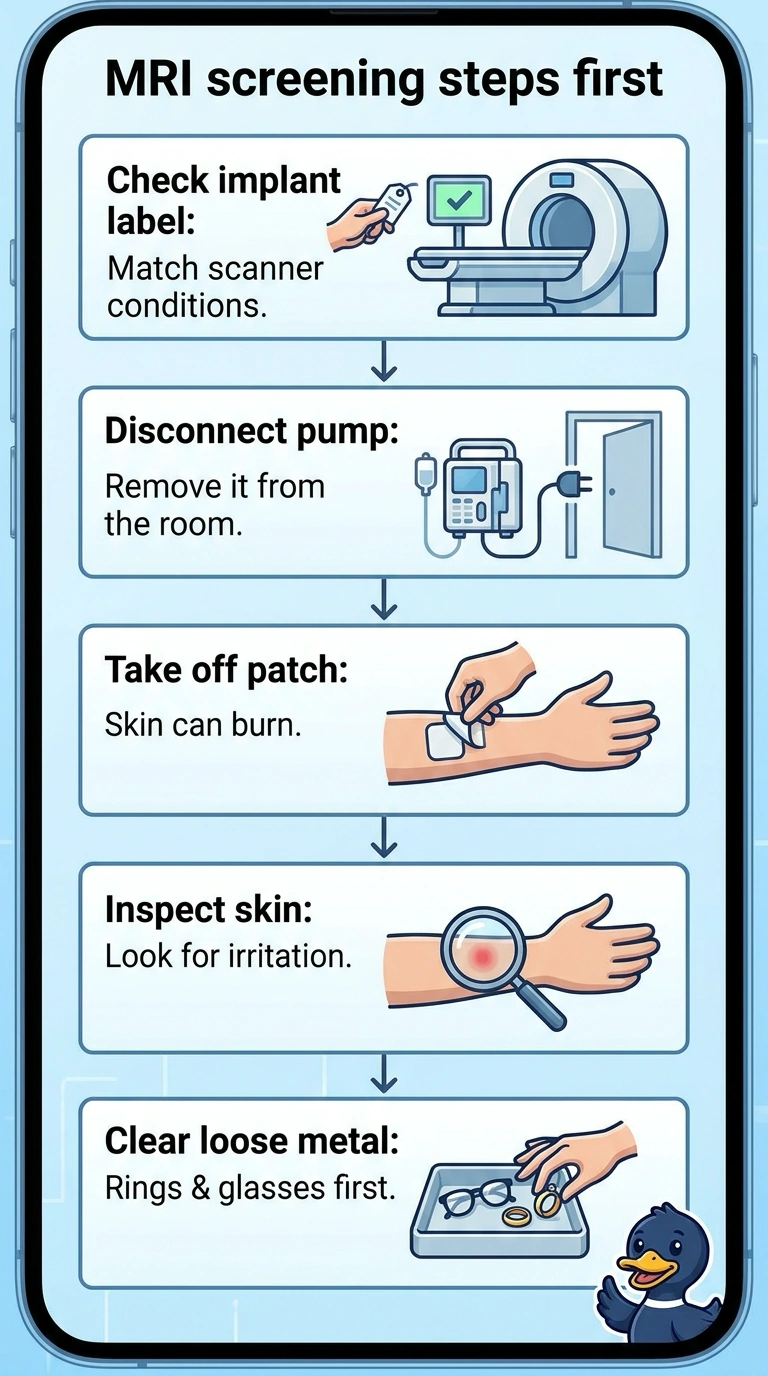
You can treat this as a checklist, giving each reported item its own safety step. Match the stimulator’s conditions to the scanner, remove the pump, take off the patch and inspect the skin, then clear loose metal. A patch left on can act as a heater against your skin during the scan.
Full Explanation
Before the patient enters the scan room, address each reported item: an MR-conditional stimulator is safe only when its conditions match the specific scanner and planned examination; the belt-worn insulin pump must be disconnected and removed; and the nicotine patch must be removed, with the skin inspected, while loose metal is cleared. Removing the patch without inspecting the skin skips a check that can reveal irritation or a burn beneath it, even when the schedule is running late. Leaving the pump outside the room but connected does not meet the required disconnection and removal procedure; follow the pump manufacturer’s instructions for safe management. Relying on a checked MR-conditional label without matching it to this scanner is also insufficient: verify the permitted field strength, configuration, programming, and other conditions against the scanner and scan protocol. Exam caveat: “MR-conditional” does not mean universally safe, and conditions vary by device and model. Practical check: use the device card or manufacturer documentation to verify the exact stimulator system and scan conditions, then document the pump and patch actions and complete the usual final metal screening.