
A biopsy of a lung mass is read as nests of malignant epithelial cells with intercellular bridges and abundant keratin pearls, and the pathologist notes that keratin production dominates the specimen. Which histopathologic type and grade does this description support?
Select an answer to reveal the explanation.
Short Explanation
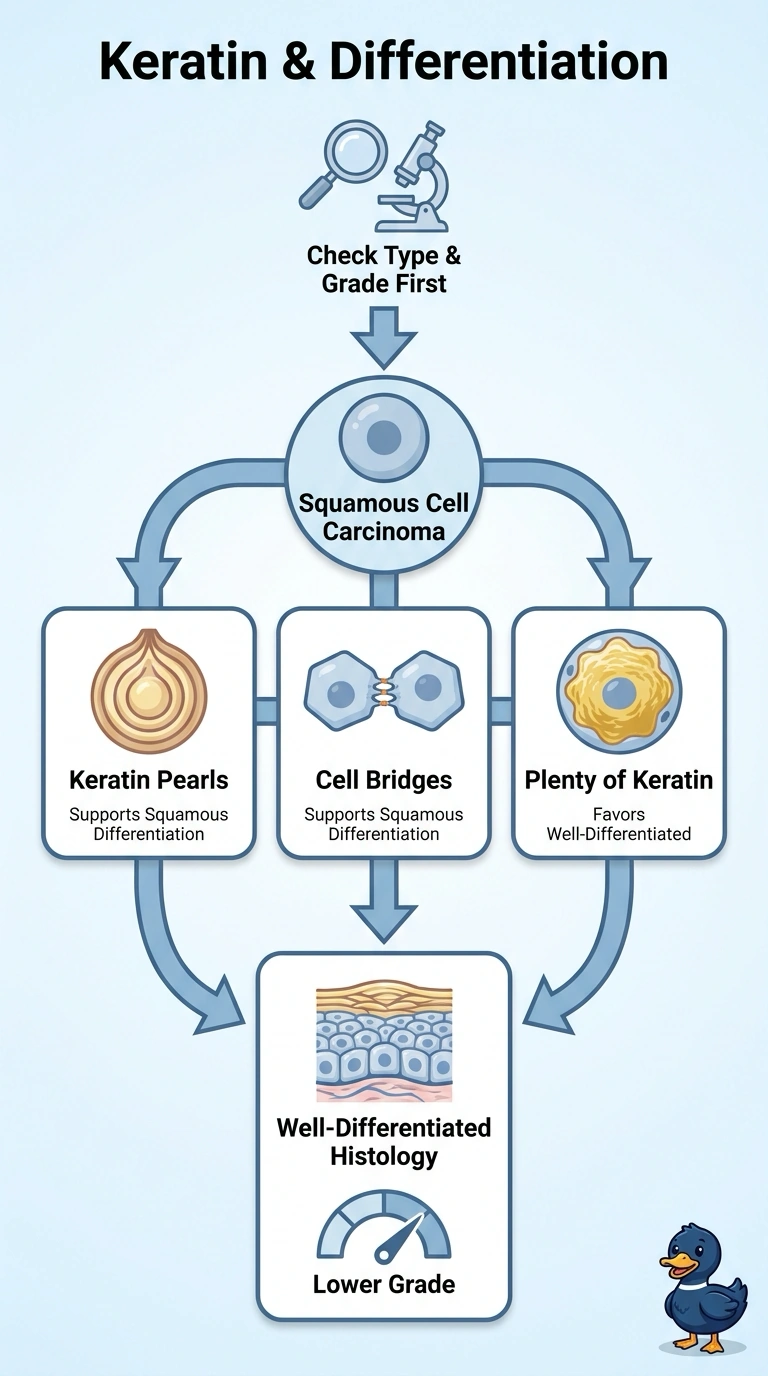
You can read the keratin pearls like a clear signature: they point to squamous cell carcinoma. Since keratin production dominates, you’d call it well differentiated (lower grade), while remembering that the tumor’s overall features determine grade.
Full Explanation
Histologic type is based on the line of differentiation the tumor shows, while grade reflects the degree of differentiation and other histologic features. Intercellular bridges and keratin production support squamous differentiation, and keratin pearls are a feature of keratinizing squamous cell carcinoma. Abundant keratinization favors well-differentiated squamous cell carcinoma, but grade should be assessed using the overall histologic appearance rather than keratin production alone. Gland formation or mucin would support adenocarcinoma; nesting alone does not establish glandular differentiation. Stromal invasion describes invasive behavior and does not by itself establish a high grade. Invasion and grade are distinct characteristics. Identify the tumor type from its differentiation features, then assess grade from the full histologic picture.