
During a contrast-enhanced CT simulation, a patient with an IV in the hand reports sudden burning at the wrist, and the power injector stops as a firm swelling rises along the forearm. The scan can be repeated later. Which immediate response to contrast extravasation should the therapist carry out at the bedside?
Select an answer to reveal the explanation.
Short Explanation
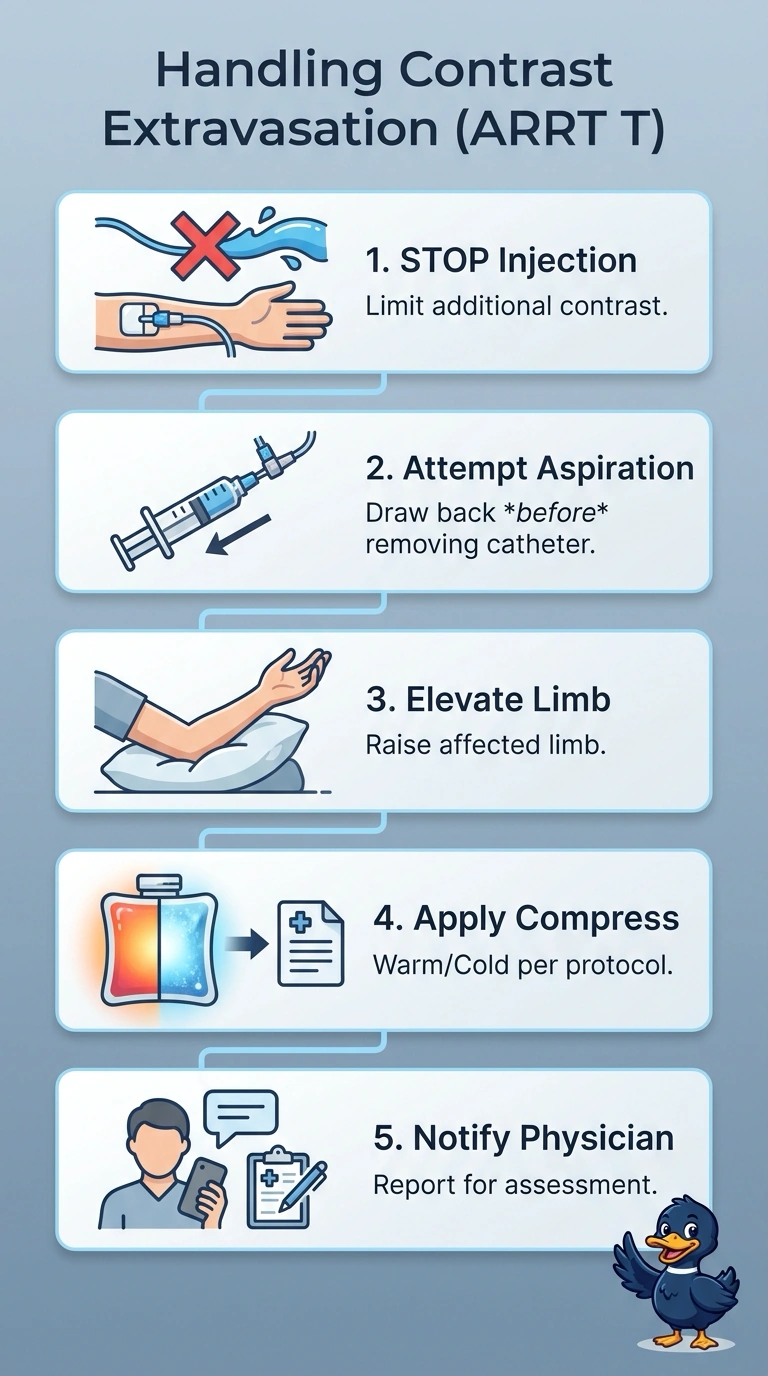
You’re right to stop the injection and keep the catheter briefly so you can attempt to aspirate accessible contrast before removing it. Then elevate the arm, apply a warm or cold compress according to protocol, and notify the physician for assessment and follow-up of the extravasation.
Full Explanation
The appropriate bedside response is to stop the injection, briefly leave the catheter in place and attempt aspiration, elevate the affected limb, apply a warm or cold compress according to local protocol, and notify the physician for assessment and follow-up. A response that leaves the catheter in place but does not attempt aspiration misses the opportunity to withdraw accessible contrast; retaining the catheter alone is not the same as aspirating. A response that attempts aspiration and provides the other bedside measures but omits physician notification fails to ensure the event and the patient’s condition are assessed and managed appropriately. A response that keeps the arm at heart level does not elevate the limb, which helps limit swelling. Do not confuse localized burning and swelling with an allergic-like reaction: assess for systemic symptoms, but do not let that assessment replace extravasation care. Exam caveat: recommendations for warm versus cold compresses vary by institutional protocol, so neither temperature is universally required. Practical check: after the immediate response, assess and document pain, swelling, skin condition, sensation, movement, and distal perfusion, and escalate promptly if symptoms worsen.