
A radiation therapist in her first trimester formally declares her pregnancy to her supervisor. She continues to run daily machine checks, position patients in the treatment room, and work at the console, and the department wants to keep her on the usual rotation. Which dosimetry practice best applies ALARA to her and the fetus during the declared pregnancy?
Select an answer to reveal the explanation.
Short Explanation
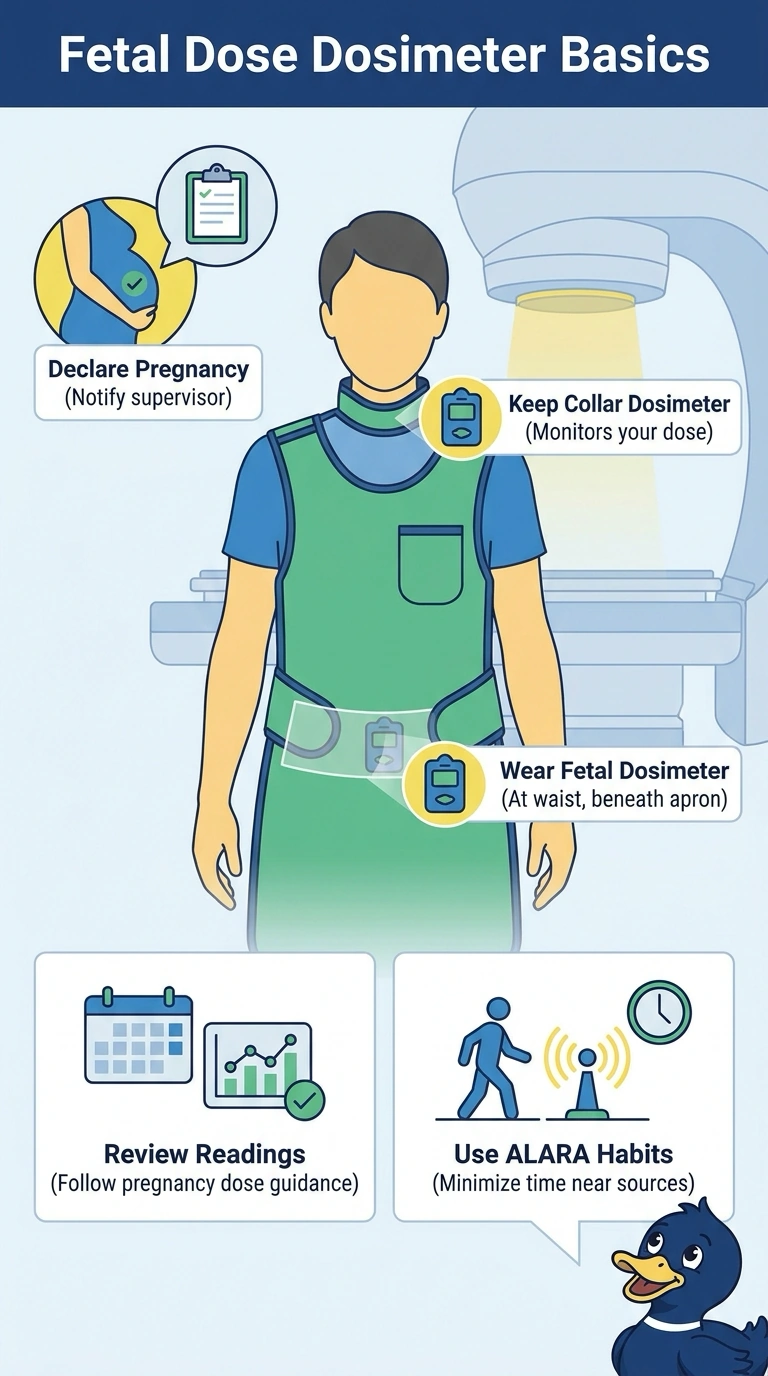
Wear a separate fetal dosimeter at your waist, like a dedicated scorecard for estimating fetal exposure. You’ll review its reading each month against pregnancy dose guidance and keep exposure as low as reasonably achievable.
Full Explanation
For a declared pregnancy, a separate dosimeter worn at waist level helps estimate dose to the embryo or fetus. If a protective apron is worn, the fetal dosimeter is generally placed beneath it; the worker’s usual dosimeter is worn as directed by the radiation safety program. Review fetal dosimeter readings regularly. NRC regulations limit embryo/fetus dose to 5 mSv over the pregnancy, and NRC guidance recommends efforts to keep monthly exposure near or below 0.5 mSv. The collar dosimeter alone does not provide the same estimate of fetal dose, and the annual occupational whole-body limit is not a substitute for the pregnancy-specific limit. Changes in duties do not, by themselves, make a collar reading an adequate estimate of fetal dose; monitoring and work practices should follow the radiation safety program. A second dosimeter at the collar duplicates a reading at a location that does not estimate fetal dose as well as a waist dosimeter. ALARA practices, including minimizing time near sources and maximizing distance and shielding when appropriate, help reduce exposure.