
Before a treatment plan is built, you check the simulation packet for a patient who has just finished her CT scan. The written setup sheet lists the immobilization device, her arms raised on the armrest, and the skin mark locations, but the setup photograph shows her with the device removed and her arms at her sides. The photograph is intended to document the treatment setup. Which documentation correction should be made before the packet is released for planning?
Select an answer to reveal the explanation.
Short Explanation
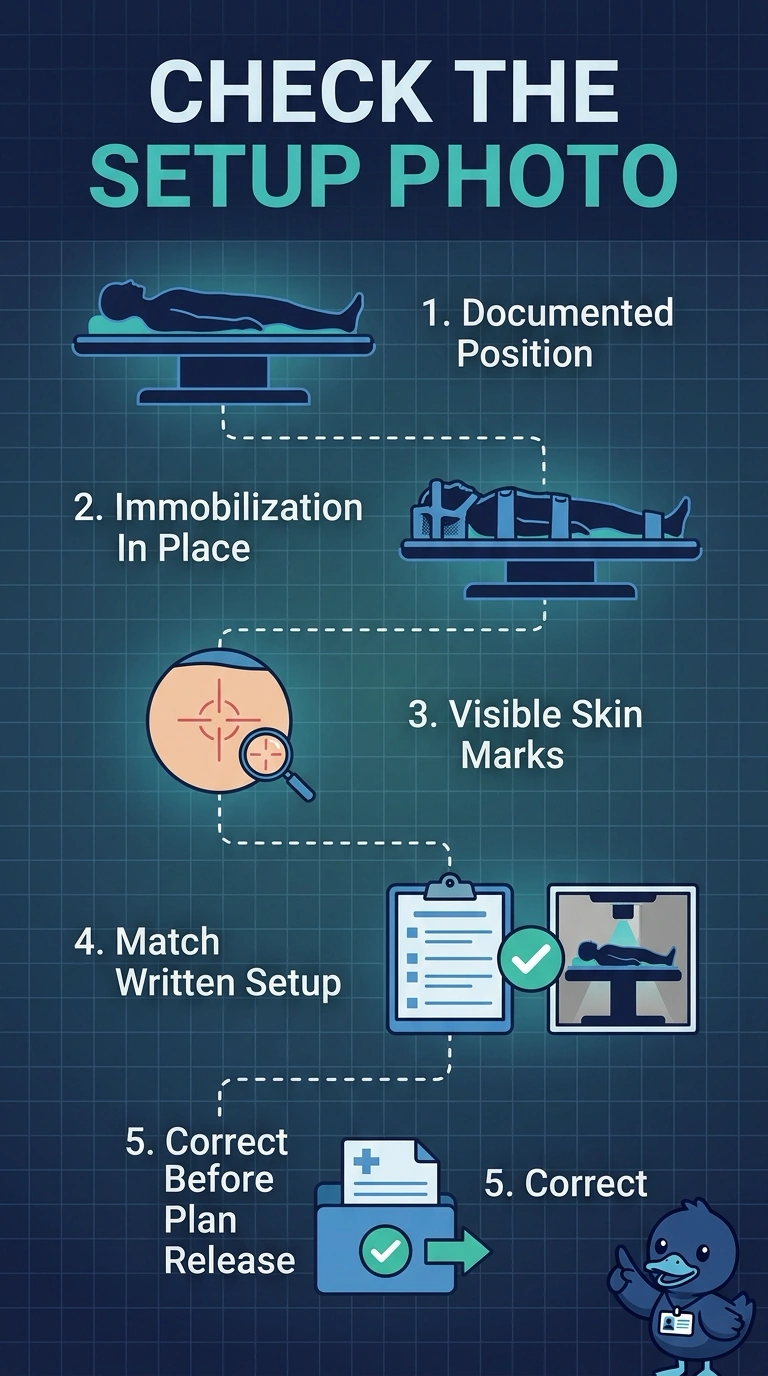
Your setup photo is like a snapshot recipe for recreating treatment, so it needs to show the patient in the documented position with the immobilization device in place. Retake it following department protocol; an annotation or a partial setup won’t resolve the mismatch, and follow protocol on whether skin marks need to be visible.
Full Explanation
The photograph is intended to document the treatment setup, so it should show the patient in the position recorded on the setup sheet, with the immobilization device in place. Retaking it according to department protocol resolves the mismatch at its source and gives the planning team a consistent visual reference. Annotating the existing photograph and attaching a verified setup diagram may add context, but the image would still show the device removed and the patient’s arms at her sides; those additions do not make it a record of the documented setup. A retake with the device in place and skin marks visible but her arms at her sides would still conflict with the recorded arm position. A retake with her arms raised and skin marks visible but without the device would omit a key part of the documented setup. Each partial correction leaves a clinically relevant discrepancy. Exam caveat: a photograph may supplement written instructions, but when it is intended to document the treatment setup, it should not contradict them or be replaced by a diagram. Practical check: before releasing the packet, compare the photograph with the setup sheet for the recorded position and device, and confirm whether department protocol requires skin marks to be visible.