
A patient is simulated for an upper abdominal treatment with daily portal imaging, and the physician wants a landmark that holds the same position between fractions so image matching stays reliable. Several organs appear in the same image. Which upper abdominal organ best serves as the stable retroperitoneal landmark?
Select an answer to reveal the explanation.
Short Explanation
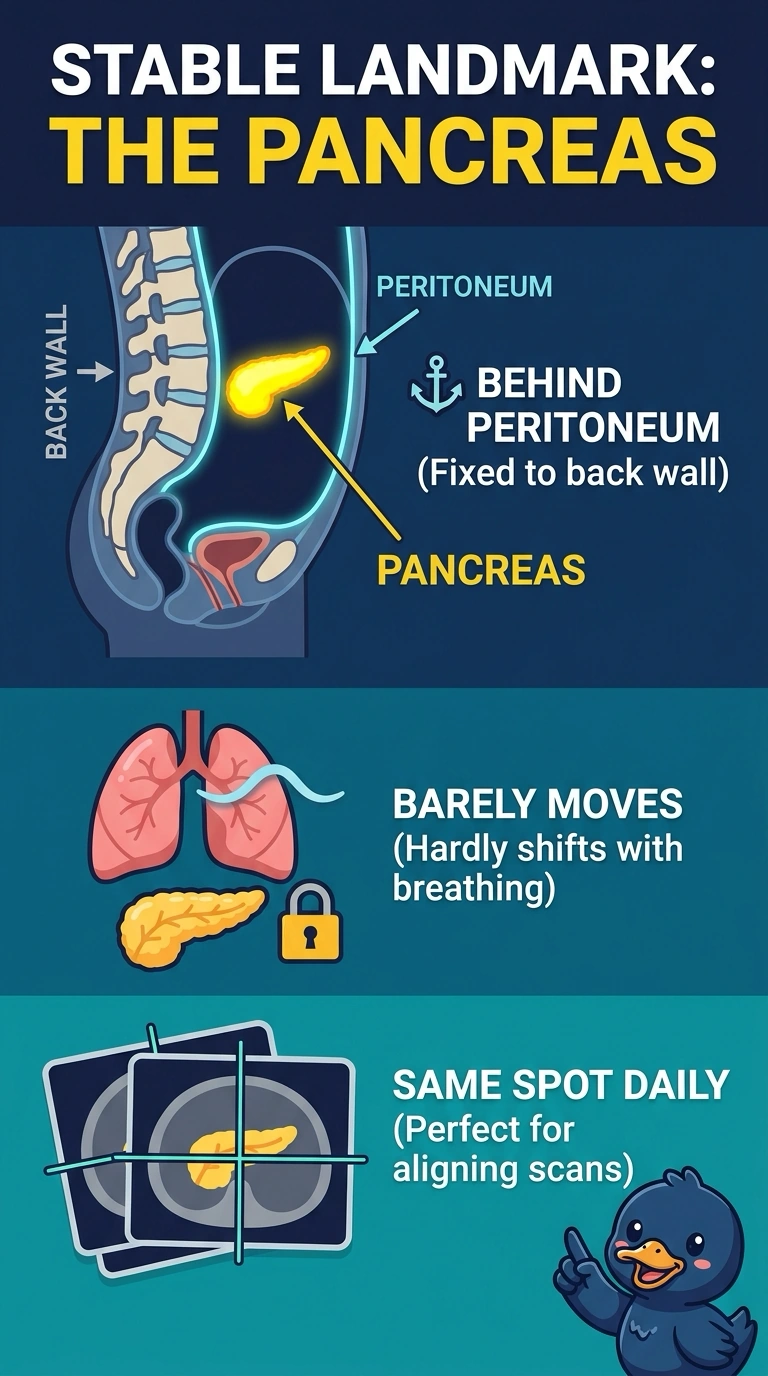
For reliable matching, you want an organ anchored against the posterior abdominal wall rather than one that shifts with breathing or bowel contents. The pancreas is retroperitoneal, so it gives you a repeatable landmark between fractions. Remember that its position is stable, though not perfectly motionless.
Full Explanation
A useful landmark must remain anatomically consistent between fractions. The pancreas is retroperitoneal and lies against the posterior abdominal wall, so it shifts relatively little with breathing or changes in bowel contents and can support reliable image matching. The transverse colon is not fixed behind the peritoneal cavity: it is suspended by a mesocolon and can move as it fills, changing its position on portal images. The stomach may sit high beneath the diaphragm, but it distends and collapses with air and meals, so its position is not reliably anchored along the posterior wall. The liver is large and dense, but it is intraperitoneal and moves with the diaphragm during breathing rather than remaining flat against the posterior abdominal wall throughout treatment. When a chosen structure moves, its apparent position changes from image to image and can create day-to-day matching error even when the external setup is accurate. One exam caveat is that “stable” does not mean completely motionless; the pancreas can still move, so its advantage is relative to the listed alternatives. As a practical check, review several portal images from the course and confirm that the pancreatic landmark remains consistent enough to match.