
A patient with locally advanced disease is three weeks into a large-field course with concurrent radiosensitizing chemotherapy when mucosal and skin reactions develop faster than expected. The physician asks whether the daily fraction size should be raised to finish sooner. Considering fractionation, treated volume, and the sensitizing drug together, what should guide the dose-per-fraction decision?
Select an answer to reveal the explanation.
Short Explanation
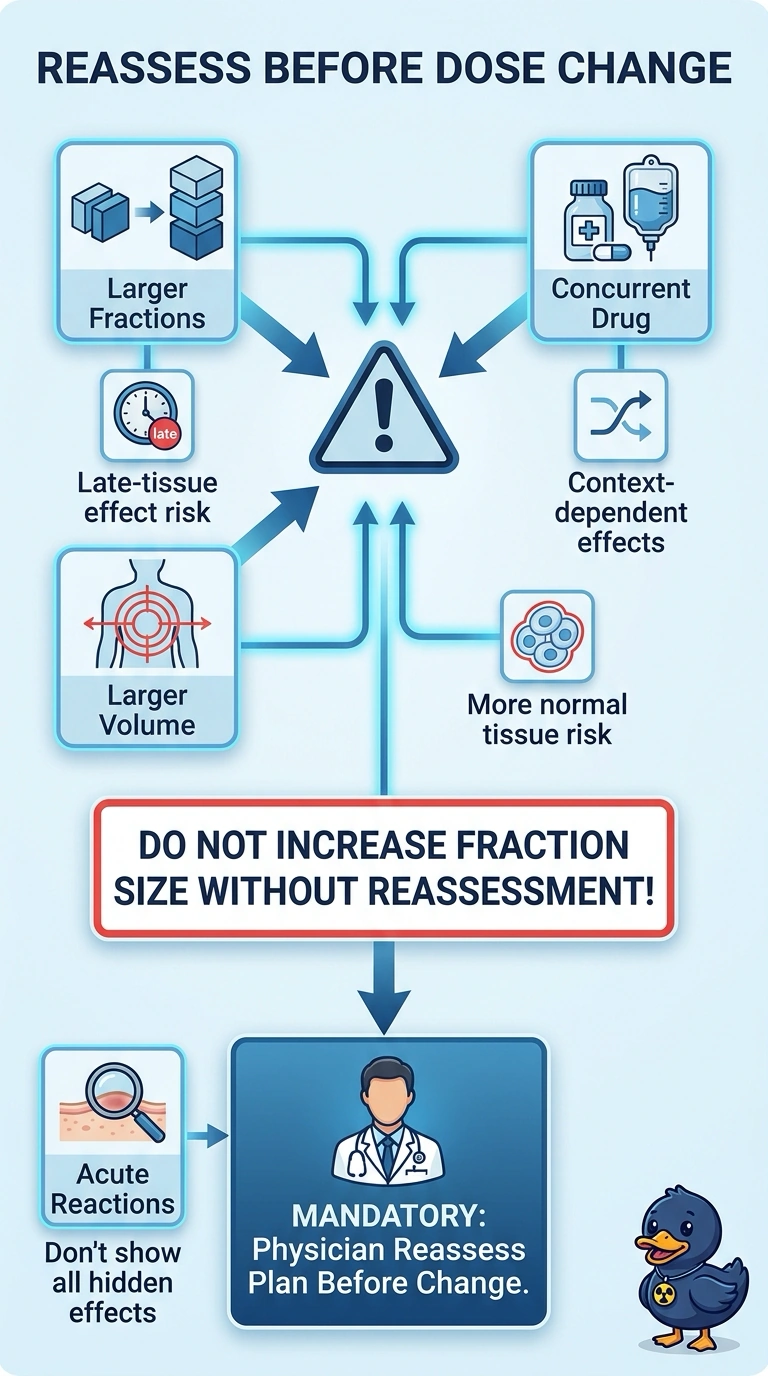
Your dose-per-fraction decision should account for the large treated volume and the radiosensitizing drug, which can both raise normal-tissue risk. Like turning up the heat, increasing the fraction size could worsen reactions, so pause for reassessment before making a change.
Full Explanation
Do not increase the fraction size until the unexpectedly rapid mucosal and skin reactions have been reassessed. A large treated volume exposes more normal tissue, and concurrent radiosensitizing chemotherapy can amplify radiation injury; together, these factors make an increase potentially hazardous. Fraction size affects late as well as acute toxicity, so finishing sooner is not by itself a reason to alter the prescription. Following the protocol’s planned fraction size and waiting for a predefined toxicity threshold at the next review can be reasonable routine practice, but reactions are already worsening unusually quickly, so prompt reassessment should not be delayed. Applying standard normal-tissue constraints to the large volume while proceeding with chemotherapy without a separate drug-related adjustment may underestimate the radiosensitizing effect. Considering a modest increase after reviewing reactions, field size, and drug accounts for important risks, but relying only on acute constraints and not recalculating late-effect biologic dose can overlook consequential late toxicity from larger fractions. Exam caveat: a fractionation change is not automatically contraindicated for every patient; it requires a justified plan that accounts for the full clinical context and normal-tissue risks. Practical check: verify delivered dose and fractionation, target and organ-at-risk volumes, concurrent drug and timing, and current toxicity before changing the prescription.