
A 6 MV isocentric pelvis plan puts the isocenter at 10 cm depth, and the physicist wants one beam-data quantity that stays valid as patient thickness changes the SSD from fraction to fraction, with all beam data collected while the detector stays in the water phantom. Which depth-dose quantity should you use to verify dose at the isocenter?
Select an answer to reveal the explanation.
Short Explanation
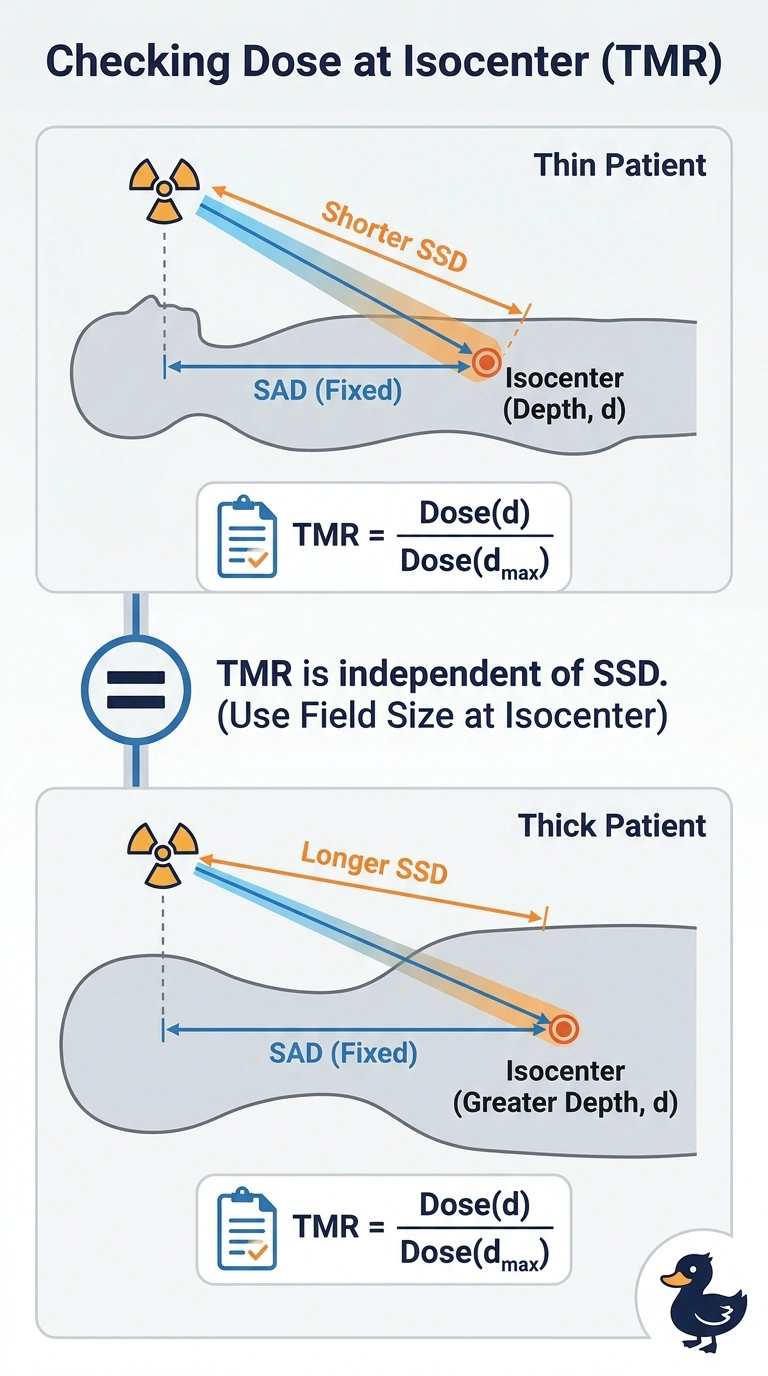
When your patient’s thickness changes the SSD, use TMR at the isocenter depth: it compares dose there with dose at dmax for the same field and beam setting, and stays valid as SSD changes. It’s like using a fixed reference point; PDD depends on SSD, while TAR requires a free-in-air measurement.
Full Explanation
TMR is the ratio of dose at a stated depth to dose at dmax for the same field size and beam setting. Both measurements are made in a phantom, and the ratio is independent of SSD. In an isocentric technique, the source-to-axis distance is fixed while the patient’s surface may move with changes in thickness, so TMR is suitable for calculating dose at the isocenter. PDD is defined for a specified SSD; an SSD correction can account for a changed SSD, but it does not provide the requested single reusable value. A scatter factor describes changes in output with field size, not attenuation to the isocenter depth. TAR is also SSD independent, but its definition requires a free-in-air dose measurement, which the phantom-only data condition excludes. Confirm that the beam data cover the field size and depth used for the calculation.