
A patient with high-risk leukemia is scheduled for allogeneic stem cell transplantation. The prescription lists whole-body photon treatment delivered in two fractions per day with lung blocks, to be finished the day before the stem cells are infused. Which treatment technique does this prescription describe?
Select an answer to reveal the explanation.
Short Explanation
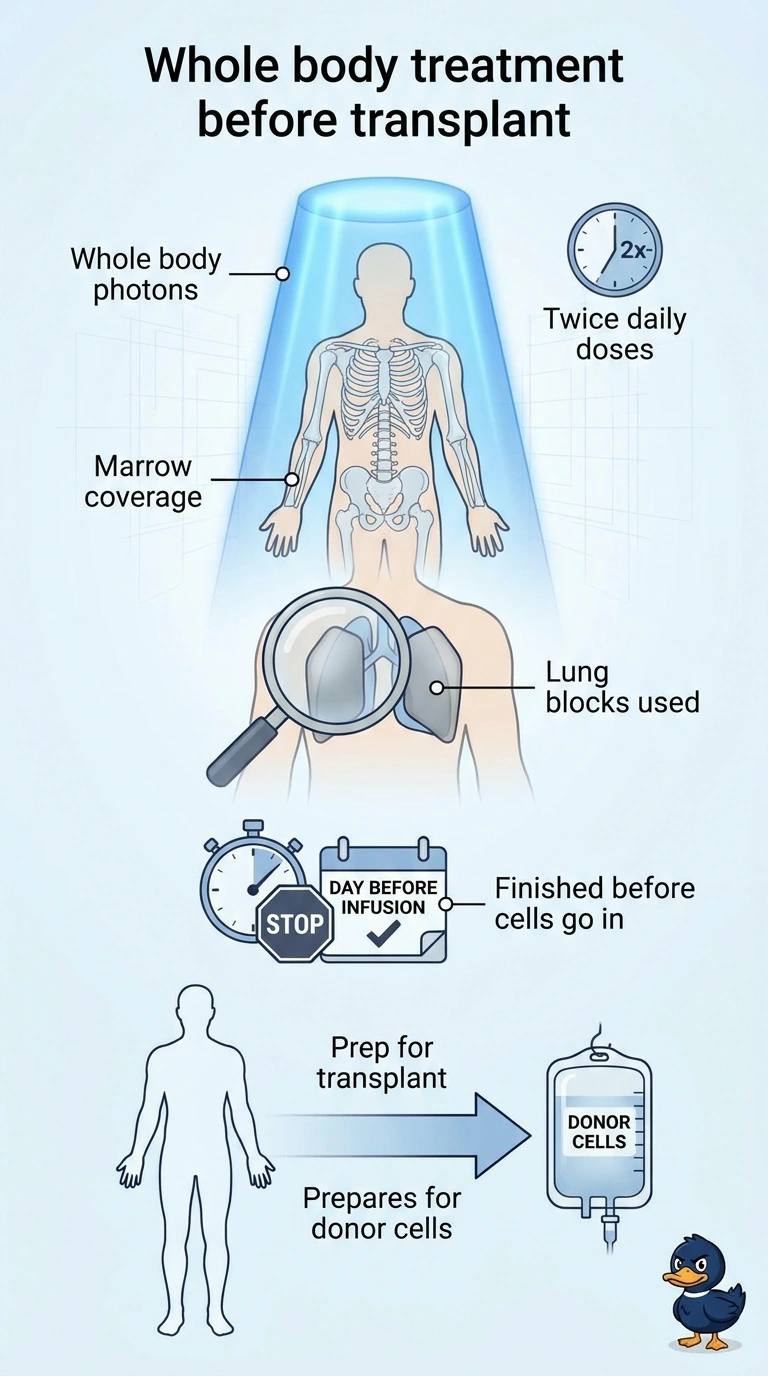
Your transplant-conditioning prescription matches total body irradiation (TBI): whole-body photons are delivered before stem-cell infusion. You can distinguish this plan by its twice-daily fractions, lung blocks, and completion the day before infusion—not once-daily treatment, compensators instead of lung blocks, or completion two days before infusion.
Full Explanation
The prescription describes total body irradiation (TBI) as part of the preparative conditioning regimen for allogeneic stem-cell transplantation. The whole body is treated with photons, commonly using a large-field or extended-distance technique; twice-daily fractions and lung blocks are recognizable features of this approach. Completing irradiation the day before infusion places it in the stated pre-transplant sequence. A once-daily TBI schedule is a legitimate conditioning approach, but it does not meet the prescription’s twice-daily fractionation requirement. TBI delivered twice daily with compensators instead of lung blocks has the stated schedule and timing, but does not use the specified lung shielding; compensators can improve dose uniformity and do not provide the same localized lung shielding. TBI with lung blocks delivered twice daily but completed two days before infusion differs from the prescribed day-before completion. An exam caveat is that TBI fractionation, shielding, and the interval before infusion vary among transplant protocols, so none should be assumed universal. As a practical check, verify the treatment schedule, beam modality, lung-shielding arrangement, and final treatment date against the prescription and transplant calendar.