
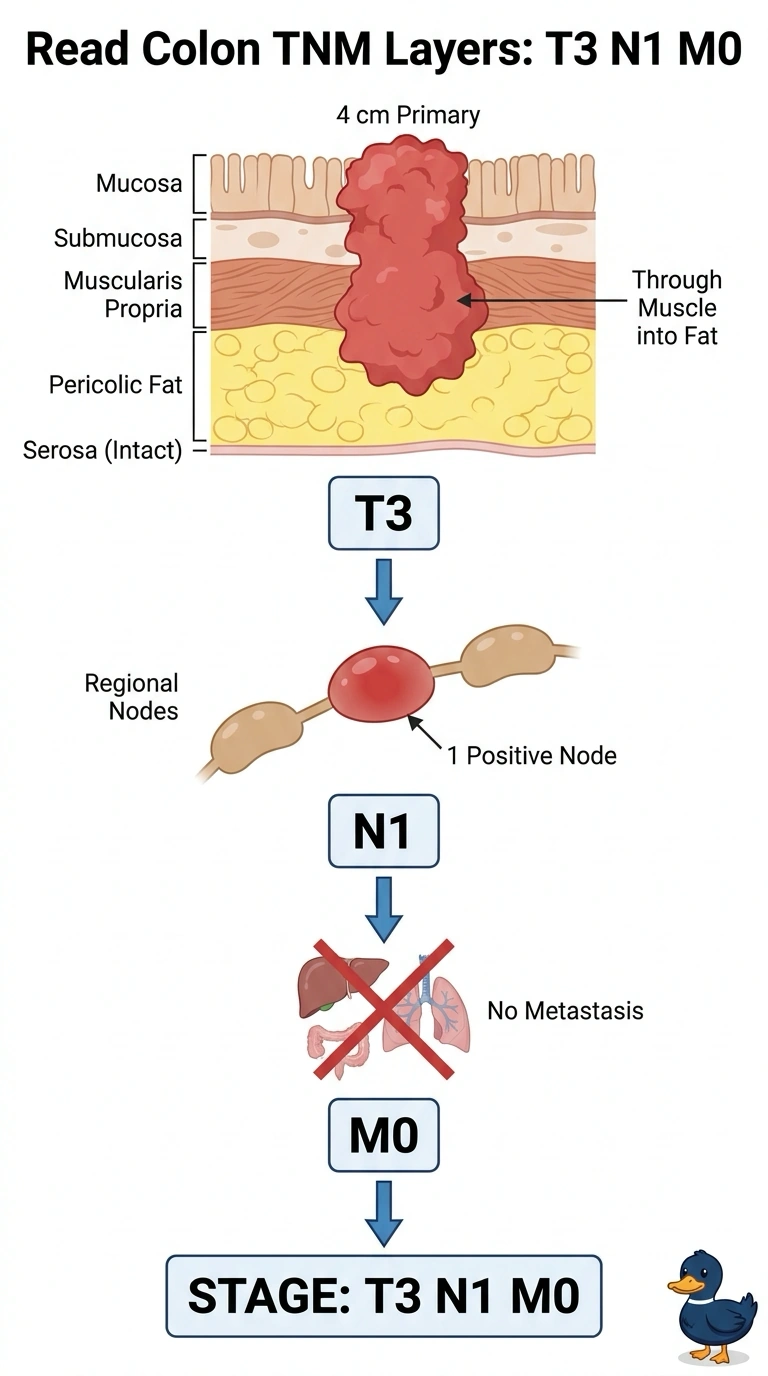
A biopsy confirms a 4 cm adenocarcinoma of the colon. The primary has grown through the muscularis propria into the surrounding pericolorectal fat, the serosa is intact, and no adjacent organ is involved. One regional lymph node contains metastatic tumor, and imaging shows no distant spread. Which TNM classification fits these findings?
Select an answer to reveal the explanation.
Short Explanation
The T category follows depth, not size: once the primary pushes past the muscularis propria into the fat, you're at T3 no matter how many centimeters it measures. The single positive regional node sets N1, and with imaging clear of distant disease the clinical M category is M0. Size alone won't move the stage once you know which layers were crossed.
Full Explanation
In the TNM system the T category for a colonic primary is assigned from the depth of invasion through the bowel wall rather than from the tumor's diameter. A primary that pushes through the muscularis propria into the pericolorectal tissues is T3, while invasion that stops inside the muscularis propria remains T2. Penetration of the visceral peritoneum is T4a, and invasion of an adjacent organ or structure is T4b; the stated intact serosa and untouched adjacent organ rule out T4. The N category counts regional nodes holding metastatic tumor, so a single involved node places the case at N1 and rules out N0. Imaging showing no distant disease supports a clinical M0 classification; M0 is not assigned as a pathologic category. The triplet then feeds a stage group. Some systems subclassify N1 by the number of positive nodes, and rectal primaries use slightly different wording for the same layers, so exact descriptors must be read from the current staging manual. A practical check: read the pathology for the deepest layer crossed and the number of positive nodes, assess distant disease clinically, then map each finding to its own category before combining them.