
A hospital is fitting out a vault for a 6 MV linear accelerator, and the physicist must classify the wall in front of the gantry, the side walls, the ceiling and the entrance maze before calculating thickness. Which statement correctly assigns the barrier type and design basis for each surface?
Select an answer to reveal the explanation.
Short Explanation
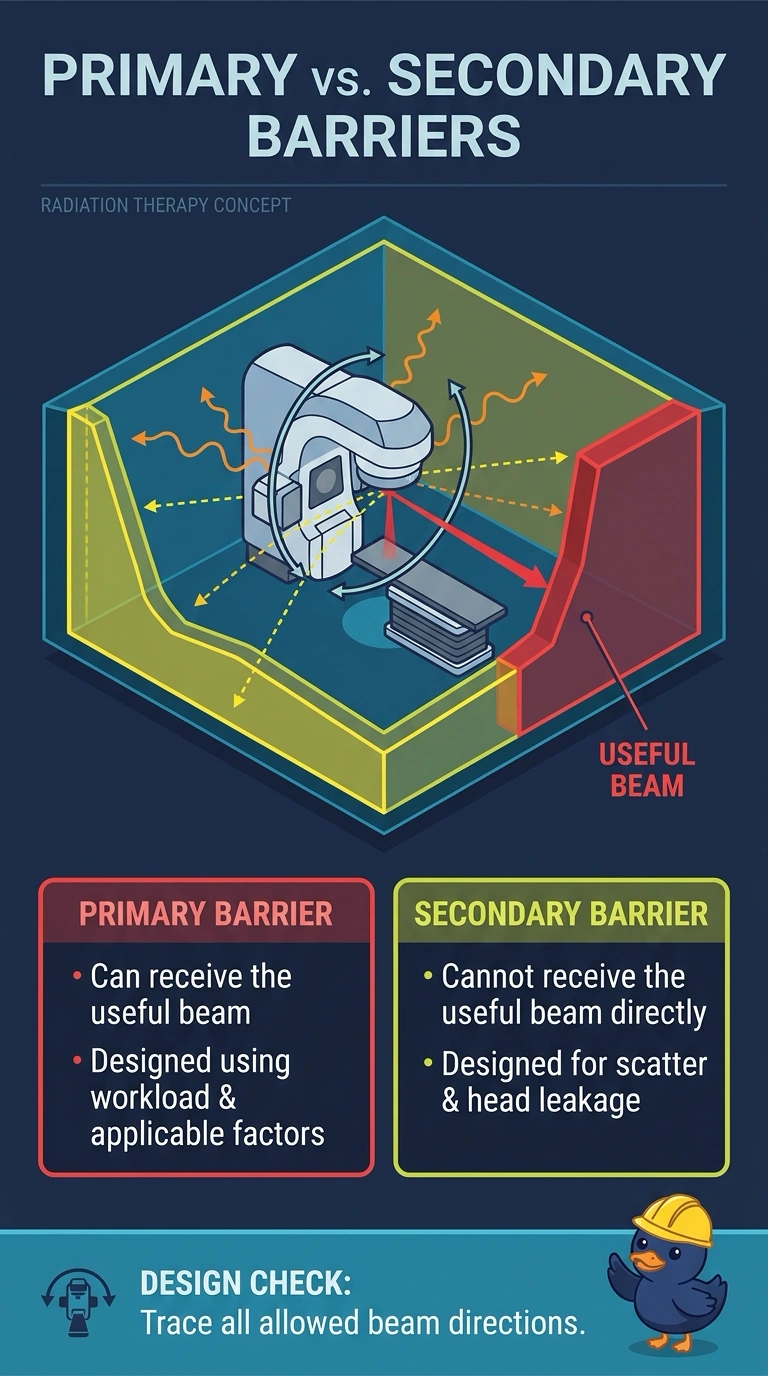
If your useful beam can strike a surface, that’s a primary barrier, designed using workload and applicable use and occupancy factors; surfaces it can’t strike are secondary barriers, designed for scatter and head leakage. Trace the beam paths your treatment unit allows—like checking where a flashlight can shine—before classifying each wall, the ceiling, and the maze.
Full Explanation
A primary barrier is a surface the useful beam can strike directly. Its design uses the workload along with the applicable use and occupancy factors. A secondary barrier is a surface the useful beam cannot strike directly; its design accounts for patient scatter and leakage from the treatment head. The entrance maze is generally treated as secondary when the useful beam cannot reach it directly, but classification depends on the room geometry and permitted beam directions. Designing every wall as primary ignores the distinction between primary and secondary barriers. Designing a secondary barrier for scatter alone omits head leakage. Trace the beam at every allowed gantry angle to identify which surfaces can receive it directly.