
For a palliative treatment, the team moves the source-to-surface distance from 100 cm to 140 cm so the patient's arm can rest comfortably at the side, and they keep the skin field size identical in both setups. Setting aside any monitor unit recalculation, how does the dose at a fixed depth change when the source-to-surface distance is increased?
Select an answer to reveal the explanation.
Short Explanation
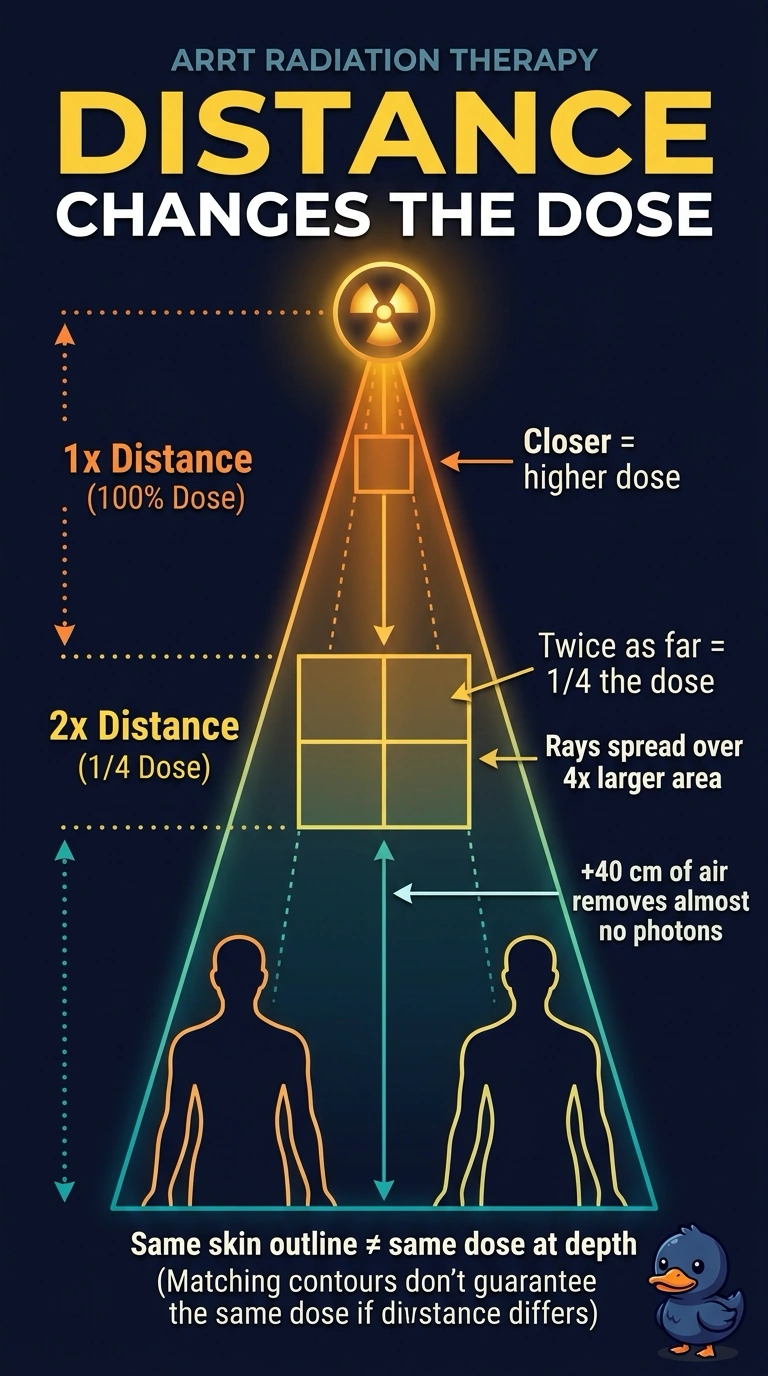
Distance wins here, and it wins fast, because intensity drops with the square of the distance from the source. The same skin outline only gives you the same mark on the surface; it does not guarantee the same dose at depth.
Full Explanation
In the inverse-square approximation, intensity at a point falls with the square of its distance from the source. At a fixed depth, increasing the source-to-surface distance by 40 cm also increases the source-to-point distance by 40 cm. The inverse-square component of the dose therefore changes according to the square of the old source-to-point distance divided by the square of the new one; the distances include the depth, so the ratio is not simply 100²/140². Other factors, including changes in percentage depth dose and scatter, can also affect the dose. Treating the dose as unchanged because the skin field size matches fails conceptually because the same surface outline does not ensure the same dose at depth. Blaming air absorption fails because an additional 40 cm of air removes little energy from a megavoltage beam; the main effect described here is geometric. Using a linear relationship fails because the inverse-square relationship is quadratic. On the exam, expect a changed setup distance with other factors held constant. As a practical check, recalculate output whenever the source-to-surface distance changes.