
In a laboratory comparison, hypoxic and well-oxygenated cell cultures receive the same absorbed dose from a 6 MV beam and from an experimental beam. The experimental beam kills hypoxic cells nearly as well as oxygenated ones, and splitting its dose into two parts with a gap changes the kill very little. Which radiobiologic feature of the experimental beam explains both observations?
Select an answer to reveal the explanation.
Short Explanation
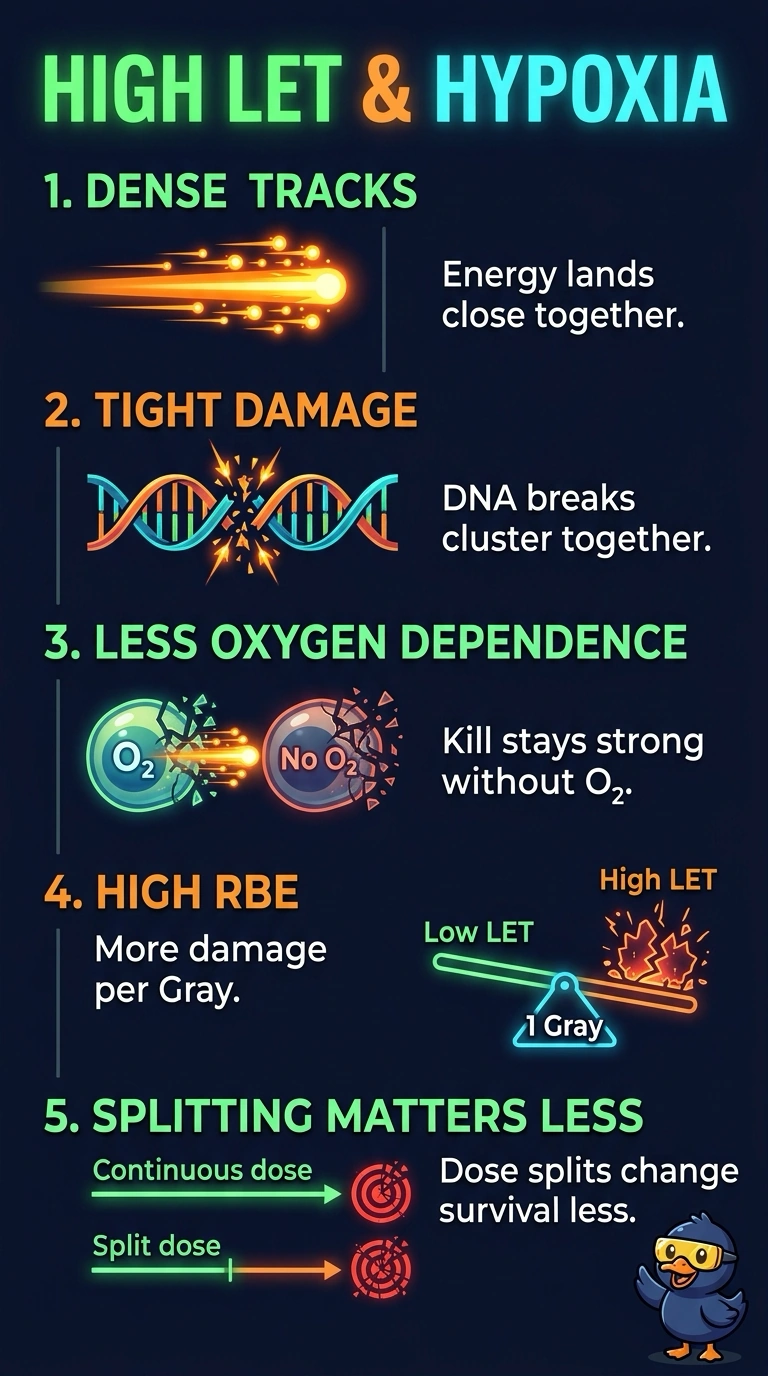
With high LET radiation, energy lands in dense tracks like a tightly packed punch, causing damage that’s hard for cells to repair. So you see less difference between oxygen-poor and oxygen-rich cells, and splitting the dose gives less protection.
Full Explanation
Linear energy transfer describes how densely a radiation track deposits energy along its path. High LET particles create clustered, complex DNA breaks that are difficult to repair, so their biological effect is less dependent on oxygen; they have a small oxygen enhancement ratio and generally show less sparing from sublethal damage repair when a dose is split. Low LET photons rely more on oxygen to fix the free-radical damage they initiate, so hypoxic cells are spared and the oxygen effect is large, which is why an oxygen-poor tumor is classically resistant to them. Although RBE can vary with dose per fraction, that variation cannot explain why hypoxic and oxygenated cultures show similar killing at the same dose. The caveat is that RBE depends on the reference radiation and the endpoint chosen, so one RBE value does not apply uniformly across experiments. A practical check is to compare surviving fractions at equal doses with and without oxygen, then repeat with the dose split.